Georges Didi-Huberman: “Francoism is not a thing of the past”
The French philosopher relates Tàpies, Picasso, Francoism and the ‘Guernica’ in an essay on the critical and subtle political image

-
CAT -
CAST
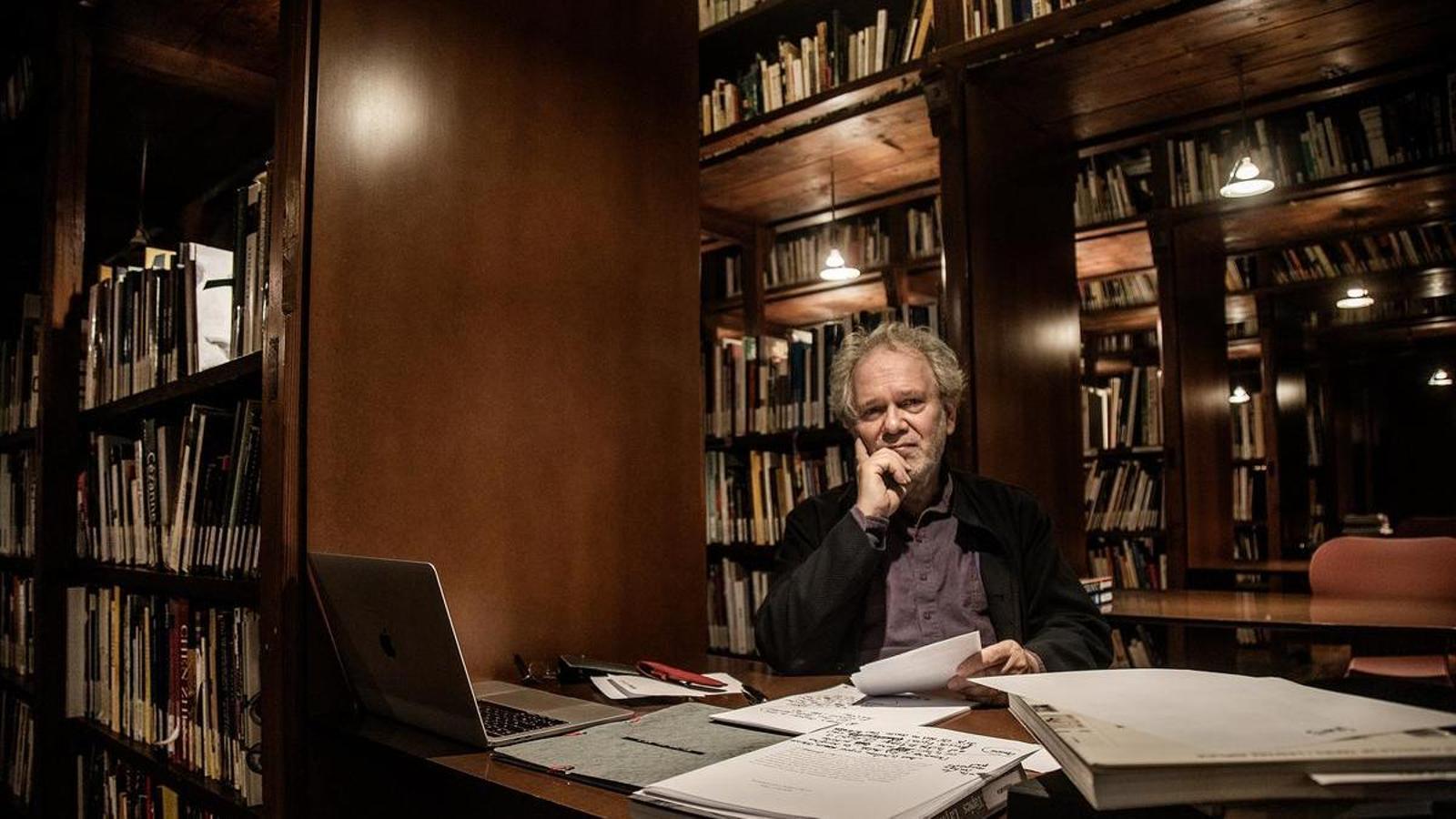
BarcelonaThe Museu Tàpies remains closed to the public until mid-January. The lobby, currently undergoing expansion, looks like a battlefield. But, despite everything, the library retains its sanctuary-like character, and in recent weeks it has had a very special user: the French philosopher Georges Didi-Huberman (Saint-Étienne, 1953), who has spent hours and hours working on the essay about Tàpies that he will present next year as the winner of the second edition of the International Essay Prize Gesture of Yesterday, Thought of Today.
“My relationship with Tàpies began with great admiration when I was a child,” states Didi-Huberman. “I am the son of a painter and, when I was young, I used to hitchhike to Paris to see exhibitions at the Maeght and Lelong galleries. And I met Georges Raillard and Jacques Dupin at that time, and also Jean Frémon,” he adds. Later, Didi-Huberman approached Tàpies again following his intellectual controversies with American criticism, especially with Rosalind Krauss and Michael Fried. And, on the other hand, following his professional and friendly relationship with Manolo Borja-Villel, former director of the Fundació Tàpies and the Museu Tàpies.
“I saw how Manolo was installing the exhibition The Practice of Art, at the Reina Sofia. He asked me to participate in a colloquium, but I do not work on commission. If what they ask me coincides with what I feel like doing, I say yes. If not, I say no, even if it is very prestigious; I do not care. Therefore, I said no to the colloquium, that I could not.” But Borja-Villel did not give up and insisted again, this time at a good moment. “For some time, I had decided to work on a theme that is also very aesthetic: grisaille, painting in gray,” the philosopher states. Grisaille is very present throughout the history of painting, from prehistory to the 20th century, and Didi-Huberman intertwined it with his concern for the political brutality of the present. “I asked myself why is the great anti-fascist political icon of the 20th century, Guernica, in gray? Shouldn't it be red? If Diego Rivera had painted it, it would all be in color,” says Didi-Huberman.
Tàpies appeared naturally in Didi-Huberman's research as an admirer of Picasso in the middle of the Franco dictatorship, at a time when saying that one liked Picasso was not at all obvious. Another example of these relationships between art and politics is found in the fact that, in 1971, a lecture at the Complutense by one of Tàpies' first defenders, the critic José María Moreno Galván, was interrupted and banned by the police. Moreno was prosecuted because he had highlighted Picasso's communist ties and, during the event, a banner with the hammer and sickle had been unfurled and protest slogans had been chanted.
This context helps to understand why Tàpies' grey paintings acquire a political dimension, especially, In Memory of Salvador Puig Antich (1974). "Why did Tàpies use grey? And, in relation to that, what is a political image that is not only an image that takes a side explicitly? What is a political image that is, at the same time, critical and subtle?", says Didi-Huberman, who in the book Critical Gestures (2024; available in Spanish from Cátedra) explains that one of his philosophical models is Walter Benjamin, a thinker who is radical and, at the same time, subtle.
In the future book about Tàpies, in which he will also speak about the philosopher Miguel Abensour, the painter's texts will resonate. "I bought the book The Practice of Art by Tàpies when I was 21 years old. Painters are thinkers; Tàpies, especially. He is like some great painters, such as Paul Klee or Duchamp. They are people who read a lot and who wrote very, very well", says Didi-Huberman.
Can art be a form of resistance?
Within the relationship between creation and politics, can art be a form of resistance? “A work of art, like philosophy, always arrives too late; that is, there is an event and the work of art arrives afterwards,” warns Didi-Huberman. “There is a certain impotence, a certain weakness in works of art. That is, Guernica, the painting, did not prevent, by any means, the bombing of Guernica, because it had already occurred. This form of resistance is elsewhere. It is found, precisely, in persistence, in memory, in what I call the survival of images. It is what makes us, I hope always, remember the poems of García Lorca,” he says. In fact, this capacity of images to endure and continue acting in memory is one of Didi-Huberman’s great ideas.
In the art world, there is a common cliché that, after dying, an artist sometimes falls into a certain oblivion and that, a few years later, it is necessary to recover them and connect them with this other moment. But Didi-Huberman denies this idea: “Tàpies never falls into the past, just as, for example, in Germany, Nazism is absolutely not a thing of the past. It is a present thing. I know the situation in Spain less well, but, given the importance of the Spanish far-right, it can be said that Francoism is not a thing of the past. In biology, you die, and then you have passed. The body disappears, that is true. But in culture, nothing has passed.”
Didi-Huberman cites Hegel when he recalls that action moves faster than thought and than art. Thus, he concludes that “the work has no power, but it has potency.” “This potency has a cultural existence, and not a factual one. That is why it lasts for a long time and, at the same time, has a complicated relationship with action. We ask ourselves about Tàpies’s action, but Tàpies’s action is his painting. Therefore, the paintings have a resistance by the very fact that we continue to look at them, that there is a Tàpies Museum and that there are people working around his work, and that there are books. And books last longer than political systems. We still have Plato. We can always read Plato, and political systems have changed a lot since Plato,” he says.
