The great mystery of Jan Van Eyck, portrait by portrait, at the National Gallery in London
A German art curator questions the identity of the famous 'Arnolfini Portrait', and points out that the man in the painting could be the painter himself
-
CAT -
CAST
LondonWhat is the great mystery of the painter Jan van Eyck, the first great master of northern Europe in the 15th century? Carola Hicks, author of an already classic study, published posthumously fifteen years ago, Girl in a green gown. The history and mystery of the Arnolfini portrait, noted that, beyond the numerous theories about the ultimate meaning of the famous Arnolfini Portrait, perhaps the true unknown that the work hid was another: how and why Van Eyck inaugurated a radically new way of representing the world with painting. An innovation of which many keys still escape us today, according to specialists. And it would be precisely this pictorial revolution, not the enigmatic symbolism of the painting, that constitutes the artist's great mystery. At least until now.
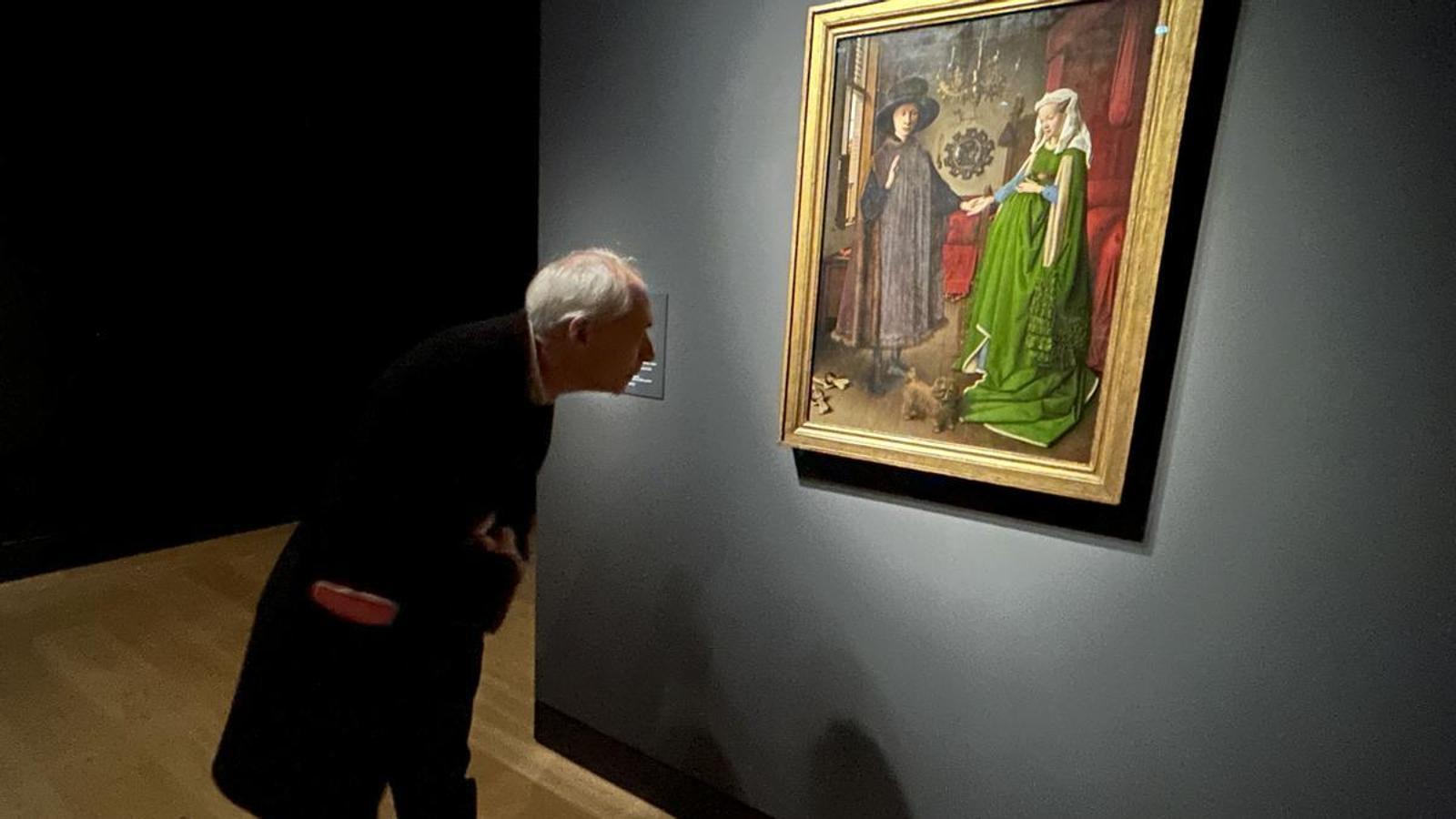
Because, coinciding with the inauguration at the National Gallery in London of the superb exhibition Van Eyck: Portraits which can be visited until April 11th, Stephan Kemperdick, curator at the Gemäldegalerie in Berlin and specialist in the art and architecture of the Middle Ages and the Renaissance, has revived a question about what is undoubtedly one of the best-known paintings by the Flemish painter, along with the eight panels of the Ghent Altarpiece of Saint Bavo's Cathedral, in Ghent. In the catalog text signed by Kemperdick, the German art curator suggests that the man in the Arnolfini Portrait is the artist himself. And the woman beside him would be his wife, Margaret, the model for another portrait, from 1439, which the Bruges museum has loaned for the London exhibition.
In total, the institution at Trafalgar Square brings together the only ten known portraits by the author, nine paintings and one drawing. It may seem like a small number, but as curator Emma Capron recalled at the time of presenting the exhibition to the international press this Wednesday, “the works represent approximately half of his entire production preserved throughout the world”.

The hypothesis of Van Eyck's self-portrait in the Arnolfini Portrait –and by extension in Portrait of a Man, since it is the same figure, and they can be seen in the same room– is not new. As reported exclusively by the publication The Art Newspaper, Kemperdick revives an idea that Charles Eastlake, the first director of the National Gallery, had already proposed in the late 1840s. Eastlake maintained that the inscription above the convex mirror –an element that expands the visual field and serves to deconstruct the reality constructed by the painting itself–, which he read as “Johannes de Eyck fuit hic” (“Jan van Eyck was here”), indicated that the painting could also be a double portrait of the painter and his wife.
However, the identification of the protagonists with the Arnolfini family took hold based on a couple of documentary clues. In a 1516 inventory of the pictorial collection of Margaret of Austria, governor of the Netherlands, preserved in Mechelen, the painting is described as a “portrait of Hernoul le Fin with his wife in a room”. The piece, which Margaret had received as a gift from the Spanish nobleman Diego de Guevara, was attributed there to Jan van Eyck. In the mid-19th century, art historians Joseph Archer Crowe and Giovanni Battista Cavalcaselle linked that name, Hernoul le Fin, with the Italian surname Arnolfini, an interpretation that W.H. James Weale deepened starting in 1861.
A second inventory, from 1523-1524, again described the work and identified the male protagonist as Arnoult Fin. Thus, the connection of the painting with this family of Italian merchants originating from Lucca and established in Bruges, who prospered in the 15th century thanks to trade and finance, was consolidated. Scholars everywhere continue to disagree, often fiercely, on which of its members is represented in the work.
In his text, Kemperdick has also revised the association between the reference to “Hernoul le Fin” and the surname Arnolfini. At that time, the painting was not always considered a portrait, but had also been interpreted as a lewd scene, linked to adultery. The Berlin curator suggests that Hernoul le Fin might not be a surname, but a burlesque nickname: in medieval literary tradition, Hernoul was the husband deceived by his wife, a cuckold. Thus, the identification of the man with the Arnolfini family could stem from a misunderstanding. The German scholar also points out that the reference to Saint Margaret in the statuette on the headboard of the bed, located near the woman's head, serves to identify her as Van Eyck's wife.
The implications of Kemperdick's theory “are far-reaching,” as can be read in The Art Newspaper. Another portrait by Van Eyck held at the National Gallery, dated 1433 and showing a man considerably older than the one in the Arnolfini work, is provisionally identified by the London museum as a self-portrait, and it is precisely the painting that opens the exhibition. But this attribution could not be sustained if Kemperdick were right, since the figure has nothing to do with that of the other two paintings mentioned above.

Emma Capron, the exhibition curator, disagrees with this hypothesis and maintains that the protagonists of the Arnolfini Portrait belong to the family of Italian merchants. But, beyond their identity, Capron places one of the keys to Van Eyck's painting in the interplay between reality and appearance. The painter creates “artifices and illusions, but he also does so to draw attention to the mechanisms with which he constructs them,” says the curator. In the Arnolfini Portrait, for example, he makes one believe that “we are inside a real room, that the characters are greeting the viewer and that they can interact with them.” But then the aforementioned convex mirror appears and—like in Las Meninas, by Velázquez—it reveals what the viewer cannot see. “Painting is, ultimately, a fiction. Van Eyck creates illusions only to dismantle them,” she summarizes.
A game of attraction and distancing that is repeated in the other portraits. Van Eyck is, in this sense, “an unreliable narrator,” who plays with the viewer's gaze and invites them to distrust what they see. The great question surrounding the Arnolfini Portrait and the rest of his work is not so much knowing who its protagonists really are, as understanding in what way the painter was able to create an image “that changed the way of representing the world forever,” concludes Capron.
