Martí Sales: "I want to continue falling in love, learning and playing until I die"
Poet, translator and musician

-
CAT -
CAST
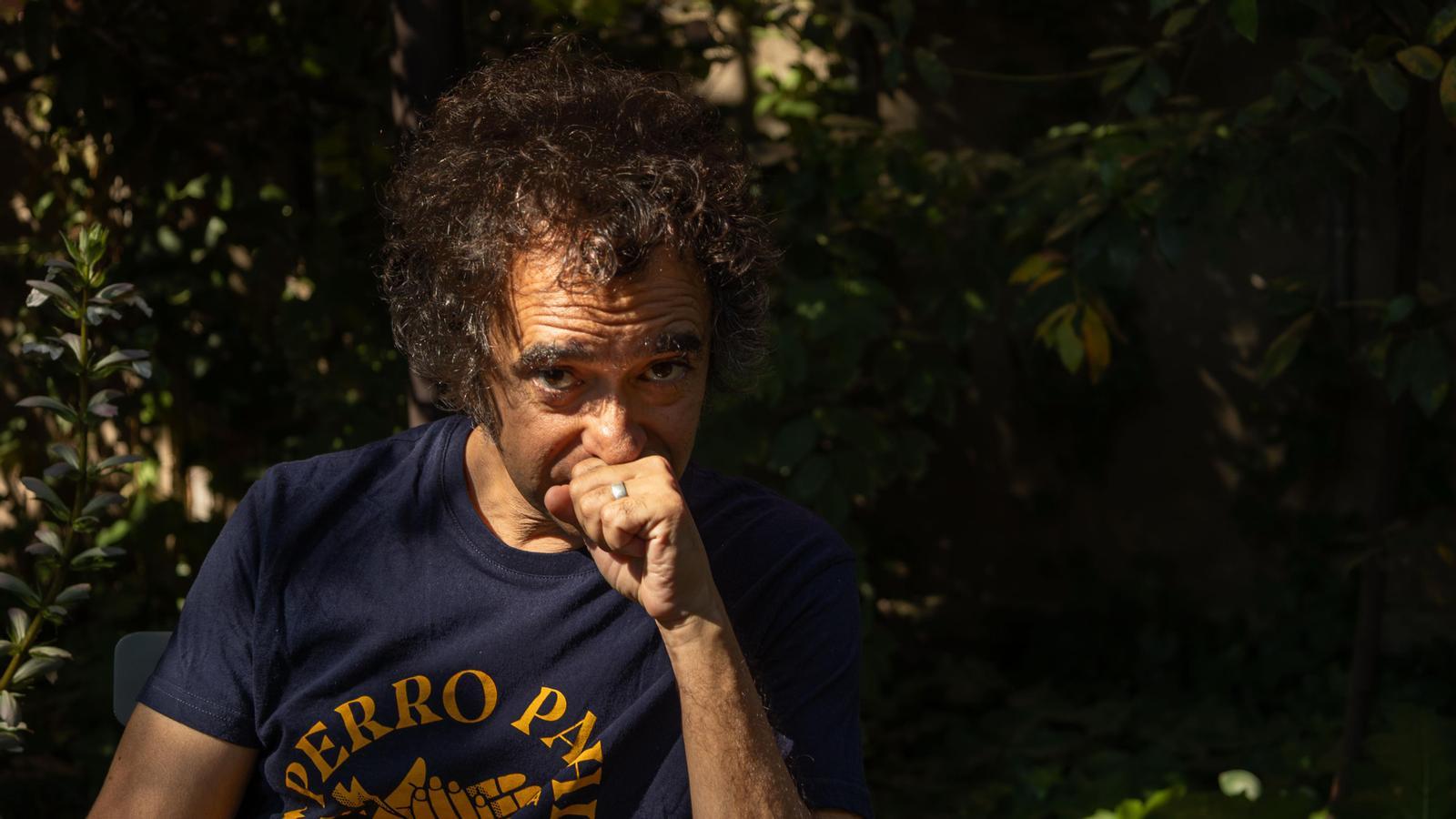
BarcelonaPerhaps because he won the last Jocs Florals prize with the book Descripció del món (Godall), Martí Sales (Barcelona, 1979) meets us in the garden of the Muñoz Ramonet Foundation, an oasis of trees, plants, and sculptural fountains that opened to the public ten years ago. A poet, narrator, translator, and singer – he was part of the fondly remembered Surfing Sirles – Sales received the prestigious award at the Saló de Cent of Barcelona City Council, where he took the opportunity to hand out leaflets to attendees in case they wanted to collaborate financially "with the struggle of the Vallcarca neighborhood against gentrification" and so that some residents could "wipe out the disproportionate fines from the police persecution to which the current council subjects them, while saying that the most important axis of its program is the right to housing".
The speech you gave at the Saló de Cent must have made more than one authority uncomfortable.
— I've been told that the video of my words ran, but I don't know how far it went, because I don't have social media. The Jocs Florals is a literary competition with 700 years of history and I was very excited to receive the prize in such a beautiful place as the Saló de Cent. It seemed like they were letting me into the king's courtyard for a day, but I didn't want to pay homage to anyone.
I don't think you did.
— During the last 50 years, there has been a process of dispossession and alienation of citizens from public institutions. Now it is as if the society that makes up the people who do not govern are not responsible for anything nor have the capacity to say what is right and what is not. There must always be someone, the government, to do it for us. The liberal democracy we live in is a pantomime. Decisions are made by people with a neoliberal ideology who do not precisely help citizens to be well. Neoliberalism defends private property, immeasurable enrichment, exacerbated individualism, work as a tool of oppression and alienation of the population...
Lately, there has been a lot of talk about how some Barcelonans are finding it increasingly difficult to stay in the city.
— It is not the city that expels us. It is the rich and gentrification that expel us. Barcelona is currently super-polarized: either you earn a lot of money and will end up earning even more, or you earn very little, have poor working conditions, and struggle to have a cushion of money so as not to be suffering all the time. Over the last 50 years, inequality has not stopped growing. It is normal for there to be tension. We don't like seeing rich people driving by in convertibles under our house, when we don't know if we will be able to continue living here.
At the same time, I would say that a parallel phenomenon of almost uncritical admiration for wealth occurs. Last week, a white Tesla appeared on the same street where I live, in Vilapicina, Nou Barris. There were young people who stopped to admire it and took photos with it as if it were theirs.
— Instead of going to scratch the Tesla, they were taking selfies... This makes me angry. There is something about Barcelona that enchants businessmen and hoteliers, and that is that it is a very friendly city to rich people. This adoration of the rich reminds me of vassalage in the Middle Ages. The big problem in Barcelona is not security, but those who buy entire buildings to speculate: these are the ones who will end up kicking your mother out of her house, and you too, who will have to go live in the middle of nowhere.
You are about to leave Gràcia. You are going to Vallcarca.
— Seven or eight years ago, shortly after returning to Gràcia – after having lived for a few years on Carretes street –, I joined the Ruderal housing cooperative, and together we began to fight to obtain one of the plots that had been left empty during the barricade practiced for years. The real estate company Núñez i Navarro owns 70% of the plots. Is it legitimate for them to come and put I don't know how many millions to buy everything they wanted? I don't think so. And there are more people who think the same. That's why we have tried to challenge the law of the strongest by saying: this is not right, we do not agree, you are richer but you will not throw us out of our homes. It is the basis of all revolts that have occurred since the beginning of time.
For this interview, you asked us to meet in the garden that for decades was owned by Julio Muñoz Ramonet. Why?
— Muñoz Ramonet was a magnate who got rich thanks to Francoism, an execrable person who one fine day decided to buy the palace of the Marquis of Alella, the work of Enric Sagnier, and around it he made these gardens, which until recently were private. This space is a very clear symbol of what Barcelona should not be: such a large and beautiful piece of the city should not have been kept by a gentleman who, moreover, had become rich in an absolutely illegal manner, and when I use these words I am not giving my opinion, but rather it is proven that it is so.
The recovery of the garden, which is now public, is positive. It is a space that people have made their own, very beautiful and I would even say luxurious.
— Luxurious and public spaces, that is what I want for everyone. Wealth can be collectivized.
The garden, moreover, is located near the apartment where you grew up.
— I was born on Carrer de l'Or, in Gràcia, but I lived for many years, with my parents and four siblings, in a giant 200 square meter apartment on Carrer Muntaner, between Calaf and Rector Ubach. It was a beautiful place and we could afford it because we paid an old rent. My father was a professor at the Institut Menéndez i Pelayo, and my mother was an illustrator. The social segregation that exists now was not so great in the 1980s. I lived in Muntaner, I went to Nausica school, and students could be the children of illustrators or the concierge. I could no longer live in the Barcelona where I grew up. If you don't have a lot of money, you can't stay here. In fact, my mother was eventually kicked out of the apartment through a real estate process.
We started by describing your closest world – the city, the house, the family – because your new book of poems aims for an intimate and total description of your surroundings. The first words we read in it are from the 17th-century philosopher Malebranche: "Attention is the natural prayer of the soul." Would you say that attention is the evolution of curiosity?
— I don't know what the relationship is between attention and curiosity, nor which one is born before the other. In any case, I think it's worth cultivating them and that doing so is the opposite of the extractivist and transactional relationship that is so in vogue. Many people constantly wonder what the point of doing this or that is and what benefit they can get from it. I remember that, for a few months, before the news, they showed an advertisement that said: "I love me". Loving, by definition, is something you do with another, with someone who is different from you. There is a phrase that is repeated quite often that says: "To love others, you must love yourself". You've heard it, haven't you?
Yes. It sounds like therapy and a mindfulness workshop.
— To know what loving is, you must first learn to love someone else. Only then can you love yourself. What happens is that the neoliberal and individualist doctrine likes a phrase like the one before very much, because it puts you at the center: take care of yourself, go to therapy, dedicate some time to yourself... Obviously, to achieve all this you have to invest money. Anything you do, you have to pay for it.
Description of the world includes a proem, six cantos, an incise, and a coda. Here you argue, like Josep Pla, that "observing is more difficult than thinking" and paraphrasing Max Jacob you recall that "the truth is always new".
— This idea of truth is the opposite of the axiom, of orthodoxy and of the fascisms of essences, of those eternal identities of nationalism... Truth is always new, and it seems to me a liberating and very potent idea in the strict sense of the word. It is a seed that allows you to understand things from a non-coercive, but fluid place. The whole book is a kind of gloss on these words of Max Jacob, which I make my own. When we write, we carry behind us all that we have read and that has interested us.
In the final coda you write that you need at least a couple of hours "to milk eternity and let it rot to make smelly cheeses, poems". Your poetry books arrive every ten years: first came Huckleberry Finn (Moll, 2005), then La cremallera (Males Herbes, 2016), and now we read Descripció del món.
— I write slowly and with many ups and downs: it's hard for me. Until I find the form of each book, I have to work a lot. Each book, moreover, has a different form: Aliment [Club Editor, 2021] was a dictionary, La cremallera was a long string of octosyllables and Descripció del món is an essay in verse structured in six cantos. When I finish, I don't know if I've succeeded, I find it difficult to find that what I've written makes sense. I strongly identify with some words of Louise Glück in an interview in The Paris Review in which she said thatthe fundamental experience of the writer is impotence and that the fantasy that creative work is a constant triumph of will must be corrected. The writer, for Glück, is one who waits and one who helps, is the midwife, never the mother.
In the last canto you ask yourself "if humor / was the reason / for everything" and "if everything plays". I would say that throughout the book there is a defense of the capacity to smile: alongside mentions of philosophers like Plotinus and Ramón Andrés, you propose amusing excursions to the "step / that makes nineteen / on the stairs / of the basement" where the aleph hides, that magical place from which the entire universe can be seen.
— Humor is there, yes, but in a different sense than that used by some postmodern authors, who use it as a defense against a terrible world. I am as interested or more in the notion of play, which again breaks with the transactional relationship with the world and with others. Play does not seek benefit, interest, or utility, but rather proposes invented rules that we can break at any time. It is one of the things that this society, which tells us we can only live in one way, robs us of.
What else does this society take away from us?
— There are three things that define us as living beings and that the world today tells us we cannot do after the age of 25: learning, falling in love, and playing. After 25 you stop learning because you've started working at a job you'll do until you retire and die... miserably, obviously. You can't fall in love either from the moment you find the person you're supposed to marry and spend the rest of your life with: hopefully, it's not by dying miserably, either. You don't play either, after 25, because it's something from when you were a child and you've already grown up, right? If you play, you're an eccentric and a weirdo. I want to keep falling in love, learning, and playing until I die.
Do you think you'll make it?
— I see that most people are trapped because socially we have agreed that life must be lived in a very specific way. Material conditions have cornered us so much that we cling to absurd 8-hour shit jobs that drain us from the inside.
This is what anthropologist David Graeber, who appears in the fourth canto of Description of the World, said. In the small cemetery of Vallclara where your father, uncle, and grandparents are buried, you also place, in this order, six of your references: Alda Merini, Georges Perec, Víctor Català, Bernard-Marie Koltès, David Graeber, and Alice Coltrane.
— It is a way of breaking the notion of blood ties, which, along with private property, [the writer and theorist] Mark Fisher explained, are considered two unquestionable values, even though there have been very different ways in other societies of both managing property and facing upbringing. In the poem, I place in the family pantheon a series of people who have been very important to me. They are from different places and have also engaged in different disciplines: Merini was a poet; Koltès, a playwright; Perec, a novelist; Coltrane dedicated himself to music... There could be others, I didn't want to be exhaustive, but I would like these names and others that appear in the book to pique the reader's curiosity and, if they wish, to approach them.
In this song you explain that in Vallclara you can find the whole world represented.
— Every inch of the world is equally important, valid, and interesting, says Perejaume. Extending this idea, I would say that every inch of the world contains the whole world. If you look closely and pay attention, everything reverberates and is overlapped. Vallclara is an extreme example, because it is a village in the province of Lleida with fewer than 100 inhabitants from where part of my family comes and where I still go to write when they let me have the house. I have been doing it for more than twenty years, when I was writing Happy Days in Prison [Empúries, 2007].
Perhaps because you said you have written an essay in verse, words like truth, light and freedom.
— Devoid of context, they are words from a categorical semantic field with a long history that I tend to avoid. I would like to restore the power of meaning to words like these: they have a much greater scope than when used in discourses of power, often in an unequivocal and manipulative way.
You place these words that weigh so much next to the importance of trees, of marsupials, of cliffs, of potatoes and chard and also of a goldfish by Paul Klee that you see at the Kunsthalle in Hamburg that makes you write "it is art that makes life more interesting than art".
— The quote is not mine, it's from Roger Caillois [philosopher and literary critic], but it fits very well where I've put it. I like to share words from other authors because we never start from scratch, whether we're aware of it or not. Regarding the relationship between life and art, I always remember an interview with Orson Welles in which the journalist asked him: "Have you worked with friends?" And he replied: "Frequently." Then he said to him: "And have you regretted it?" And Welles replied: "Frequently." He still asked him one last question: "Would you work with friends again?" Welles's answer was: "Yes. For many of the artists I like, art was more important than life, but I try to make life come before art."
