"Barcelona was the gay capital of the State during the Franco regime"
The historian Geoffroy Huard explains how there was an important migration to the capital and how the police only detained the poorest
-
CAT -
CAST
BarcelonaThere is a historiographical narrative that maintains that before LGBTI liberation movements, in the grey Barcelona of the Franco regime, there was practically nothing: only silence, darkness, and persecution that would have prevented any attempt to live sexual freedom outside the home. However, the research of Geoffroy Huard (Paris, 1982) disproves this thesis. A professor of contemporary history at the University of Cergy-Paris and a specialist in the history of sexual and gender dissidence in contemporary Spain, Huard has participated in the conference on the history of sexual and gender diversity in Barcelona during the Franco regime, organized by the Barcelona History Museum.
Through the analysis of the judicial archives of Barcelona, the historian demonstrates that the Catalan capital became the great destination for sexile. In contrast, he has not been able to conduct the same research in other cities in the State because he has encountered many difficulties and refusals. "Barcelona was the gay capital of the State during the Franco regime. There was significant sexile; that is, people who migrated for sexual reasons and who wanted to live much better than in a town in Andalusia or Castile and León, for example. They went to the industrial capital of the State because there, there was indeed a gay life," Huard explains. According to the historian, even in specific places in Barcelona and despite protests and the police, there were those who dared to hold hands.
Very few raids
Where one could have a chance encounter was an open secret. Just like the spaces for female and male prostitution, in Barcelona the places frequented by homosexuals were located mainly between La Rambla and Carrer d'Avinyó. The main axes were the famous Carrer d'Escudellers, which some called Escudellers International Street, and Carrer Nou de la Rambla. Apart from bars and clubs, there were the stations and public urinals in Plaça de Catalunya and Plaça del Teatre. The Latino, Unión, Atlántico and, above all, the Arnau cinemas were the most famous among the community. Beyond the Barri Xino, there were the beaches and, very especially, the mountain of Montjuïc.
The most numerous police interventions took place at Villa Rosa (Carrer de l'Arc del Teatre), at the Texas bar (Carrer d'Escudellers), at the Laso cafeteria (Avinguda del Marquès del Duero, currently Paral·lel) and, above all, at the Drugstore on Passeig de Gràcia. The police also acted in other bars, clubs, and cabarets where a homosexual public predominated, where some clients were arrested. "However, there was no authentic generalized or systematic surveillance. The police interventions seem rather sporadic, since the vast majority of the bars cited in the archives only appear there once," points out Huard. In fact, in the legal documentation consulted between 1956 and 1980, only six raids are recorded in Barcelona.
A question of social class
One of the things that most surprised the historian was the blatantly obvious class bias: 95% of those convicted under the law of vagos y maleantes (reformed on July 15, 1954, to include homosexuality) and the subsequent law of peligrosidad y rehabilitación social of 1970 were people of humble class. "They do not have steady work, they do not have a fixed address; it is the truly poor people. On the other hand, there are practically no wealthy people in the files. The only ones that appear there are those who have some sexual relationship with a minor, and in those cases, there was indeed a more significant conviction. This bias is fundamental, because we know from different writers like Juan Goytisolo and Jaime Gil de Biedma – because they explained it themselves – that the police identified or stopped them at some point in the Barri Xino of Barcelona and, nevertheless, they do not appear in the files. And they do not appear there not because they are not vagos or maleantes, but because they belong to the bourgeoisie," says the historian.
Indeed, all the sentences of the courts of vagos y maleantes and of peligrosidad y rehabilitación social convicted the "chaperos" for "vagrancy and homosexuality", alleging that they did not have a “lawful” job and did not earn a living in an "honest" and "healthy" way. Their lifestyle was considered "contaminated by the environment". On the other hand, the majority of the so-called "inverts" who were arrested considered this condition as innate to their own nature. Many were those who declared, during interrogations at the police station, that since childhood, or rather since they had the use of reason, they felt this attraction toward individuals of their own sex.
Resistance in times of repression
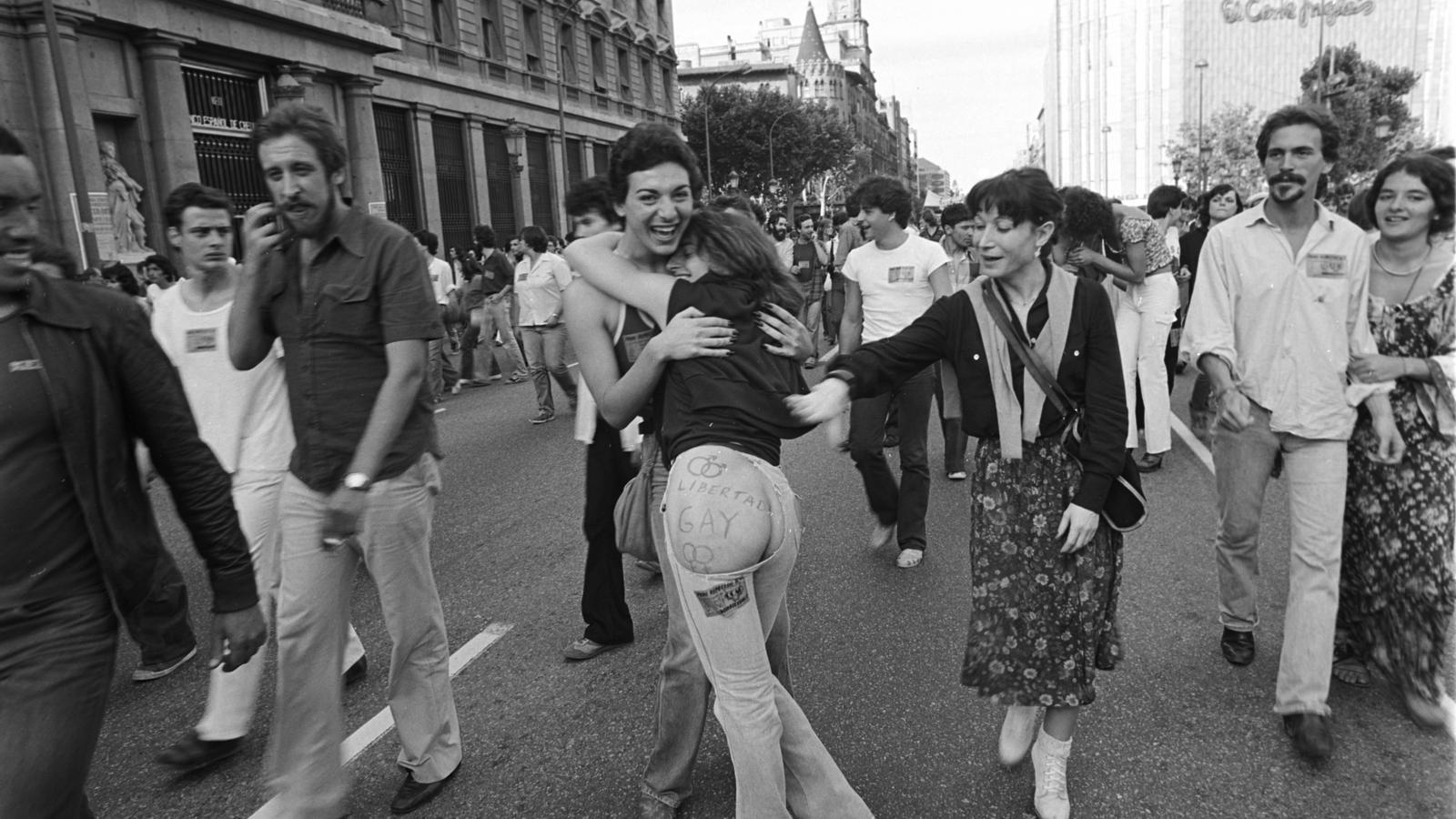
For Huard, this identity assertion is key. "This is a very important fact, because it seems that everything began with the 1977 demonstration in Barcelona. Nowadays we tend to think that everything is about demonstrating, which I do not criticize at all, but there was also resistance before. I see it, for example, in the files of those convicted: there are people who declare themselves before the police as a trans person or as a gay person, and they say that they are homosexual by birth. Claiming that they were homosexual by birth was simply a way to question the theory of the regime at the time, which considered that homosexuality was something acquired by the criminal environment," asserts Huard, who is the author of works such as Los antisociales. Historia de la homosexualidad en Barcelona y París, 1945-1975 (2014), Los gais bajo el franquismo. Discursos, subculturas y reivindicaciones (2020) and Los invertidos. Verdad, justicia y reparación para gais y transexuales bajo la dictadura franquista (2021), and who this October also publishes El destape gay. El cine de Eloy de la Iglesia (2026).
Beyond the Spanish case, Huard recalls that the persecution of sexual dissent during the fifties and sixties was not exclusive to Francoism. European democracies such as post-war France or West Germany, as well as the United States in the midst of the witch hunt, condemned and persecuted homosexuality with very similar mechanisms.

