"The woman in the photos" who earned the trust of a neighborhood in flames
The Kbr center of the Mapfre Foundation shows the first retrospective of the photographer Dana Lixenberg

-
CAT -
CAST
- Kbr Center of the Mapfre Foundation. From October 1st, 2026 to January 17th, 2027
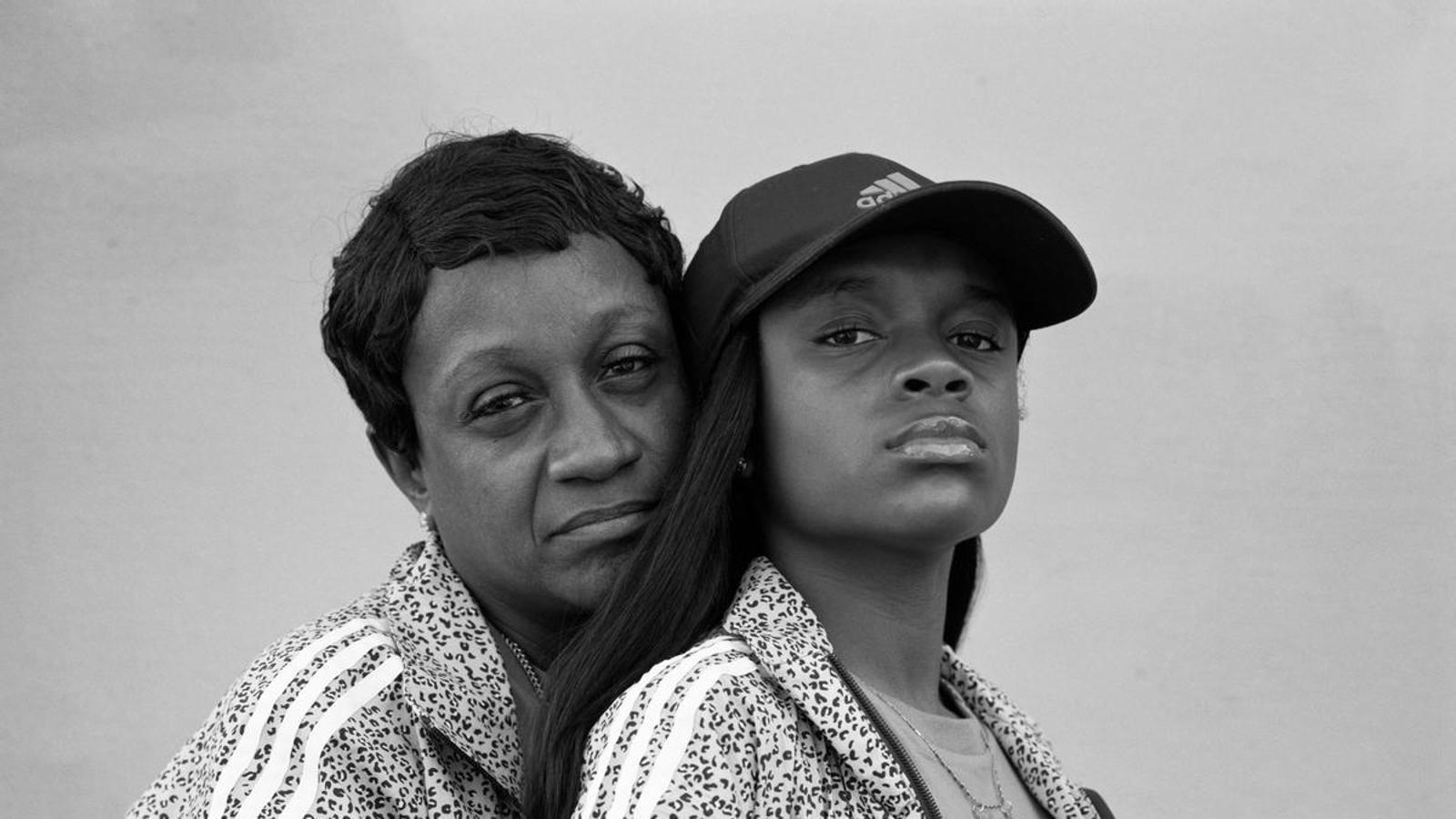
A white European woman arrived with her camera at a public housing complex in South Los Angeles, Imperial Courts, whose population was mostly Hispanic and African American. The timing could not have been worse: after the 1992 riots following the beating of Rodney King at the hands of the police, the neighborhood and its inhabitants were in the spotlight. The gangs had agreed to a truce, but there was still a lot of violence. It was most likely that the whole thing would have gone wrong, but little by little this woman, the photographer Dana Lixenberg (Amsterdam, 1964), earned the people's trust and managed to take a magnificent series of portraits. She talks to the people and gives them portraits she takes of them with a Polaroid. Soon she began to be known in the neighborhood as "the photo lady".
Now a selection of these portraits, all of them contained and at the same time monumental, opens the path of the great exhibition dedicated to her by the Kbr center of the Mapfre Foundation in Barcelona. "It was the first time I had worked with a large-format camera. It was a conscious choice to slow down the portrait process, which is not about immortalizing someone in action but about making calm portraits," recalls Dana Lixenberg. The project was published in the magazine Vibe that same year, and it is still ongoing.
During the visit to the Kbr, Lixenberg lists the relationships between the subjects and the portraits. Some were murdered, others are in prison. But she does not want to make all this information explicit in the image and, for that reason, she made a book and a video installation that can be seen in the auditorium. "I took these photographs during the new trial of the four officers, so there was a lot of media attention again. And my way of working was very different from the way the press that arrived there worked: they did a quick piece, and they made the community seem very pathetic," points out the artist.
"My editorial practice consists of work commissioned by magazines, at a time when they still had much more weight, because it was the only way you had to see a photograph of someone, because there was no internet or social media –recalls Lixenberg–. The absence of social media meant I had the possibility of working with people in a way that might be much more difficult now; now I would have much less freedom, there is much more control, and people worry about the images that circulate on the internet".


A first retrospective
Lixenberg grew up in a committed family: her father was an artist and her mother was a kindergarten teacher. Her first contact with photography, which she defines as "love at first sight," occurred during a night course she took at the Parsons School in New York while working as an au-pair. During her first two years in New York, Lixenberg worked as an assistant to various photographers, until she embarked on her own path. "Lixenberg's gaze on the United States is shaped by her status as a foreigner: neither a tourist nor integrated, but a sensitive and committed observer," notes Laurie Hurwitz, curator at the Maison Européenne de la Photographie (MEP) and co-curator of the exhibition together with the deputy director and head of the Amsterdam Museum of Photography (FOAM), Marcel Feil.
Lixenberg returned to the Netherlands in 2018, and currently works between Amsterdam and New York. This return was one of the reasons why she considered taking a retrospective look at her work. "Dana's exhibitions are usually focused on specific projects, and this is the first major exhibition that brings them together and also incorporates the editorial work she did in New York. I am truly convinced that Dana deserves to reach a wider international audience. It is clear that her work is known, but I believe it should be known by many more people," says Feil. The exhibition, which will be open until January 17, is a co-production with the Maison Européenne de la Photographie (MEP), and was on view in Paris in the spring.

Portraying Donald Trump and Tupac
The tour continues with an installation featuring some 300 of the Polaroids that Lixenberg took while preparing for the celebrity portraits she made between 1993 and 2003 for publications such as Vibe, The New York Times Magazine, Interview, i-D, The New Yorker, Newsweek and Rolling Stone. Among them are Ivana and Donald Trump, Iggy Pop, Prince, Philip Seymour Hoffman, Silvio Berlusconi (who signed an autograph for her), Whitney Houston, Toni Morrison, Louise Bourgeois, Kate Moss and rappers Eminem and Tupac Shakur. The latter, which she took for Vibe magazine, has become one of her most iconic works and later has a small monographic space. "What is beautiful about Polaroids is that they are mementos of the sessions," says Lixenberg. "My approach to taking these other portraits is no different from those of Imperial Courts, which are much more personal because I have been going there for 33 years, and, therefore, I feel more personally involved," says Lixenberg. Even so, in the short time the session lasts, the artist tries to make the character her own: "I try to look for something that seems interesting to me. For example, Iggy Pop always posed in a very dramatic way and I wanted him to be really calm, not playing or acting out any role".
Regarding the portrait of Tupac Shakur, Hurwitz highlights its almost feminine beauty, the depth of his gaze, and the sense of "dignity" it exudes. "Instead of being some kind of delinquent, or however we want to define it, he becomes almost a kind of visionary," says the curator. On the other hand, Lixenberg sued the company Bioworld, which was manufacturing large quantities of merchandise featuring this portrait and the one she took of The Notorious B.I.G. without her permission. The lawsuit ended with a judicial settlement in 2018, the terms of which were not made public. "When we reached the agreement, I thought it was a good time to present the photographs, because people have turned them into illustrations, tattoos, and clothing, and I wanted to show where all these materials come from," the artist says.
"It is very interesting what time does: many people who at a certain moment were a kind of cultural hero, like Puff Daddy, are now seen with different eyes. The same thing happens with Trump: he had always been a controversial figure, but back then he was simply a very famous real estate mogul and no one would have expected him to end up being president of the United States," says the photographer.
Trapped on an island that is melting
Attention to vulnerable people is once again present in the portraits of homeless people she took in Jeffersonville, in the United States. Lixenberg portrayed, with the desire to empower them, the temporary residents of the local Haven House Services shelter. This project started as a magazine assignment and turned into a long-term job. "It's a place you more or less pass by, it has nothing remarkable," Lixenberg recalled in an interview. This is another of the projects with which she has wanted to make a personal contribution to the tradition of photographers who have explored the United States.
The exhibition also includes a series of portraits taken in 2007 in Shishmaref, an Inupiaq village in Alaska, on the island of Sarichef. This community, made up of about six hundred inhabitants, is facing accelerated coastal erosion caused by melting ice and rising sea levels. The residents voted to leave the island, but the relocation has not been carried out due to a lack of federal funding. In this case, Lixenberg focused on people's daily lives. In the same interview, Lixenberg explained that this community was slowly losing its culture, and the high rates of depression and suicide that existed among the young Inupiaq. "I perceived a kind of weight, and I think some people may feel a bit trapped, because it is difficult to leave for another place to look for job opportunities when this is their community," says the photographer.
Coinciding with this exhibition, the show for the sixth edition of Flama, the foundation's emerging photographers program, also opens its doors. The selected photographers are Sara Bravo (Girona, 1999), Elena Bulet i Llopis (Barcelona, 1997), Meghan Mathews (Winston-Salem, North Carolina, 1995), and Luca Gaetano Pira (Modena, 1987).
