The week that publishers replace beers with coffees
We visit the Liber fair, the main event of the publishing industry that takes place in Barcelona before the apotheosis of Frankfurt

-
CAT -
CAST
BarcelonaWe are still digesting the excitement of the best Catalan Book Week in history and it is time to turn the page. If on Lluís Companys promenade there was a party, colleagueship, the public, and Catalan, at the international Liber fair there is business, meetings, international agents, Spanish, and English. Coffee replaces beer, I guess. This week, the Fair is taking place in L'Hospitalet de Llobregat, the main meeting point for the state's publishing industry, which the Federation of Publishers' Guilds of Spain celebrates one year here and the next in Madrid. It is where the money people are.
In September, publishing houses and literary agencies live their own particular Cup-League-Champions, which will end next week at the Frankfurt Book Fair. Liber is a preview of it and complements the German maelstrom. I am told there are 250 exhibitors selling their wares and about 9,000 professionals are expected, 40% of whom are foreigners. The goal is to sell books with a very specific focus, which is the fair's motto: to be a bridge between the countries of Europe and Latin America.

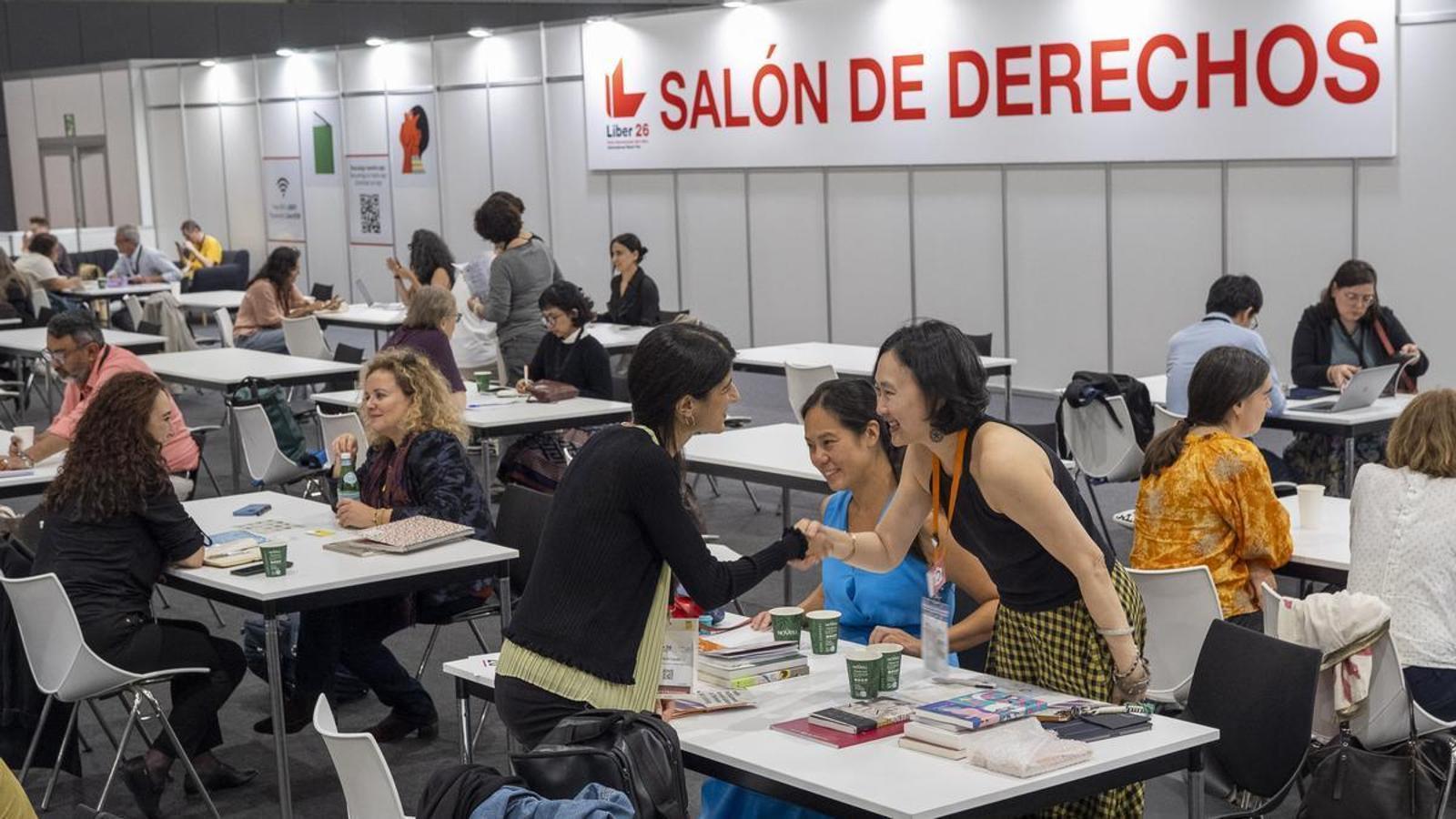
I cross all the stalls and head towards the rights hall, which Liber is setting up for only the second year. At aligned tables, publishers or agents from the state meet every half hour with their foreign counterparts. They put faces to names, establish a certain familiarity, and trade in catalogs. "Revenue from the sale of rights has been stagnant for seven years at between 70 and 75 million [peanuts if we consider that the book sector in the State invoiced 3.138 billion in 2025, more than 50% in Catalonia]. Since Spanish is a language with a global presence, perhaps publishers have not needed to sell rights in other languages because they already had the business covered –certifies José Manuel Anta, manager of the Federation of Publishers' Guilds of Spain, to the ARA–. But the quality of the books and authors we have shows that we are a powerhouse and we believe it makes sense to exploit this aspect".
Clara Rosell, from the Pontas Agency, is promoting two Catalan authors who have already opened the international path, Laura Gost and Laura Autonell. "We still have many languages left to sell rights for, and there are really people from all over the world here. For us, fairs are always a good opportunity to meet new editors", she states. On the first day, she met with a Brazilian, a Ukrainian, and an Azerbaijani editor, and so on throughout the day. However, here contracts are watered, but they are closed via email. Natàlia Berenguer, from Asterisc Agents, brings authors such as Carlota Gurt, Joan-Lluís Lluís, and Joan Carreras to Liber. "The European market knows that Catalan has its own literature. The Anglo-Saxons do too, and they know that it can be translated from Catalan to English, without going through Spanish. We always provide the books in the original version, and in the language the editor can read. The Llull has done a fantastic job", she assures, before leaving busily to the next point.
A couple of tables away I meet Pilar Lafuente, who is explaining the Planeta catalog to Carmen Giménez of the publisher Graywolf Press, a label based in Minneapolis. They are the publishers of Irene Solà's three books in English, which she says are selling very well: "I love the intimacy of her writing." "There is interest in the Spanish language, not so much in the Spanish market –explains Lafuente, citing the popularity of authors of the new Argentine narrative such as Mariana Enríquez, Samanta Schweblin [AENA Prize, remember?] and María Gainza–. If you are a woman, young and Latin American, you have more points than if you are a Spanish author, of a certain age and cisgender, if you know what I mean. In this job, you always have to grind away."
And that is without counting the impact of AI, which these days is being debated in talks on the upper floors of the Fair. "Will the world of publishing be the realm of slop? [low-quality content created massively by AI] Will we adapt to it and will it not be necessary to exclude Goncourt authors for having worked with AI? Or will we look for more authenticity?", asks Isabel Fernández, of The Futures Factory. And she makes a bet: "You cannot go against AI. How could you want to give up the best library in the world? But you will have to be transparent about how the work was produced so as not to have a feeling of deception." She is clear that AI has entered the publishing sector to revolutionize it from head to toe, but not to replace the author. "If you are not mortal, and your life is not at stake, you cannot make art."
