The million euros of the Aena prize flies into Samanta Schweblin's pocket
The Barcelona Maritime Museum hosts the first gala of the controversial Aena Prize for Hispanic American Narrative, better endowed than the Nobel Prize

-
CAT -
CAST
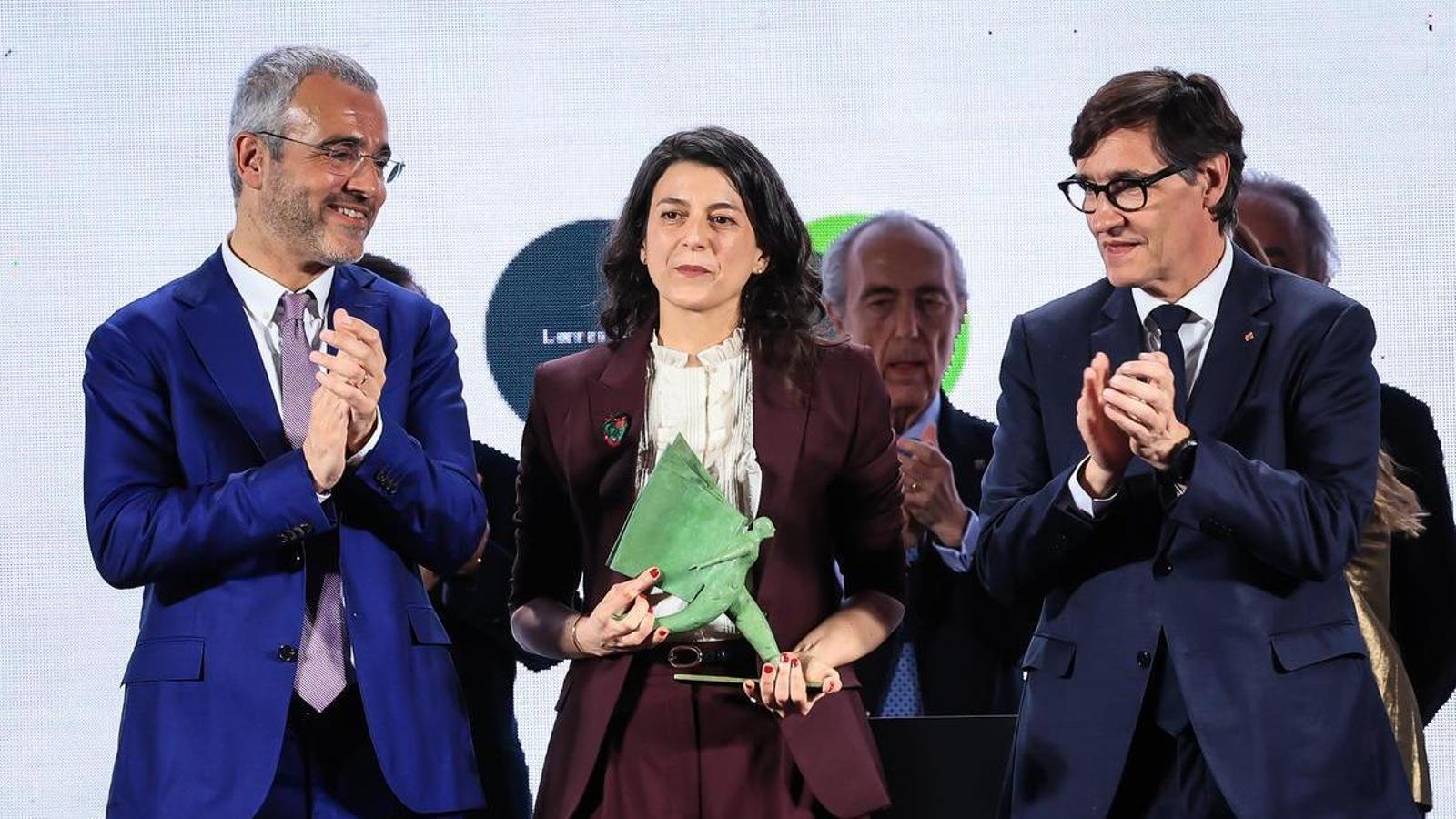
BarcelonaThe one million euros of the first Aena Award for Hispano-American Narrative has finally gone to the book of disturbing and dystopian short stories, El buen mal, by the Argentine author Samanta Schweblin, published by Seix Barral. The award, better endowed than the Nobel Prize in Literature and matching the Planeta Prize, was the icing on the cake of a gala as lavish as it was extravagant, held at the Museu Marítim de Barcelona with five live performances based on each finalist book and with most attendees dressed in "relaxed elegance," as requested on the invitation.
"I literally feel like we just played Russian roulette," Schweblin said after learning she had won. "It was my family who first passed on to me the love of literature. Then, the public university of Buenos Aires. I also want to thank many authors from whom I have learned, including Nona Fernández, also a finalist and present here. Finally, although it may sound like a cliché, I want to thank my readers for their support." Schweblin also had critical and hopeful words about current events. "It seems like the world is falling apart, but we insist on continuing to celebrate literature, which doesn't save other people's lives nor cure them," she continued. "It's a tiny rudder that helps steer the ship. Literature is empathy and common sense in a complicated reality. To paraphrase Wis'awa Szymborska, at a time like this, worse than starting to read and write would be not to start reading or writing".
Just three weeks ago, the airport operator Aena made public the call for a literary award that wanted to reward with one million euros the After a standing cocktail reception where hundreds of chocolate and foie gras bonbons and croissants with beef steak tartare, cured yolk, and kimchi mayonnaise were served, Martina Klein and Josep Cuní have kicked off the gala. "The jury is still gathered deliberating," assured the presenters, combining interventions in Catalan and Spanish. Maurici Lucena, president of Aena, opted for this same bilingual strategy: "Our company's decision is part, unlike some things that have been said or written in recent weeks, of a patronage initiative, as has been the Booker, the Strega, or even the Nobel, which was promoted by a businessman specializing in dynamite. Our patronage wants to contribute to society with a small part of Aena's business volume.
A controversial origin
Since only three weeks ago, airport operator Aena made public the call for a literary award that intended to reward the best published work of the previous year with one million euros, controversy has been rife. Why is a semi-public company dependent on the Ministry of Transport entering the literary arena? Should a new award be added to the crowded schedule of accolades? How is it that, despite works written in any official language of the state being eligible, Catalan, Basque, and Galician were conditioned on passing through a Castilian translation? Does such a lucrative award distort the cultural ecosystem?
Aena's investment for this award has totaled 2.5 million euros, a figure that, broken down, corresponds to the winner's million —next year they will find out, when they file their tax return, if they will be taxed around 35%, like an award for unpublished work, or if they are almost exempt from taxes, just like career achievement awards—, the 30,000 euros that the four finalists will receive, the organization and celebration of the gala, the promotion of the award, and the fees of the jury, which has been presided over by Rosa Montero and included Pilar Adón, Luis Alberto de Cuenca, Jorge Fernández Díaz, Leila Guerriero, José Carlos Llop, and É Elmer Mendoza, with two non-voting secretaries such as Sergio Vila-Sanjuán and Jesús García Calero. "Aena will also acquire a large quantity of copies for both our 11,000 workers and for libraries, cultural centers, and other public institutions," assured Maurici Lucena.
The jury's verdict, sealed in an envelope, was placed on a platform in front of the diners throughout the dinner. The five candidates for the one million euro prize dined, with unease and anticipation, on roasted pear vichyssoise with confit langoustine and turbot with vegetables and potato parmentier. It was not until after dessert that the winner opened the prize and pocketed the precious million euros.
