Shakira puts to the test the limits of macro-concerts
The Colombian singer begins a series of 12 performances in Madrid that can gather 600,000 spectators

-
CAT -
CAST
MadridWho would have told Gabriel García Márquez that in a wheat field that is no longer cultivated –a legacy of what was once the Madrid district of Villaverde, as its name suggests– a venue called Macondo Park would be installed. The name of the town that the Colombian writer imagined in Cien años de soledad is what Shakira has decided to christen her European residence in Madrid, where she has been since this Friday until October 11, when she will put an end to the Las Mujeres Ya No Lloran world tour. There are a total of 12 concerts and, in just two days, the Colombian has already sung in front of more than 100,000 people.
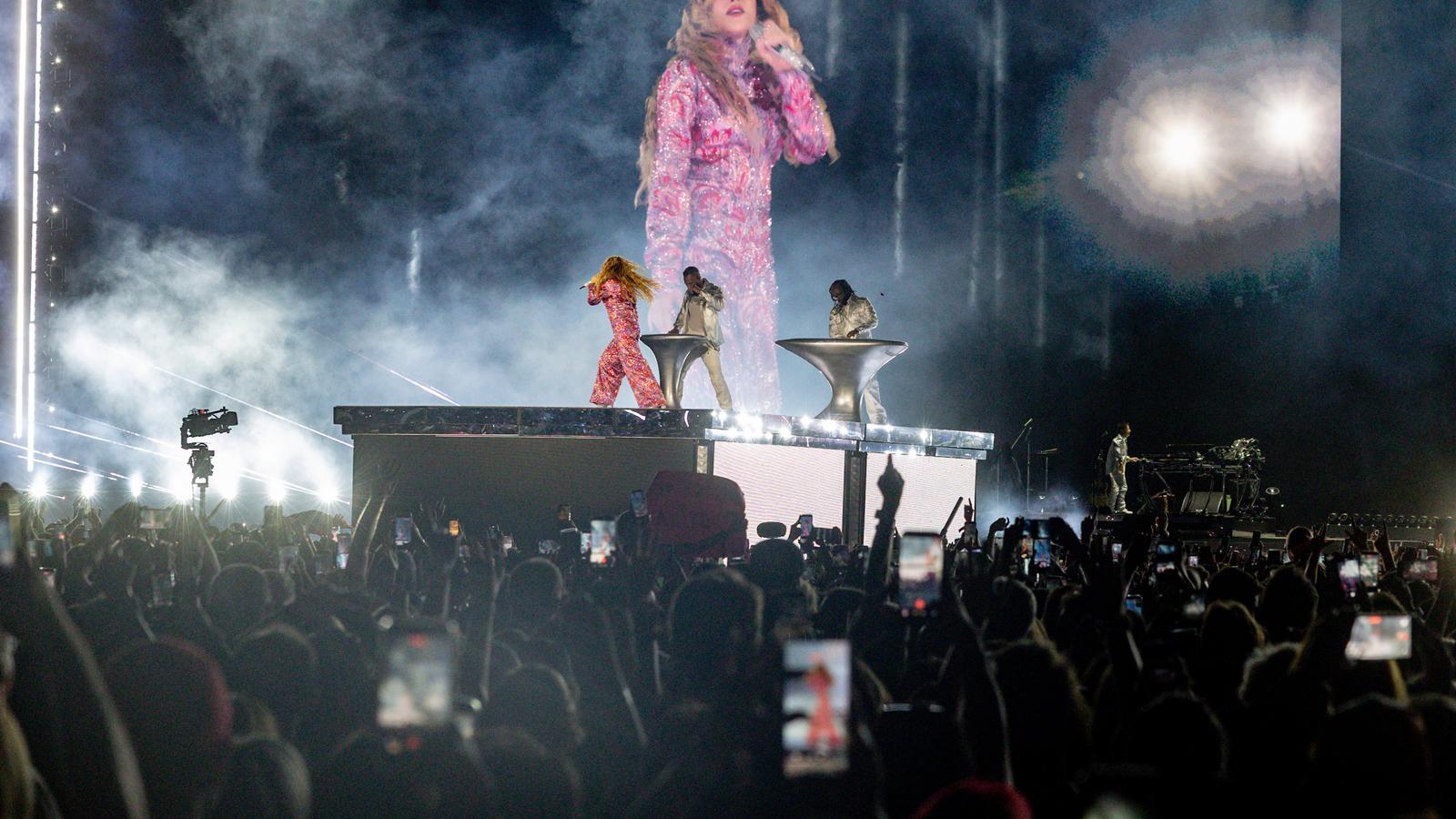
About 55,000 people –the daily capacity– welcomed her this Saturday, in what was her second concert. A "Shakira" in giant pink letters appears on the giant screen on the stage. In fact, it will be through this that many people will watch the concert without being able to avoid the feeling of being inside a documentary. On the floor and in the stands, hundreds of mobile phones light up. And an almost silence is broken in an apotheotic way when the singer suddenly appears. "¡Buenas noches, Madrid!", exclaims Shakira, who soon starts with classics like Las de la intuición, and which a devoted audience does not hesitate to sing and dance to. Individual bracelets that light up and fireworks take care of the lights.
Shakira promises to "give it her all" and it seems the audience does the same for her. Soon one of the references to her latest hit that brought her to this tour appears: "There is nothing like when a she-wolf reunites with her pack". She states that the last few years in Spain "have not been easy": "They told me I left with one face and have returned with another", she says while the audience applauds her. The euphoria escalates song after song until the last one: the song she made with the Argentine producer Bizarrap,with the implicit references to her ex-partner, Gerard Piqué, and explicit ones: the debt with the Tax Agency. In the end, a shower of confetti in the shape of banknotes.
220,000 square meters
In this residency, the Colombian singer has imagined and built a custom Macondo for herself, and who knows if it is because the residents of this peripheral and industrial neighborhood of Madrid have also been promised a new landscape for a long time, which some fear, ever since various administrations promoted the "city of music" there.
"You are surprised by the mural, aren't you?", asks Gemma, a neighbor of the district and member of the Stop Festivales Villaverde platform. "Very much so", I reply. "They have told us that this could be the future Soho of New York. Can you imagine tourists here?", she responds. It is Thursday, September 10th, and we are walking with other neighbors around the surroundings of the venue where the singer will perform. Right next to it is the industrial estate of the same district, and on the facade of one of the warehouses, there is a painting with bright colors and imaginary figures that contrasts with the grayscale of the warehouses and the red of the brick of the nearby buildings. "This is an industrial neighborhood", they reaffirm with pride.
Macondo Park is part of the Iberdrola Music venue: grounds of up to 220,000 m2. The promoter Mad Cool Events –whose president is a director at Live Nation España, Shakira's promoter– is the owner along with other private investors, and the energy company is a sponsor. Since it was inaugurated, the events have not stopped growing to the point that while the Colombian singer's musical residency is being installed, the Coca-Cola Music Experience is being dismantled.
For some residents of Villaverde, as well as Colonia Marconi and Getafe Norte, neighborhoods that border the venue, Shakira's concerts are the final strawof what began in 2023, when the Madrid macro-festival Mad Cool arrived there: noise above the permitted limits, collapsed public transport, blocked streets, isolated neighbors, businesses forced to pull down their shutters outside of normal hours, filth, or the fear that a crush of people might occur. "This [Shakira's residency] surpasses everything we have seen so far", exclaims a neighbor from the same association. Festivals usually last between two and four days. And she warns: "The area is not prepared for the fan phenomenon".

These concerts will be the only ones the Colombian singer will perform in Europe. Therefore, it is not she who travels to different cities, but rather the audience who does so. Live Nation Spain has focused on the arrival of European citizens, but also those from Latin America. "We come from Helsinki. It has turned out quite expensive for us, but she is the singer of my generation. We grew up with her," says Maria (27 years old). She and her three friends paid 205 euros for this Saturday's ticket. During the concert, Shakira does not hesitate to throw out a thank you in English.
It is expected that more than 600,000 people will pass through in total. This Saturday, when there were still more than two hours left until the concert, a very long line was already accumulating at the entrance to the floor area: "They told us that yesterday there were people who couldn't get in," comments a girl, who admits she has "very high expectations" for the concert. A father who is with his daughter takes it more calmly: "We will stay at the very back, where it is sure to be possible to dance," he comments while sitting in the shade with a group of strangers.
The central stage and the stands form an immense black amphitheater. Around it, up to eight pavilions of different bright colors and a large white VIP area have been deployed. All pavilions have their own programming hours before the concert: musical, literary, artistic, gastronomic, children's, and fashion-related. For example, a Shakira museum, a book club for Cien años de soledad or a runway show of Ágatha Ruiz de la Prada's designs. It is, as defined by the organization, an "experience" under the umbrella of what the singer understands as "Latin" culture.
A showcase?
But the Colombian woman will not be alone. During these days she will be accompanied by up to 27 different artists: Amaia, Guitarricadelafuente, Lia Kali and Yerai Cortés, among others. "I suppose the fact that she [Shakira] is also a showcase comes into play. You have to make yourself known and the music world is very tough." This is how two of the organizers of the Observatorio Festival reflect,who were surprised by the presence of some names on the lineup. They have been linked to the world of musical entertainment for years but from a different format; initially, of much smaller dimensions.
They consider that Shakira's "artistic residency" is not a turning point –although they have doubts regarding the environmental impact–, because the model of macro-concerts and macro-festivals is consolidated: "Even so, it is full of increasingly visible edges," they add.
"There are macro-festivals that overflow the physical and mental capacities of their audience. There are human-scale festivals and superhuman festivals," reflects the journalist Nando Cruz in the book Macrofestivales: el agujero negro de la música. Recently, the proliferation of these large events has gone hand in hand with complaints from many of the attendees about the feeling of being in a tin of sardines, the quality of the music, the price of the tickets, the cost of food and drinks inside –at Shakira's residency a glass of water costs 6 euros: 3 for the water and 3 for the cup– and the feeling of "chaos".
"In terms of profitability it is a perfect business, but they are very sold out. The presence and dependence on brands is very strong," they reflect from the Observatorio Festival On the venue map this translates into the fact that each of the pavilions bears the name of a sponsor. For example, the Ouigo, Disney or Boss Perfums space. In the latter case, the public could queue to leave their signature on a panel. "They come to more than just a concert. Or do you pay 100 euros to enter to see Shakira from a screen 200 meters away?".
Neighborhood conflict
Outside the venue, the organization has also tailored the surroundings to its needs. "Along this paved path, which used to be a dirt road where cars couldn't pass, we used to ride our bikes to get to Getafe. Now it serves the staff ," the neighbors point out. They also report that some white pines have been cut down. The ones that remain will live alongside giant palm trees these days.
Madrid City Council has established a mobility plan, although it is seen as insufficient from the neighborhood's perspective. The same applies to the Getafe City Council. The area only has one commuter train station, and the nearest metro is half an hour away on foot or ten minutes by bus. When the passage is blocked –they cannot enter or leave during peak hours–, taxis and VTCs waiting for the public at the concert exit take over the streets. "Maybe you go to the supermarket and when you want to return, they won't let you in," a neighbor complains.
"During the rehearsals, we've already had it [the music] inside our homes," laments Gemma, who claims that the noise emissions exceed what is permitted. Stop Festivales Villaverde has already taken the battle to the courts through criminal proceedings. "We cannot go through the administrative route as has happened against the Santiago Bernabéu [...] We cannot afford expensive lawyers," some members of the organization explain with a laugh.
Some neighbors fear that the businesses in the industrial estate that lose money on days like this and are not compensated will end up leaving. "If we lose this industry, what is left for us? They tell us that this [the festivals] might provide jobs [...] Misery, they bring a lot of money to Madrid, perhaps to the hotels, but poorly distributed," asserts Gemma, who criticizes that it doesn't even affect the few local businesses in the neighborhood. "At most, they can go to Burger King once they leave because it's the only thing open." They also recount that when faced with their complaints, the music promoters sometimes promise them free tickets or even work: "For our children, as waiters or to guide cars and attendees."
"They have even told us [the administration] that thanks to this they are removing the prostitutes," indicates one of the neighbors. "Of course, because they are closing the access points –adds another–. They must think we have them at our doorstep [...] I will tell you that I prefer them over this." Near the area is one of the historic spots in Madrid where sex work is practiced. Most are immigrant women. The situation of some of them as victims of human trafficking has also been reported. This, added to the shantytown conditions that marked the neighborhood in the past, has always been an element used to stigmatize an area that has one of the lowest per capita incomes in Madrid. "We are not a marginal neighborhood, we have been marginalized," denounces Gemma.
Other musical connections
For the organizers of the Observatorio Festival, there are other models that everyone can enjoy, "but not on this scale," they warn. The problem, they say, is that brands "are not interested" in sponsoring them because it is less profitable. "It is a paradox when there are more and more people interested [...] In the end, you depend a lot on public subsidies, which luckily exist, but are not guaranteed," they lament. They have a small budget, a good part of which pays salaries.
"I like music, and so do many neighbors. And surely many would like to see Shakira or other concerts. But I think that on principle I will not go; and at the same time, what a sacrifice not being able to enjoy your artist. It is complicated. What we want is for them to be held in authorized places. And if you have to travel further, it shouldn't matter if what you want is to see your favorite singer," concludes Gemma, who does not hide a certain pessimism: "This is not culture, it is business [...] We are sold out." While the fit does not arrive, macro-festivals and macro-concerts seem to have assumed the thesis of endless growth.
