Mario Gas: "Inside me I think I could have done more, as a father, lover, partner, director, actor, and citizen"
Theatre director

-
CAT -
CAST
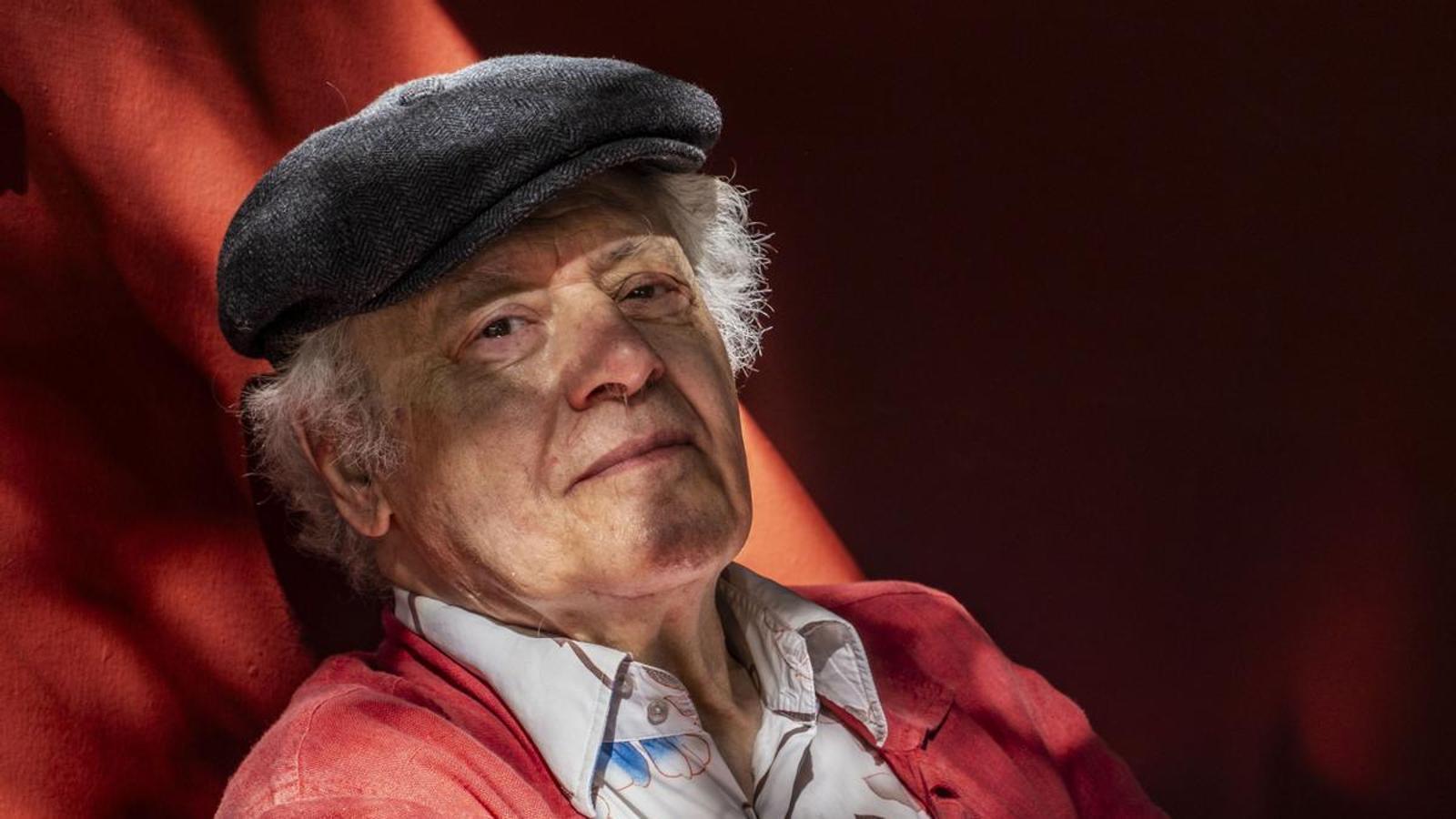
BarcelonaMario Gas (Montevideo, 1947) is one of the great names of the Catalan stage. Since his debut – he counts 18 years, with the direction of Asalto nocturno (1965), although he had been acting since he was eight – he must have directed about 150 productions. He has been an actor, director, voice actor, set designer, lighting designer and creator of legendary shows, such as Sweeney Todd and The Beauty Queen of Leenane. Around 80 years old, he continues to be combative and fighting from the theater. Until June 28, he interprets the autobiographical cabaret at La FàbricaLa lluna és blanca, muy blanca… and has just published memoirs, Conversaciones con Mario Gas (Fundamentos), written by Santi Fondevila and Teresa Petit. With him, we review fifty years of our theater.
La lluna és blanca, muy blanca…
— It is a verse from a romance by La tabernera del puerto by Pablo Solozábal that my father premiered in the 40s and sang throughout his professional career. I have put it in Catalan and Spanish because he premiered it in Spanish, and there is a recording from 1943, but shortly before retiring he also sang it in Catalan. Furthermore, it so happens that I was born in Montevideo when he was singing this zarzuela.
Does that mean he didn't come down from the stage?
— He came to see me after finishing, I couldn't leave it. And since it's a show where I talk to the audience, I sing, I recite, I say a monologue, I comment on things, it seemed to me that it was interesting to pay a small family tribute to my ancestors.
Do you think his destiny in theater was inevitable? Because he studied law, but theater kidnapped him at 20 years old...
— I thought not. I have always really liked theater, I have had a great time. I used to go on tour with my parents and my uncle, Mario Cabré, and I did independent theater. But a moment came when I thought I wanted to be a lawyer, a diplomat, or an architect. But as John Lennon said, "life is what happens while you are busy making other plans." And so it was. I don't believe in the inevitability of destiny, but it's clear I had many chances. At that time I had a scholarship to go to the United States. I had everything planned, but no: I fell in love, I took on two theater directing roles, something as an actor, and I stayed here.
It was an effervescent time: May '68, the Sitges Independent Theatre Festival is born, the first shows with Fabià Puigserver (the mythical Adefesio), he works at Ràdio Barcelona on weekends, he also gets involved in a decade of union struggles, the assembly Grec of '76, the assembly Grec of '76, the Tenorio of El Born. How does he remember those 70s? Would you say they shaped his identity?
— I'm not nostalgic at all, but I have to admit that they are historical facts. And I think that yes, they shaped me, but it also came from my time at university, where I met Carlos Trías, Cristina Fernández Cubas, Gustavo Hernández, Vila-Matas, Cadena... All this intellectual, cinematographic and theatrical effervescence opened up a very important world for me, of ideas and attitudes towards life; also ideological positioning. And all this was put into practice in late Francoism. We were coming out of a very dark era and society was moving towards a freedom that would later lead to this kind of neoliberal democracy always besieged by the far-right. Before democracy and institutions were established, in 1976-77, there were many self-managed movements. Independent theaters became professionalized. We wanted to change the production systems, as well as the aesthetics and ethics of the dominant type of theater being produced. Afterwards, in life, you have to navigate through many difficult places, but I think I've been quite faithful to all the ideas we already had. I was quite anarcho-syndicalist.
Do you still have this anarchist spirit?
— I think so, because it responds to a way of being. But God forbid I call myself an anarchist, because one has to be more serious than I am. But sympathy for anarchic ideas, always so mistreated by the ideologies that have established themselves in power and counter-power, makes me very happy. I read a great many books on anarchism. And at the beginning they were all together, Marx and Bakunin!
I suppose the memories of projects like Saló Diana, which was [assembly-based] and had slogans like "Saló Diana, a hat shop at the service of the people", arrive wrapped in nostalgia.
— Not nostalgia, but I really like thinking about those impulses. Think that we in the assemblies wanted to create a kind of soviet to direct the theaters and establish a decentralized public theater. The administration, which was settling in, sought fewer interlocutors and to re-establish hierarchical order. And we have gone as we have gone, with Trump, Milei, technocrats like Elon Musk, and the far-right.
Which are just the opposite.
— I do think they are movements that generated a spirit that many people carry within. Now we are in a low-key moment. Everything is very structured and everything has been invented for many years. As Jaime Gil de Biedma used to say: "We of that time are no longer the same, although sometimes we like a song" –he declaims–. "And today, today we do not expect the revolution". In that era we expected it.
Those young people from the 70s are the ones who fought and achieved the institutionalization of culture, which leads to what is called "a domesticated bourgeois democracy". Therefore, does it have pros and cons?
— Exactly. Now you set up a meeting and very few people go. At that time, in the meetings we held until 5 in the morning in Sala Princesa, there were 500 people. Solidarity has been undone. The more separated we are, the more they dominate us, because there is no strength of collective response. I think that the country's companies have done a lot for theater, but, as Pere Planella used to say, in the 70s-80s the plays were chosen by the directors and now they are chosen by public theaters and private companies. There is a difference. With your left hand you make art and with your right hand you make money.
But as a professional, can you escape this system?
— If I can, I don't get involved. And if I do, it's my way: with my teams, with people who think like me, which are many.
Let's pick up the thread. 80s.
— I was already doing a lot of theater as an actor and directing operas, and Hermann Bonnín offered me to direct The Threepenny Opera in 1984 at the Teatre Romea, with 45 actors and 10 musicians. The following year I directed Salomé with Núria Espert. In 1986, La ronda. I started directing for Madrid and Barcelona, where we had the Teatre Condal, until in 1989 I was proposed to direct the Autumn Festival and the Olympic Festival of the Arts of 1992, which was the child of all the self-managed experiences of the Assembly of '76, of Diana and of all that I had seen and learned in Nancy, in Paris, in Edinburgh, and wherever.
And in the 90s, the era of great tours begins, with mythical works like The Time and the Conways, and the era of Sondheims arrives.
— Yes, it was a much-cherished project that didn't arrive until 1993 with Golfus de Roma at the Mérida Festival, in 1995 it was the Sweeney Todd at the Dramatic Centre at the Poliorama, in 2000 we did Little Night Music at the Grec and at the Novedades, and then Follies to say goodbye to L'Espanyol in 2012.
And the awards for Guys and Dolls and The Beauty Queen of Leenane... What productions have marked it?
— It is a time of maturity, of very strong contact with the public and of recognition. I could name two or three shows that I would reject, but among the others I wouldn't know which to choose. I enjoy myself a lot and I take what I do very seriously. Always, in every show, there are things left to do: you can always search, learn from others, revise your aesthetics, your ethical positions... One's way of directing changes a lot, too, doesn't it? And now we are in difficult times. There are people who seven years later denounce deviant practices. And why don't they denounce them at the beginning? "No, it's just that I'm young...". We have all been young and I have many friends who have not allowed anyone to overstep a professional relationship.
He says so because in the world of theater, feminism and social transformations have driven changes: the way of directing has changed, cases of salary differences and abuse of power have been uncovered, and this in particular has affected his friends, like Joan Ollé and Lluís Pasqual.
— I think when you feel your integrity is compromised, you have to say it immediately. And if you also know the people... I've never thought Joan Ollé is a predator, he may have a questionable attitude towards women and other things, like many people, and they destroyed his life. Lluís Pasqual, worse, years later they are intellectually mobbing him and now about the Liceu it can't be directed by the 50 years of the Lliure either. I don't agree with that. And I am a feminist, and I don't allow anyone to intellectually or physically bully anyone, but I also think that erotic and sexual relationships are between free beings.
But the power and patriarchal structure must be taken into account.
— I think we are in very dangerous maximalisms typical of a puritan society that lets real conflicts escape when they are present. We must judge talent. And we must never allow anyone to cross the line. Confusing things and leaving them for the long term makes me doubt. I must have confidence in the people I have met, who are my friends, whom I have admired and who, despite knowing their perhaps slightly improper ways, do not believe the process to which they have been subjected. And I will not be moved from this.
We won't drag it out, but I think time changes the view on things and behaviors considered improper twenty years ago are intolerable today.
— Of course. But can you say "don't talk to me like that, I'm leaving". And in sexual harassment, excuse me, when there's a rape it's very clear. I could be more conciliatory but I'll tell you what I think, whether many people agree with me or not.
We return. Have you tried to explain yourself through theatre?
— In theater, it's all questions. I think there are two important themes: the condition of the individual as a finite being and the condition of the individual facing society that destroys them, or not. The theatrical genre doesn't matter to me, because I like music as much as I am very influenced by Brecht. You always try to explain yourself, share the questions you have about the world, work for the people who lose, not glorify the winners, experiment ethically and aesthetically, and try to be understandable to the audience. I explain myself through the titles I've chosen: Rise and Fall of the City of Mahagonny by Brecht, Homebody/Kabul by Tony Kushner, the Millers, Wajdi Mouawad, English and American social theater... Theater is a collective act and, despite being an element of pleasure, you have to keep probing. The Trojan Women by Euripides is one of the most contemporary works there is.
Maybe the world hasn't evolved that much either.
— It's a great question. Has little time passed, if we have historical perspective, or is it that no matter how much time passes, we will never learn from mistakes? If we look now at Hormuz, Gaza, southern Lebanon, Sudan, Ukraine, the emigrants, it's brutal.
And the Zapatero case, also, a brutal blow for the left...
— I am still a Zapaterista.
Still trust it?
— Yes, I think there is a great world coup d'état trying to absolutely erode any center-left idea. And here it is evident that they are going all out. I have read a lot of John le Carré. Why don't we believe in reality what we believe in fiction? It is evident that there is a sector of the judiciary, public powers, the media, big capital, and technocrats who are trying to boycott anything that is not an extreme right-wing state. I have confidence for now. And besides, I think one thing is human errors and the other is structured, thought-out things put into play over a long time and with many people around. We still don't know who M. Rajoy is.
He has always had one foot in Barcelona and the other in Madrid, one in Catalan and the other in Spanish. How does he feel in each place?
— It is evident that I am Catalan and fundamentally from Barcelona. It is also true that since I was very young I have gone to Madrid, I have worked there, I have owned an apartment there for twenty years, I settled there for eight years directing the Spanish Theatre. In Madrid, I am just another Madrilenian. And I master both Catalan and Spanish and can switch from one to the other calmly in a conversation. Until I was 36-37 years old, my Catalan was quite rudimentary, but when I was hired to perform Maria Rosa by Guimerà with Julieta Serrano, directed by John Strasberg, I underwent a tremendous linguistic immersion and for 42-43 years now I have been speaking Catalan perfectly and using it with a great many people. And I know 19th and 20th century Catalan literature very well, both novels and poetry as well as theatre.
Speaking of Barcelona-Madrid. How is it that there he directed a theater, and with the help of Ruiz Gallardón, and not a Catalan theater?
— You don't have to ask me. I had the Condal with some friends, from '83 to '92, and after that they haven't offered me anything. I don't believe in competitions, even though I entered the last call for the Lliure because I was excited about it. Competitions are an excuse. When they called me for the Español we spent eight months discussing all the clauses I asked for to be able to direct with freedom, and they complied. Gallardón as mayor was a progressive and Gallardón as Minister of Justice was an unpresentable reactionary. There are those who called me now for the Nacional, but now is not the time, it's too big a theater.

He does have a theatrical family, a tribe with whom he tries to work. And his fetish actress is Vicky Peña, who is the mother of his children. I say it like this because one time I wrote that they were married and she scolded me...
— We are married. For a year now. We have taken great care of our independence, but we have also taken great care of our love and everything we have done together: two children, working together, loving each other very much... and now we are married.
Well done!
— I think we are a sensitive, intelligent couple who have gone through many stages of life, but we have always been very united and have worked a lot together. First, because I consider her an extraordinary actress, from whom I learn a great deal. It is a pleasure to direct her, although it is not easy, but she has fantastic versatility, stage generosity, and power. But there are more regular actresses: Rosa Renom, Rosa Boladeras, Mónica López, Lluïsa Castell, Marta Poveda, Gloria Muñoz, Mercedes Sampietro, and actors too.

He has had two children: Orestes, a name that comes from Greek tragedies, and Miranda, from The Tempest. How do you think he has been, as a father?
— I have tried to make them see things in me, that they could learn from me. I have wanted to be very close to them, although, due to work, much less than I would have liked. I hope the mirror has served them. They are two extraordinary people. Inside me, in many areas of life, I think I could have done more, not only as a father, but as a lover, husband, partner, director, actor, citizen, as everything. I have done what I could with all the good intentions in the world. Of course, I really like looking at my children and seeing how they are. And the grandchildren too, Tonino and Gala.
In the show recites Joan Baptista Humet, who sang: "Sometimes I think I'm lucky without a penny and my profession still entertains me". A star of his generation must have done well financially.
— In this profession, they always try to pay you as little as possible. And if you get a certain status, at a certain point they tell you no. You spend many seasons without working and the money goes very quickly. And maybe one is a bit of a spendthrift, thinking more about living than accumulating.
Generation after generation, it has experienced years of accelerated growth.
— Yes, but we started by paying for our own productions, fighting hard for public and private structures, and as soon as we arrived and had done things, they immediately told us we were a blocked generation. The generation that is fifty years old has been able to leave the Institut del Teatre and get contracts thanks to the fact that we worked there. So, not all that glitters is gold. But since I do dubbing, television, cinema... I am very lazy, don't think I'm not, I love doing nothing very much. But the work is very nice and they pay me for it too.
When the La Gleva theater opened, Albert de la Torre said he was doing it to recover names that had been unfairly marginalized. Has he felt cornered?
— No, no. I like theatre, if there's a gap I jump in, if there's a big door I go in, if they call me I go and if not, I make up whatever is necessary. I can be critical, but I don't complain because I have more or less work. Every theatre or producer is free to call whoever they want. For the last offer from the Teatre Nacional de Catalunya I said no because they didn't want to pay me the fee I charge when I work for big companies, and I don't have to finance the state, neither Catalan nor Spanish, especially when they haven't raised salaries for many years. And the next day I forget about it, you know. They'll sort it out themselves!
Says no to a TNC and comes to La Fàbrica?
— This gentleman maintains with his sweat a space that costs him money and health every day. I put my labor where I want. It's about being coherent with whoever hires you.
What is the trick to staying active in your 80s? Keep working hard. In Madrid, the zarzuela Los gavilanes is revived in January. In Barcelona, at the Beckett, the monologue Mi suicidio is brought by Fernando Bernués.
— I'm on a diet now because I've had two heart attacks, but I'm fine. I have to manage my energy, of course, but I feel eager, energetic, and friendly. Without fanaticism, but if the body and mind are well, this job is my way of relating to the world, to the people around me, and to life. Maria Galiana is 91, Pepe Sacristán is 88, Núria Espert has been doing theater until she was 89, so many people! As long as the brain works, the body does too, and you have things to say and things to seek, this is a never-ending race.
