From an assembly to a pandemic: the behind-the-scenes stories of the Grec
We follow the 50 years of the Barcelona festival at the hands of directors and artists such as Mario Gas, Dagoll Dagom, Peeping Tom and La Veronal
-
CAT -
CAST
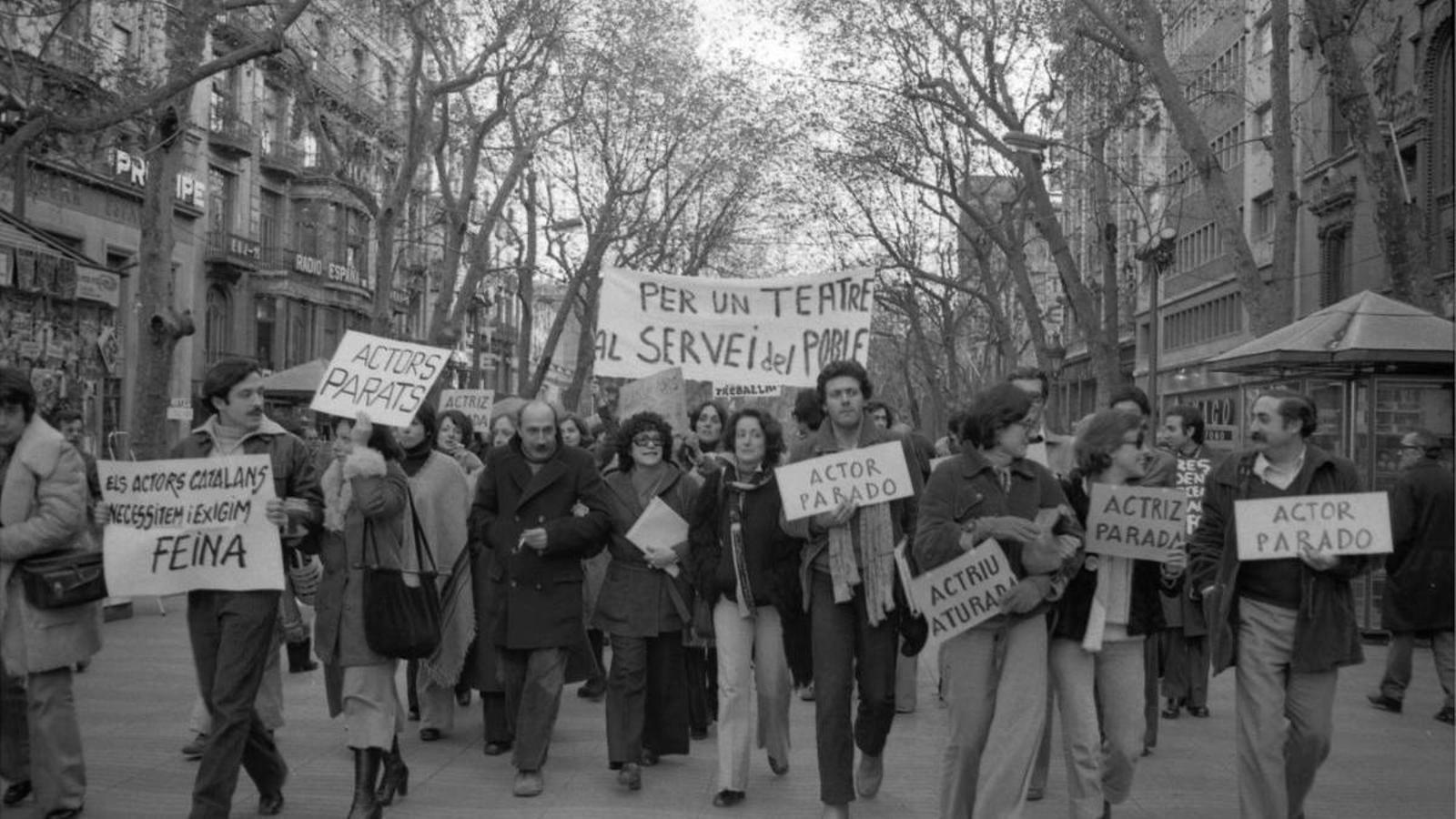
Barcelona50 years ago, a group of artists joined forces with one goal: to reclaim the Grec Theatre and put it at the service of the people. From that collective impulse, the Grec was born, a festival that in the last five decades has become a showcase for the best international shows and, at the same time, a springboard for local creation. We take advantage of the anniversary to rescue the festival's behind-the-scenes history from the hands of artists and directors who have been part of it all this time.
Mario Gas
Stage director and actor
El Grec was born in 1976 as an initiative directly driven by the theater profession. It was the early years of post-Francoism and artists organized to reclaim a stage, that of the Grec Theater, which was highly valued by the city. "El Grec emerges through a long union struggle that begins in 1971 and seeks to dismantle the structures of the Franco regime from within," recalls director and actor Mario Gas, who was heavily involved in the festival's beginnings and later premiered several shows there. Gas explains that the artistic world was debating between two strategies: producing a white paper demanding various public spaces or organizing a single direct action with the entire profession. "It was put to a vote in an assembly, the second option won, and a specific action was designed at the Grec Theater, which had been closed for a year," says Gas.
Inaugurated in 1929 for the Barcelona International Exposition, the stage had been intermittently active. In the 1960s, for example, it hosted classical and contemporary theater, dance, and music. But with the recovery of theater, a self-managed festival also began, involving the entire profession. "That season was titled For a theater at the service of the people. The atmosphere of seriousness, and at the same time of celebration and joy, was fantastic, and attendance was brutal," emphasizes Gas. After that first edition, the assembly split, and in 1979 El Grec passed into the hands of the new democratic administration. "The first stage, with Joan-Anton Benach and Biel Moll, was spectacular," concludes Gas, who advocates for more theater to be performed on that stage. "It is becoming increasingly sonically polluted, and many shows cannot be performed, but it should be recovered," says the director.
Anna Rosa Cisquella
Co-founder of Dagoll Dagom
Dagoll Dagom is one of the Catalan companies that has premiered the most shows at Grec. The first one they staged there was Antaviana in 1979 and the play marked a before and after for the company. "It meant our professionalization. For us, performing at Grec was a huge opportunity," recalls Anna Rosa Cisquella, who adds that the performances were a great success. At a time when there weren't many theaters in the city yet —the Teatre Nacional de Catalunya didn't exist, nor did the Teatre Lliure de Montjuïc, among many others—, the recovery of the Teatre Grec was a great joy for the profession. "It was a stage with two thousand seats that opened up to the city. Being part of the festival was a sign of quality shows, which were heavily promoted because there was no other offer in the summer," points out Cisquella.
Later, the company returned with Glups! (1983), El Mikado (1986), La Perritxola (2003, the festival's opening show) and La gran nit de Dagoll Dagom (2024). "In the beginning, the programming was quite popular. Everyone looked forward to Grec, for the theater and also for the added bonus of spending time in the gardens. It was quite an event," highlights Cisquella, who has a lot of anecdotes from those nights. "In Antaviana we had mirrors on stage. We had to stop the show to clean them, because they had become foggy with the humidity," she explains. She also has a special memory of a performance of El Mikado where they had 24 musicians in the orchestra pit, which was open. "They were wonderful nights, full of color and joy," emphasizes Cisquella.

Santi Fondevila
Theatre critic
In the mid-80s, and especially under the direction of Elena Posa, Grec became a great showcase for the international contemporary scene in Barcelona. At that time, it was one of the few venues in Catalonia where you could see cutting-edge European shows, and the public responded with enthusiasm. Santi Fondevila, theatre critic for ARA, particularly remembers A Night with Vittorio Gassman, which the legendary Italian actor presented at the Teatre Grec in 1984. "It was amazing, to see and hear him speak in the middle of the stage," says Fondevila. Among the most prestigious creators the festival brought to our country for the first time, the critic also highlights the performance of choreographer Merce Cunningham and musician John Cage in 2000. "They brought the most revolutionary dance from the United States in a show that was beautiful," emphasizes Fondevila, who also has in memory "a sensational version of The Master and Margarita by the company Complicité" that was seen there in 2012.
"More and more it has been a festival of accumulation, rather than selection. It has been incorporating everything that happens in Barcelona in July," explains Fondevila. What has not changed is the importance of the opening show —"It's a difficult challenge, and over time we've seen that starting the festival with a theatre proposal is not usually successful. The most ingenious directors have leaned towards circus, dance, and music," says the critic— and the precarious gastronomic offer. According to Fondevila, "you've never been able to eat properly there, even if it's just sandwiches at a reasonable price." Fortunately, the magic of the experience has been maintained: "Experiencing summer nights in these gardens has a very valuable appeal for everyone. This means that the public has always been very diverse, not strictly theatrical. The only thing that has changed is that now people take photos with their mobile phones and post them on social media".
Àngels Margarit
Choreographer
The beginnings of the company Mudances, led by Àngels Margarit, are partly linked to the Grec festival. The company had premiered its first show in 1985 and, a year later, brought it to the old Casa de Caritat within the Grec. "They were years when Europe was looking towards Catalonia and Spain, we were emerging from the dictatorship. We had performed abroad and it was great that we were programmed in Barcelona. At that time, we sometimes did two weeks of performances," explains Margarit. Before that, she had been a spectator of the festival and particularly remembers the Bread and Puppet company, which left a mark on her. Throughout its trajectory, Mudances performed up to seven creations at the Grec, including Atzavara (1991), Tèrbola (1998), and Capricis (2013).
The weight of dance in the festival's programming has varied. "For many years, the Grec hosted the street festival Dies de Dansa, which was very important for local artists and for bringing in international emerging artists, but it operated with a small budget and too much precariousness. They were years of little respect for dance," explains Margarit. The choreographer particularly highlights the work of Xavier Albertí, Ramon Simó, and, more recently, Francesc Casadesús, for placing dance at the forefront of the Grec. "In recent years, it has gained a lot of ground thanks to the impetus given by people who love it. We have managed to program it and show how innovative, daring, and spectacular it is. Now dance is very present in all programming, but a few years ago all this did not exist. In Barcelona, we are in a good moment," points out Margarit.

Xavier Albertí
Stage director and director of the Grec (1995-1999)
Xavier Albertí arrived at the direction of Grec in 1995, at a time when the festival had opened for the first time to private theaters. "It was a turning point in terms of programming, because we went from about thirty shows to a hundred," explains the director. His great challenge at the head of Grec consisted of ordering this hybrid format. He chose to organize two programming sessions, the official one and the open one, mirroring the models of the Avignon and Edinburgh festivals. He also created Grec Metropolità, adding the participation of different municipalities near Barcelona to the festival.
"I was told that my festivals had too much to offer, but that was a consequence of the institutions, which believed that opening Grec to private enterprise was a way to make it grow," points out Albertí. During his time as director, he opted to bring major international figures to Barcelona such as the German choreographer Sasha Waltz, the Swiss director Christoph Marthaler, the Belgians Needcompany —"we rented La Villarroel and had 40 people in the audience, a failure," says Albertí— and the Italian company Societat Raffaello Sanzio, with Romeo Castellucci at the helm. "They performed the Oresteia and halfway through the performance the entire critical press left the stalls. The following year, the Avignon festival programmed it and La Vanguardia published a double-page spread praising the show. It is the first and only time I have called a critic to reproach them for anything. That episode was a symptom of the fact that Barcelona still needed the tutelage of the older European siblings for someone to tell us that this was the path of the avant-garde," reflects Albertí. He also highlights the bets on local creators such as Carlota Subirós and Roger Bernat at a time when the festival's resources were more meager, compared to the present day.

Calixto Bieito
Stage director
Since the late 1980s, Calixto Bieito established a deep connection with the Grec. In 1989 he premiered Shakespeare's The Two Gentlemen of Verona, in 1990 he brought Goldoni's The Lovers, in 1991 he performed Shakespeare's A Midsummer Night's Dream, and in 1993 he did Rodoreda's Un dia. "I remember the collaboration with Elena Posa and Miquel Lumbierres to stage King John in a church in 1995 and how we adapted the space almost entirely ourselves, with great passion and joy. It was a feverish but fun rehearsal process," explains Bieito. With "Un dia" he experienced the death of his first agent and friend, Àngels Vila, and also met Roser Camí. "They are memories full of life and emotion, and those long nights in the amphitheater, designing the lighting until dawn, with the humidity and the mosquitoes," highlights the director. His bond with the Grec has remained intact to this day and, in fact, in this edition of the festival Bieito will present The True Story of Richard III.
Marcos Morau
Choreographer and director of La Veronal
The first memory of the festival that comes to mind is the premiere of Voronia in 2015 at the Grec amphitheater. We were very young and opening the Grec was a mix of dream, responsibility, and a lot of fear. That vertigo before going on stage is a memory I still hold very vividly," explains Marcos Morau. Since that performance, La Veronal has forged a solid and deep bond with the Barcelona festival, where it has presented shows such as Firmamento (2023) and Sonomatook responsibility for carrying out the festivalMorau also has memories as a spectator: "They are summer nights in Barcelona, discovering artists and sharing the feeling that art is a very special part of the city's life." If he had to choose one experience linked to the Grec, he picks the performance of Sonoma with Maria Arnal. "It was one of the most beautiful moments of my career. Even the rain, which could have been a problem, ended up being part of an absolutely magical and unforgettable night," highlights the artist.

Gabriela Carrizo
Choreographer and co-founder of Peeping Tom
One of the most distressing moments in the history of the Grec was during the coronavirus pandemic. With health restrictions, the 2020 edition was on the brink and could not proceed normally. Until mid-July, all in-person cultural events were suspended and the population had limited mobility to try to contain the virus. But on Sunday, July 19, 2020, when Peeping Tom was to premiere, 200 people demonstrated in front of the Teatre Grec in Barcelona with the slogan #culturaéssegura, which went viral on social media. The City Council, unusually, took responsibility for moving forward with the festival, despite the restrictions that the Generalitat had imposed on Friday, which prohibited cultural performances. Finally, on Monday, the Generalitat gave the green light to the Grec Festival, Cruïlla XXS and Pedralbes.
"We had been preparing the Díptic
with a new group, we had performers blocked in Australia, we rehearsed by video, and finally we arrived here. The Avignon Festival had stopped, the Grec was one of the few European festivals that continued, with separation between spectators. It was very exciting because at one point it was raised: does the festival continue or not? We were waiting before the performance. And the slogan «La cultura és segura» (Culture is safe) emerged in a demonstration," recalls Gabriela Carrizo. That performance was especially moving, to the point that a few minutes after the show began, the audience applauded simply because it was being performed. "All the Grec technicians and ours came out to greet us —Carrizo recalls—. For us, the Grec has been important, but I feel there is a whole ecosystem that opened its arms to us and supports us, and that is precious. We liked coming to work in Barcelona, the Grec in the summer, with this climate, was like a dream: we fell so much in love with the city that we stayed to live here," explains the artist.
