Exceptional finding of 14th-century mural paintings in the monastery of Sant Cugat
Here appears a Calvary during the restoration of Saint Scholastica's chapel

-
CAT -
CAST
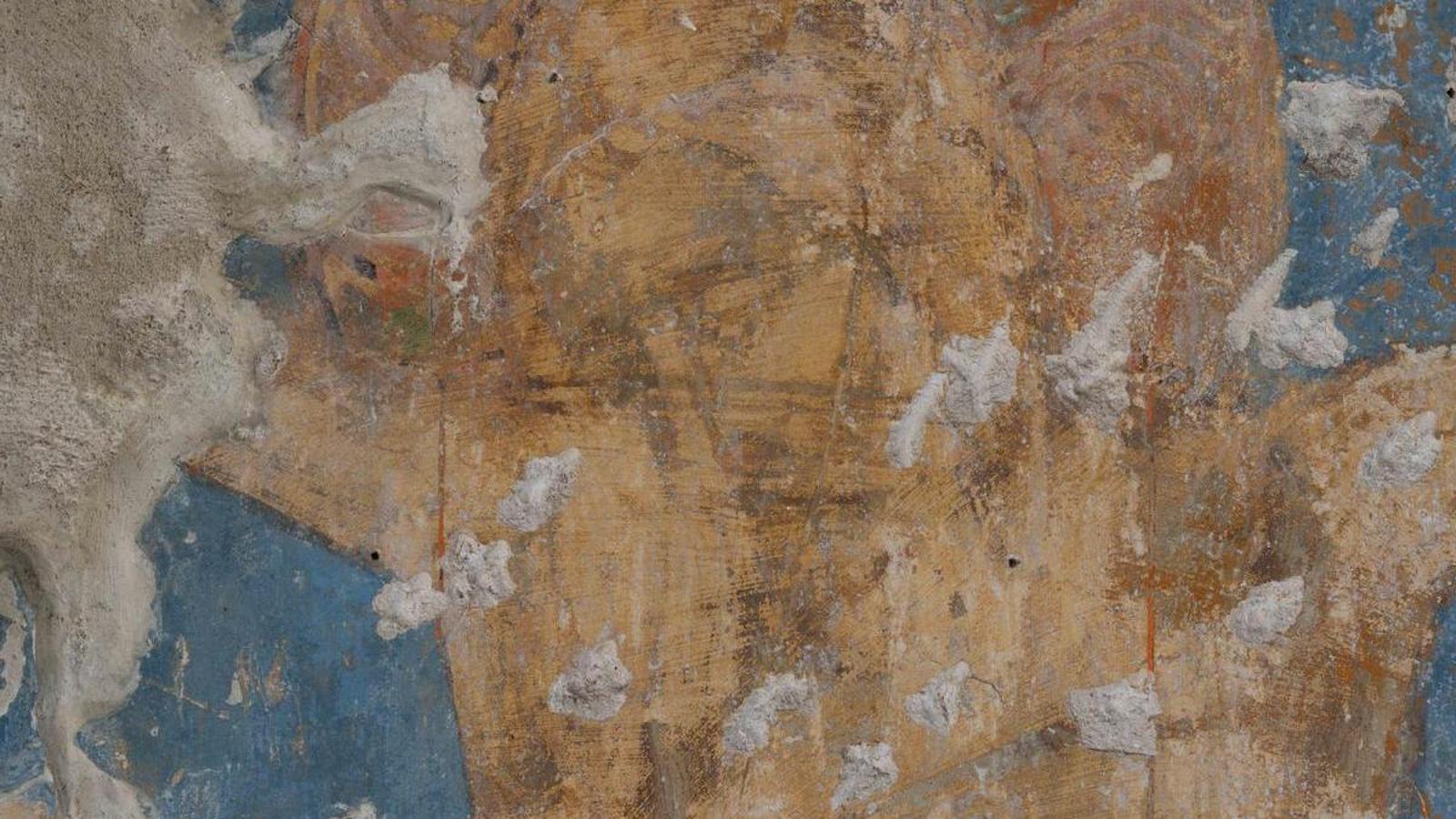
Sant Cugat del VallèsThe restoration of the chapel of Santa Escolástica in the monastery of Sant Cugat del Vallès has provided an exceptional surprise. After removing the baroque altarpiece for restoration, a mural painting of a Calvario, which can be dated to the mid-14th century, has come to light on the back wall. At the time of removing the altarpiece, the knees of Christ were revealed. Afterwards, the restorer Beatriz de Colmenares and her team continued to remove pieces of plaster until the figure of Christ was revealed and, on one side and the other, the figures of Saint John (on the right) and the holy women (on the left), among whom are the Virgin Mary, fainting, and Mary Magdalene lamenting.
The Calvario is full of holes, as it was chipped so that the plaster with which it was covered would adhere better to the wall. Despite the poor state of conservation, the painter's talent can be appreciated in the representation of Christ's pained gesture, the grain of the wood of the cross, and the bark of the cross itself. Furthermore, above the cross there is part of another scene and, further down, on the wall, a fragment of another scene. Thus, it is possible that the mural painting extended across the entire wall, which would make the discovery even more spectacular.
Stylistically, the Calvario is part of Italianizing painting and dates back to the period before large Gothic altarpieces replaced mural painting and it entered a phase of decline. The glue tempera technique with which it was painted suggests that the author was “an Italianizing native Catalan painter”, as stated by Rafael Cornudella, professor of art history and member of the Institut d'Estudis Catalans.

Saint Scholastica's chapel is at the entrance of the church, next to the right nave. It had never been restored until now. The altarpiece was removed from the chapel about three months ago, and studies have been done on the wall hangings during these weeks. The scaffolding was removed on Tuesday. Although there is still a lot of work to be done, for Cornudella, who insists on being cautious, the “closest reference” for the Calvary of Sant Cugat is the one in the abbey space of the monastery of Pedralbes. He does not rule out that the two paintings are the work of the same painter.
The Calvary of Pedralbes was discovered by Agustí Duran i Sanpere under whitewash when the room was used as an archive during the Civil War. In these paintings, there are curtains with fantastic animals that cover the entire room. The curtains and the Calvary are by two different painters. The way the crucifixion is painted resembles a tapestry surrounded by a border of geometric motifs combined with the monastery's coat of arms. In this painting from Pedralbes, to the left of Christ is Saint John the Evangelist, Saint Clare, and Saint Eulalia; and to the right, the Three Marys with Saint Louis of Toulouse and Saint Francis of Assisi.

Experts date the Calvari of Pedralbes between the 1330s and 1340s. “It is then that a change occurs in the Catalan painting scene, which basically consists of the exhaustion of the French-inspired model that had prevailed since the end of the 13th century and the arrival of a wave of Italianism, led by native Catalan painters, such as the Ferrer and Arnau Bassa, and by Italian painters present in Catalonia”, such as the painter of the chapel of Sant Miquel de Pedralbes and the Master of the Coronation of the Virgin of Bellpuig, points out Cornudella.
Regarding the chronology of the Calvari of Sant Cugat, the chapel was completed in 1337 during the Gothic period. Before being dedicated to Saint Scholastica, the chapel had been dedicated to Corpus Christi. In this regard, Cornudella recalls that in 1333 Abbot Galseran Solà founded a Corpus Christi benefice, that is, he endowed an altar. “It was at that time that the construction of the church was finished. This date gives us a reference: the paintings could be from around 1333 or slightly later,” says Cornudella. The theme of Corpus Christi is related to a moment of apogee. "At that time the Corpus Christi feast gained great strength in Barcelona," explains the parish priest, Emili Marlés. "The Corpus Christi feast took to the streets in 1323 – he adds –. Corpus Christi is the Eucharist, which always has a connection with the crucifixion: 'This is my body, which is given for you.' So from a theological point of view, the Eucharist and the crucifixion illuminate each other."
Later, in the 17th century, with the new religious practices of the Baroque era; the south nave of the church of Sant Cugat was divided into three spaces separated by walls. The space corresponding to the Corpus Christi altar was assigned to the new chapel of Saint Scholastica, sister of Saint Benedict and patroness of the Benedictine nuns.

The altarpiece of the chapel of Saint Scholastica
Traditionally, the first chapel of parish churches is dedicated to baptism, and in it is preserved a 16th-century baptismal font from the old church of Sant Pere. The vault and arches are decorated with 18th-century mural paintings, with religious scenes of Saint Scholastica and other Benedictine saints and abbesses. The altarpiece is a large-scale work (nearly 6 meters high and 5.5 meters wide), with a painting depicting the glorification of the saint in the center.
The altarpiece was dismantled in 1938, when the chapel was used as a bar for the deputies, as the last courts of the Republic were held in the monastery church. The restoration is being carried out at the Centre de Restauració de Béns Mobles de Catalunya (CRBMC), in Valldoreix. The total cost of the project is 86,264 euros, of which 72,257 euros will be allocated to the restoration of the altarpiece. The parish of Sant Pere d’Octavià will assume 64,843 euros, while there is a subsidy from the Generalitat of 21,421 euros. To obtain the rest, the parish has initiated a patronage campaign. And the budget to continue removing the cladding to see if there are more murals is 22,000 euros. The Government has subsidies for the CRBMC to take charge of cases like this. The monastery of Sant Cugat is owned by the Ajuntament de Sant Cugat.
