The drama of immigrant deportations in the USA, World Press Photo 2026 award
Photographer Carol Guzy has documented how the country's government separates families under the guise of an executive order from 2025

-
CAT -
CAST
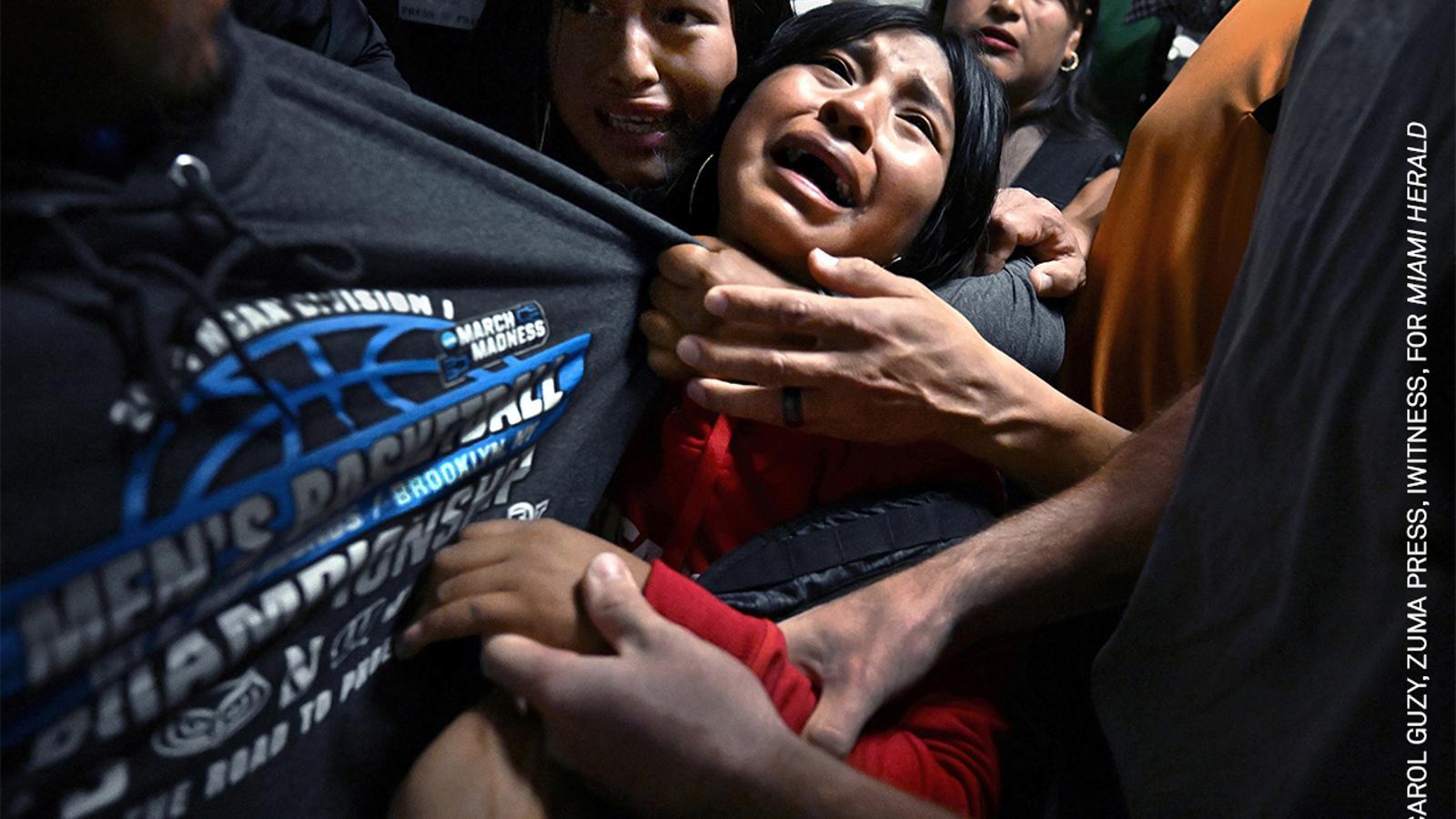
BarcelonaAfter two editions focusing on the horror of Gaza, this year the World Press Photo has turned its gaze towards the deportations of immigrants to the United States and has decided to award American photographer Carol Guzy, of ZUMA Press and iWitness. Thus, the award for photo of the year goes to Separated by ICE, a photograph taken for the newspaper Miami Herald in one of the few federal buildings in the US to which photojournalists had access. Guzy's image captures the dramatic moment when a family is separated by agents of the US government. The World Press Photo exhibition can be seen at the Centre de Cultura Contemporània de Barcelona from November 6 to December 13.
The protagonist of the winning image is Luis, an Ecuadorian immigrant who was detained by agents of Immigration and Customs Enforcement (ICE) after a hearing in immigration court held at the Jacob K. Javits federal building in New York City on August 26, 2025. Luis was the sole economic provider for his family, and after his detention, his wife and their three children, aged seven, thirteen, and fifteen, had to face not only the trauma but also severe economic problems. Through an executive order in 2025, protections for "sensitive locations" such as hospitals, schools, and courthouses were revoked, making it possible for ICE to detain immigrants in these spaces. The World Press Photo reminds us that Luis's case is not isolated and that many other people have been detained while complying with the rules set by the Administration.
The image awarded as best photo of the year is part of a broader series by Guzy, titled ICE Arrests at New York Court (Arrestos del ICE en el tribunal de Nueva York), which has been awarded in the Photojournalism category for the North and Central America region. After the award was announced, Guzy wanted to highlight the bravery shown by the protagonists of her photographs. "We have witnessed the suffering of countless families, but also their dignity and strength, which transcend adversity, which has been a humbling lesson. The courage they have shown by opening their lives to our cameras has allowed us to tell their stories. And, undoubtedly, this award belongs to them, not to me," the photojournalist remarked.
For their part, the director of World Press Photo, Joumana El Zein Khoury, has described Guzy's images as a "raw and necessary testimony to the family separation caused by United States reform policies." Furthermore, she has advocated for photojournalism as a tool for denunciation. "In a democracy, the presence of the camera in this hallway serves as testimony to a policy that has turned courthouses into scenes of shattered lives; it is a powerful example of why independent photojournalism is important," she said.
The two finalists
In addition to announcing the winner of the best photograph of the year, the organization has also announced the two finalists in this same category, Saber Nuraldin, from Palestine, and Victor J. Blue, from the United States. The former has been selected for the photograph Humanitarian emergency in Gaza, by EPA Images, an image in which a crowd of Palestinians can be seen climbing onto a humanitarian aid truck to try to get flour. The photograph was taken during the so-called "tactical pause" in Israeli army operations to allow humanitarian aid to enter. As for J. Blue, the chosen photo is The trials of the Achi women, published by the New York Times. It is a portrait of Paulina Ixpatá Alvarado standing with other women of the Achi ethnic group, in front of a courthouse in Guatemala City, Guatemala, hours after three former members of the civil defense patrols were sentenced to 40 years in prison for rape and crimes against humanity. The civil war in Guatemala resulted in the genocide of thousands of Achi Maya people by the army and paramilitary forces, who used sexual violence as a tool of repression.


In early April, World Press Photo also announced the regional winners. Among all the awardees were three Spanish photojournalists, Brais Lorenzo, Luis Tato, and Diego Ibarra Sánchez. The first was awarded in the Graphic Storytelling category for the Europe region for portraying forest fires in Galicia. For his part, Tato was recognized in the Graphic Storytelling category for the Africa region for a work on student protests in Madagascar. Finally, Ibarra Sánchez was awarded in the Contemporary Issues category for Western, Central and Southern Asia for documenting the lack of access to education for children from nine countries.
