Another full Sant Jordi (and allergy-proof)
Among the best-selling authors of the day were Regina Rodríguez Sirvent, Gil Pratsobrerroca, Òscar Andreu and Eduardo Mendoza

-
CAT -
CAST
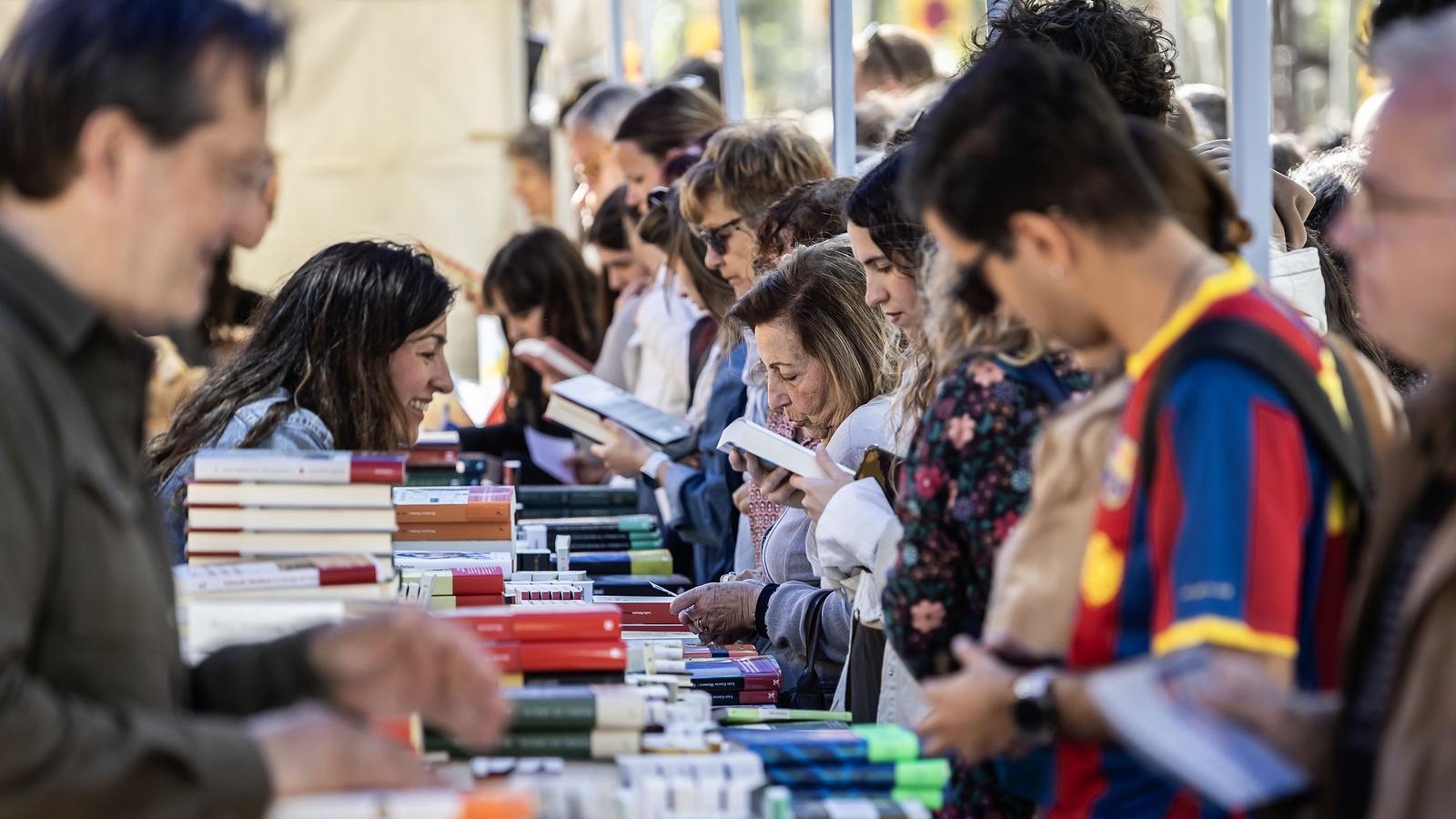
BarcelonaSant Jordi has once again overflowed Catalonia with the magic formula that never fails: books for all tastes —from the exquisite Nobel laureate Han Kang to young authors in love with success, such as Gil Pratsobrerroca, David Uclés and Inma Rubiales—, roses at prices ranging from 4 to 25 euros, and the contagious enthusiasm of millions of citizens who have taken to the streets ready to have a good time.
Even a skeptic of the holiday like Eduardo Mendoza has surrendered in his own way. A few days ago, the author of Sin noticias de Gurb declared that he was campaigning for April 23rd to stop being associated with Sant Jordi: "For me, April 23rd is Book Day, period —he said—. Sant Jordi was an animal abuser who surely couldn't read." This Thursday, although he maintained a prudent distance from journalists at all times, as if they caused him more allergies than the golden dust falling from the plane trees, Mendoza wore a pin with a dragon and a rose on his lapel, a discreet and elegant way to settle the controversy.
A festival that is not dying of success
The positive strength and energy of Sant Jordi can defeat the most recalcitrant party poopers. In other years, it has been said that the festival had reached its peak and could die of success due to crowds. This year, the criticisms have been deactivated by the good atmosphere among the strollers and the warm words of many authors. "It's a day when there's a lot of connection, a kind of friendship abounds," assured Carles Rebassa, who with Prometeu de mil maneres (Univers) has won the last Sant Jordi prize. "What I'm experiencing here doesn't happen anywhere else in the world," assured the Icelander Audur Ava Olafsdóttir. Amélie Nothomb, who last year was a last-minute absentee due to an unexpected health problem, received curious gifts from some of the hundreds of readers queuing for her to sign one of the more than 30 novels she has published: "One reader brought me a book by Kawabata, The House of the Sleeping Beauties, another a box of chocolates, another a beautiful pen — she said, a champagne glass in one hand—. People are very generous.
The only element that threatened to disturb the day's placidity was the dust from the open fruits of the banana trees: it accumulated on the ground and floated in the air. "It's the trees' revenge on the publishing sector for making so many books," commented a man after a coughing fit. "I think I'll have to end up buying a mask." The presence of masked passers-by was reminiscent of the distant, but real, times of covid-19. Albert Sánchez Piñol, who agreed to sign copies of his novels for the first time —"traditions are meant to be broken," he proclaimed at Espai Abacus— had to resort to antihistamines, but even so, he couldn't calm the itching in his eyes or the irritation of his mucous membranes.

Persecuted writers and frivolous writers
For writers, Sant Jordi is a day that starts very early and ends very late. Before the signing marathon, authors such as Francesc Serés, Màrius Serra, Francesc Torralba, and Regina Rodríguez Sirvent —who admitted she struggled to suppress "the tears for all the wonderful things" she is experiencing— have been present at the breakfast that the Institut de Cultura de Barcelona convenes each year. "For one day, Barcelona declares itself more openly romantic and a little wiser," assured Jaume Collboni, who also wanted to mention the Escriptor Acollit program promoted by PEN Català. "Writing, today more than ever, is an act of resistance," he recalled.
On Sant Jordi, solidarity with persecuted authors coexists with the frivolity of some signing record-holders, to whom an assistant recites the name of the person to whom they should dedicate the book to save time and move on to the next in line. Han Kang only signed 100 copies in two hours, but she almost failed the readers because anxiety was devouring her first thing in the morning. As she explained over a cup of steaming tea during the lunch that Penguin Random House convened at the Hotel Majestic, the crowds, above all, give her "fear." She had to sit next to the smiling Joël Dicker, whom it took God and help to strike up a conversation with the Nobel laureate: the literary distance between them is abysmal, no matter how much they share an editorial group and a table.
During the morning, we saw Pol Guasch signing copies of Relíquia (Anagrama) in shorts. We verified the drawing power of authors like Lucía Solla Sobral, a publishing phenomenon thanks to Comerás flores (Libros del Asteroide); Gil Pratsobrerroca, author of El joc del silenci (La Campana), and Roger Bastida, winner of the Santa Eulàlia prize with Passeig de Gràcia. We discussed with Carlota Gurt "the good reception" that Els erms (Anagrama) is having and "the difficulty that books published in autumn have in arriving alive" to Sant Jordi: an exception would be Qui salva una vida, by Núria Cadenes, published by Proa in November.

A food rivalry too
, both at La Campana. For the first course, there were artichokes and peas with Regina Rodríguez Sirvent, who has repeated the success of Les calces al sol with Crispetes de matinada, both at La Campana. For the first course, there were artichokes and peas with foie gras parfait, morels, and black pudding. For the second, hake Bilbao-style with green asparagus, potato, and ham.
"If there is a phrase that we should all remember on a day like today, it is that signing more books does not make you a better writer," said Javier Cercas at the entrance of the Majestic's gymnasium, a place that all diners who intended to go to the bathroom had to pass through before resuming the signing marathon. An hour later, the author of Soldados de Salamina had a queue of readers as long or longer than that of Sonsoles Onega or Flavia Company.

The highly anticipated best-seller ranking
This Sant Jordi afternoon amplified the morning and midday success even further. There were stretches of Passeig de Gracia that were impassable. In Portal de l'Àngel, which temporarily replaced the section of La Rambla, still under construction, it was impossible to find standing room. The scene on Passeig de Sant Joan between Tetuán and Ciutadella was also spectacular: it gathered thousands of strollers interested in children's, young adult, and comic literature. At seven o'clock, the six simultaneous demonstrations began to denounce the decline of Catalan and the increase in linguistic discrimination, which were held in Barcelona, Girona, Reus, Tortosa, Igualada, and Manresa.
Shortly after eight in the evening, the Cambra del Llibre de Catalunya announced the news most eagerly awaited by lovers of rankings. The first estimation of the day's bestsellers, which the guild itself might correct in a few days, when it releases the definitive data, has crowned Regina Rodríguez Sirvent and Eduardo Mendoza as the two best-selling fiction authors in Catalan and Spanish, respectively. In non-fiction, the top spots on the ranking are occupied by Òscar Andreu and his Manual de defensa del català (Univers) and Instrucción de novicias, by Ana Garriga and Carmen Urbita (Blackie Books). In children's and young adult books, the tenth installment of Em dic Goa, by Míriam Tirado (B de Blok) and Si fuéramos eternos, by Emma Gil (Martínez Roca) lead the list. The Cambra del Llibre values "very positively the great citizen participation and the volume of book sales in this edition of the Day of the Book and the Rose": sales are approaching 27 million euros, and have once again surpassed the previous figure, which reached a record of 26 million.
Joan Riambau, literary director of La Campana, La Magrana, and Rosa dels Vents, was right when he said that there is a "reading public eager to discover new talents from this country". In addition to Crispetes de matinada, by Regina Rodríguez Sirvent, in Catalan, El joc del silenci, by Gil Pratsobrerroca —also from La Campana—, and Passeig de Gràcia, by Roger Bastida, published by Comanegra, have been a success. In Spanish, third and fifth place on the list are occupied by debutante Lucía Solla Sobral and the young and controversial David Uclés, who has managed to repeat the success of La península de las casas vacías (Siruela) with La ciudad de las luces muertas (Destino). In Catalan non-fiction, the great reception of the essay Anatomia de l'esperança (Destino), by philosopher Francesc Torralba, with which he won the Josep Pla award, and the latest book by doctor Oriol Mitjà, the autobiographical On neix la llum (Columna), also stands out.
