BarcelonaA 2017 scientific study claimed having one fewer child was the most effective way to fight climate change – more impactful than going vegan or ditching your car. A small but growing number of people have consciously chosen not to have children to help the planet. Yet sacrifice may prove unnecessary. After half a century of population explosion and global overpopulation alarms, the problem now appears reversed: population decline. "We're not preparing for what's coming. Just as rapid population growth disrupted the world, the coming population drop will be equally – or more – swift and disruptive", warns Darrell Bricker, Ipsos researcher and co-author (with John Ibbitson) of Empty Planet.
The UN now forecasts global population will shrink by century's end, with ever more countries sounding depopulation alarms. Just as the world crosses 8 billion threshold, governments such as Japan's, South Korea, Italy, and even China are implementing policies to increase birth rates. Women worldwide are having dramatically fewer children – far faster than demographers predicted – a trend experts say will eventually hit every country. "Empty Planet is about female empowerment, which is good news, but its massive population effects will be hugely disruptive, for better or worse," Bricker explains by phone from Toronto.
Why will the demographic explosion be curbed?
If a few years ago global population growth seemed endless, the UN now predicts it will peak at 10.4 billion in 2080 before declining. Bricker believes UN figures are conservative: a Lancet study forecasts a 2060 peak at 9.7 billion. Either way, global population decline is underway.
Evolució i projecció de la població mundial
En nombre d'habitants
"This projection shift came in 2016, and the main reason was China, which provided new and very low fertility data”, explains John Wilmoth, UN Population Division director, to ARA. Asia's 2020 census confirmed the trend, and this January China announced it lost population for the first time in 60 years. The country is home to one-sixth of the world's population. After decades of "one-child policy," Beijing now struggles to boost births, even more so amid economic crisis. Even India – expected to overtake China as most populous state this year – "appears headed the same way," Wilmoth notes. Only sub-Saharan Africa maintains high fertility this century, though also declining.
Índex de fecunditat al món
La majoria de països del món ja tenen un índex de fecunditat per sota de la xifra de reposició (2,1 fills per dona) mentre que alguns països de l'Àfrica encara tenen 6 fills per dona
All developed nations have completed the demographic transition – from an average of 6 children per woman to 2 – thanks to falling infant mortality and economic gains. Many developing countries have followed or are following suit; all eventually will. "But why the sustained drop from 2 to 1.5 or fewer? Gender factors dominate," says UPF demographer Clara Cortina. The key threshold is 2.1, a fertility rate considered as the replacement level: above it, population grows; below, it shrinks. Demographers were surprised by the radical, sustained plunge below this level now affecting 70% of countries.
Evolució de l'índex de fecunditat segons regions
Arreu del món, les dones tenen cada cop menys fills, però només Oceania i Àfrica estan encara per sobre dels 2,1 fills per dona, que garanteixen que la població segueix creixent
Evolució de l'índex de fecunditat en països seleccionats
El Japó i Corea del Sud han aixecat la veu d'alarma per la seva pèrdua de població, però la baixa natalitat també afecta les dues primeres potències mundials
Why are women having fewer children?
In South Korea, the country with the lowest fertility rate in the world (0.8), many women have declared a birth strike. Not having children is a conscious, voluntary decision prioritising professional career ambitions. "In such traditional societies, educated women with aspirations know motherhood will erase them – so they opt out," says Cortina, but cautions this "patriarchy backlash" explains Japan or Korea, not everywhere. In Spain, women born late 1970s mark the first generation where up to a quarter (over 25%) will remain childless. "Yet studies and surveys show most of them wanted children," Cortina notes.
Research conducted by UAB Centre for Demographic Studies found that while some women chose childlessness voluntarily and others faced biological infertility, many simply kept postponing motherhood – unable to find suitable partners or adequate economic/work conditions. "Top reasons women don't have children: medical issues first, financial second, lack of partner third", Bricker says. Medical infertility often ties to "delayed motherhood age".
Molts països del món perden població
En taronja i vermell, els que tenien un índex de creixement poblacional negatiu l'any 2021. Dada afectada tant per la natalitat i la mortalitat del país com pels moviments migratoris
Could gender equality boost birth rates?
Sweden managed to recover the replacement fertility (2.1) when it introduced a nine-month paid parental leave, and other benefits, in the late 70s. Although it's since fallen again to 1.6, the Swedish and other Nordic examples suggest solutions. Favourable policies, "not just subsidies but workplace protections preventing motherhood career penalties" would encourage birth rates, says Cortina. "Plus equitable couple dynamics: surveys show unequal childcare stops second children. More gender-equal societies – state, employers, men – better enable women to meet their ~2 child fertility desires."
Favourable policies, “not only in the form of aid, but also of regulation that prevents having a child from penalizing you professionally,” would encourage birth rates, says Cortina. "But beyond public policies, there's the partner factor: in many countries, men still don't equitably share childcare responsibilities." Surveys show this stops many women from having a second child. "The more gender-equal a society – from state policies and workplaces to men – the easier for women to fulfil their reproductive desires, averaging around two children," the sociologist explains.
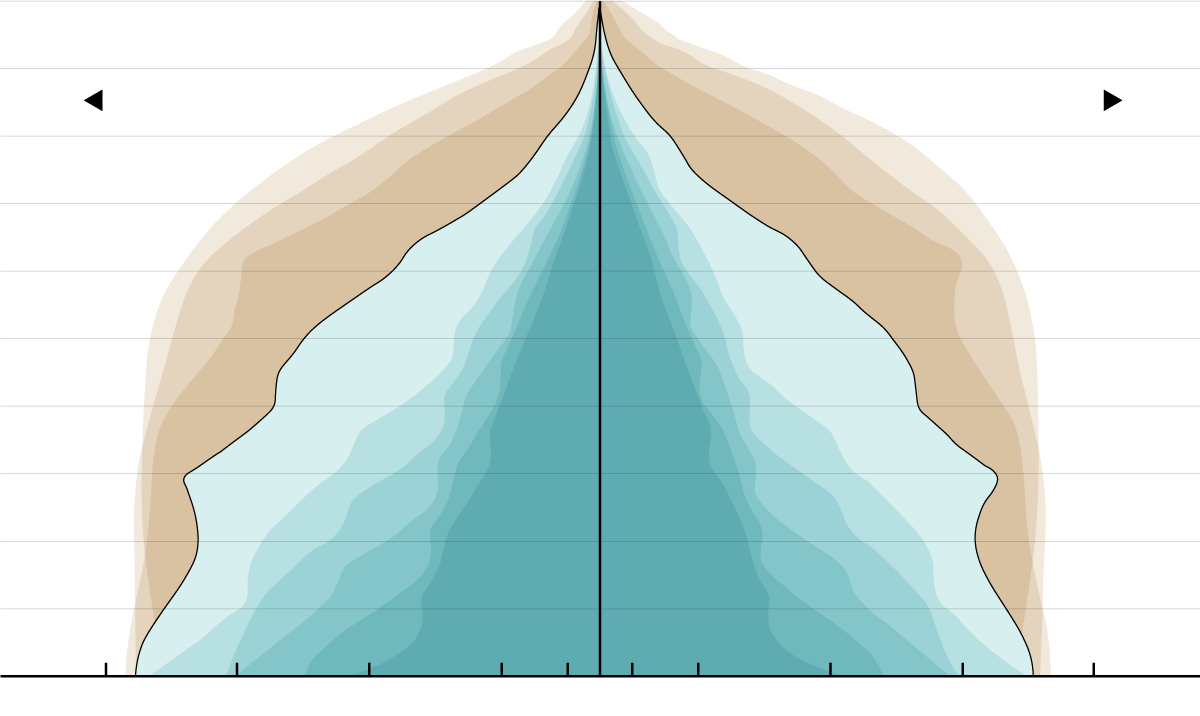
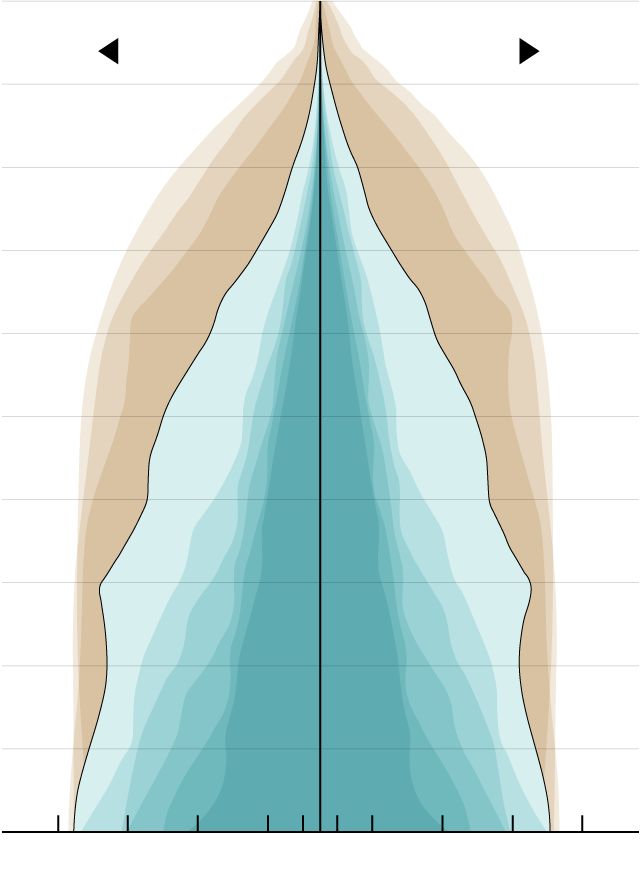
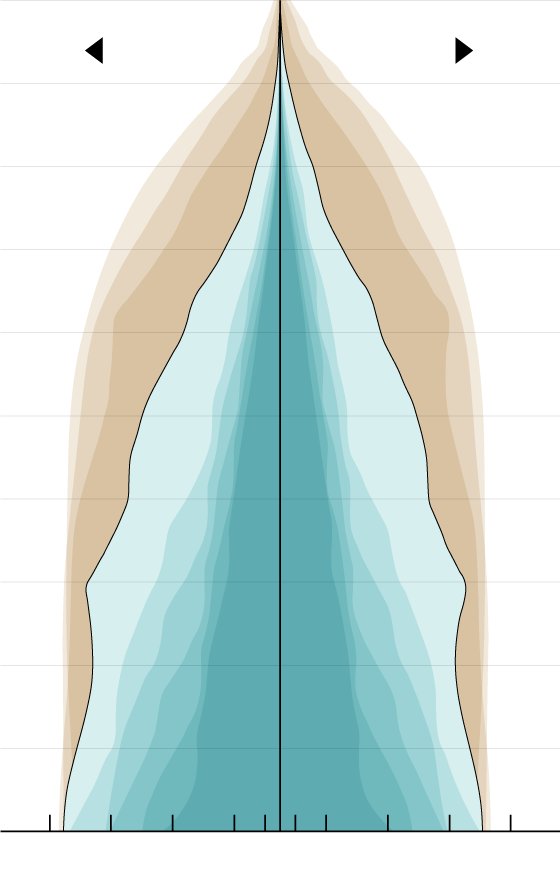
Evolució i projecció de la piràmide de població mundial
L’eix vertical indica l’edat (de 0 a 100) i l’eix horitzontal els milions de persones, segons el gènere
Why does the economy need population growth?
The change isn't just about numbers – it's also about population ageing. In Japan, 28% of the population is over 65. In many countries worldwide, working-age generations are shrinking while social spending on pensions and dependency care rises. "Dementia cases will explode, and consumer numbers – in younger cohorts – will dwindle," Bricker warns, insisting "societies must adapt to these changes as quickly as possible."
Economist Xavier Ferrer sees clearly that many countries will need to raise retirement ages, despite France showing the conflicts this generates. "With rising life expectancy, many elderly spend up to 30 years retired with good quality of life. It would benefit them – and many would want – to extend working lives or undertake meaningful societal activities," notes Ferrer, member of Catalonia's College of Economists. "Population decline has historically been offset by migration," the expert adds. Indeed, in many European countries like Spain, immigration has precisely prevented population decline.
Faced with pro-natalist policies' limited success, Japan also experiments with robotics to replace shrinking workforces or some tasks demand. But Ferrer believes "technology isn't the solution either" due to its high costs, implying "companies and families would face a specific new tax".
Why more births if we face overpopulation?
"No solution exists," remarks Canadian researcher Darrell Bricker fatalistically, convinced population decline "may benefit the planet but harms humanity." Economist Ferrer, however, believes that "current population growth is unsustainable – both for the planet due to resource overexploitation, and for the global dysfunction it creates where some regions grow faster than others".
Amid contradictory views, Jason Hickel (ICTA-UAB) demands radical reframing: "Global population isn't an ecological crisis. We know empirically that 10+ billion can live decently within ecological limits, but it requires systemic economic shifts: slashing meat production, replacing private cars with public transport, reducing inequalities".
"Low-fertility panic stems precisely from capitalist growth struggles amid shrinking populations," Hickel adds. "For 500 years, capitalism demanded population growth – even curbing women's reproductive rights and economic independence. That's a core reason capitalism remains patriarchal".
Impacts of Demographic Change on the World Order
"China is projected to reach 2100 with around 800 million people – a brutal drop", says international relations professor Rafael Grasa. Meanwhile, the United States could avoid decline through immigration, according to demographers, potentially "changing the country's face" and making it more Latin American. Grasa acknowledges demography's geopolitical impact but believes the US-China rivalry will be decided – at least short-term – by other factors.
"Might China cut military spending to care for an aging population? Possibly, but not in coming years given the context," he says. "India will soon be the world's most populous nation, impacting its geopolitical contest with China". Meanwhile, Africa's demographic growth – the youngest continent – "will sustain migratory pressure on Europe", an economic benefit amid Europe's population decline but one that could further fuel populism.
Source of graphics: Our World in Data / Graphics: Eduard Forroll Isanda