Catalan architecture, a fabulous game of balances between reason and passion
A large exhibition at the Dhub reviews Catalan architecture from 1875 through the dichotomy 'Seny i rauxa'

-
CAT -
CAST
- Disseny Hub Barcelona. From May 21 to September 6. Exhibition included in the events of Barcelona World Capital of Architecture.
One of the first projects for the facade of El Corte Inglés on Plaça Catalunya in Barcelona is at the antipodes of the final result: in the center there is a tower lit from within and the entire facade is dotted with triangular windows, like the department store's logo. This project by Elías Torres and José Antonio Martínez Lapeña, who a few years earlier had inaugurated the functional Hospital de Móra d'Ebre, brings to mind the audacity and lyricism of some of Josep Maria Jujol's works. But then, the client planed it down until they reached the austere and restrained project that was actually built. In fact, the same thing had happened to Josep Maria Jujol with Casa Planells on Diagonal, which was supposed to be a decorative explosion and ended up being an almost rationalist building. In both cases, common sense prevailed over impulse.
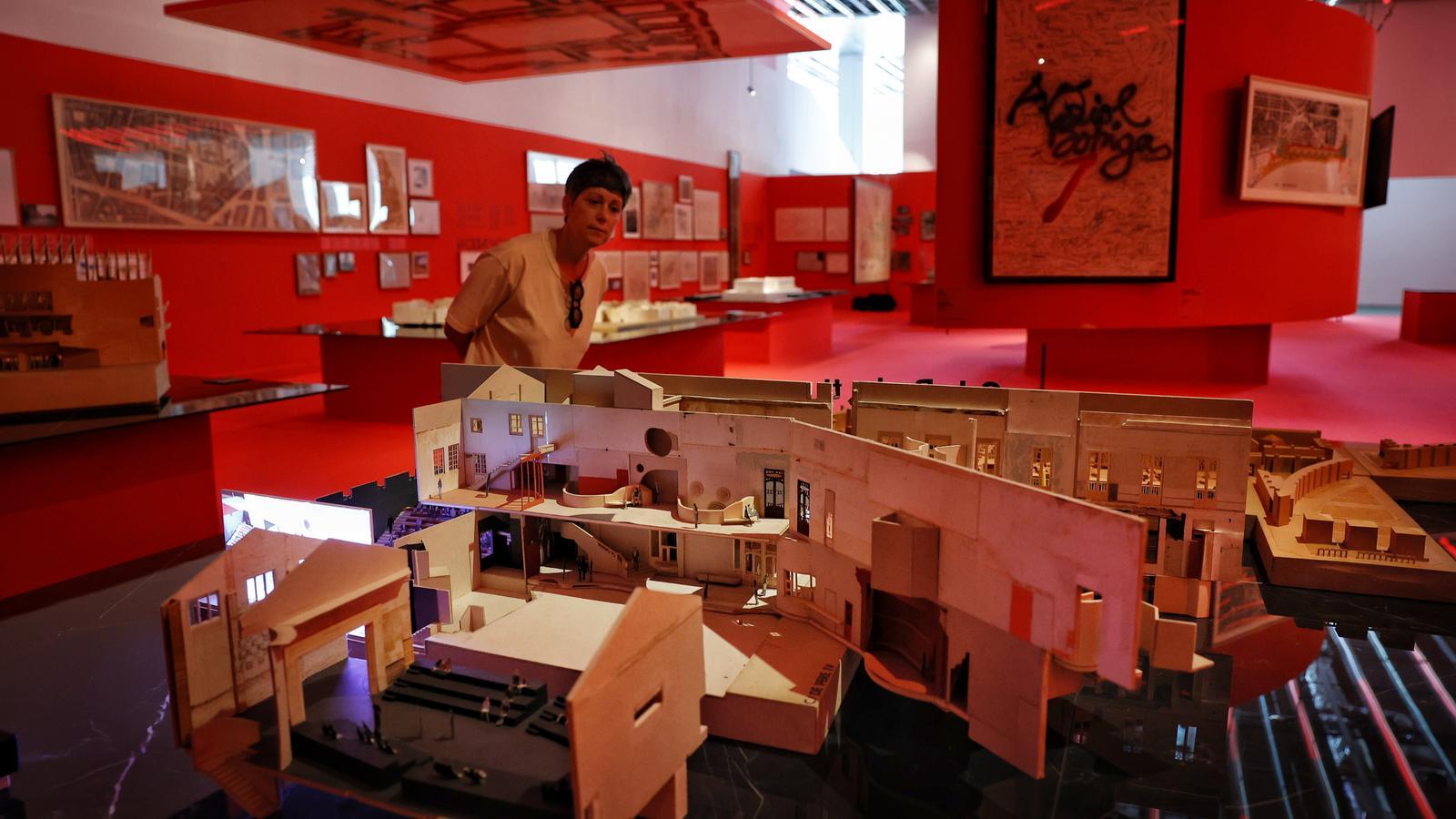
This very Catalan dichotomy between prudence and passion is the cornerstone of the exhibition Seny i rauxa, which the Disseny Hub Barcelona is dedicating starting this Friday to the last 150 years of Catalan architecture, since the School of Architecture was founded. The other key is that the curators, architects Victòria Garriga, Carme Ribas, and Joan Roig, go from the smallest scale to the largest, that is, from objects and furniture – among which is a bed by Gaspar Homar – to urban planning macro-projects like that of the Eixample and the green axes. They also reach utopian projects, such as Ricardo Bofill's legendary Ciutat a l'Espai.
The exhibition is structured into various areas: the room, the house, the apartment buildings, the buildings, the street, the old city, the new city, and the territory. "The exhibition has three objectives: the first is to show in a single space the best of Catalan architecture of the last 150 years; the second is to try to demonstrate that there is a thread of continuity that defines it, and the third is to bring out things that are not normally shown and, therefore, to renew the canon of Catalan architecture," states Joan Roig. "There are two types of canons in Catalan architecture and, in general, in architecture. One is formed by the names: Gaudí, Bohigas, Gatpac, Miralles. They are in the exhibition, but they are like trees that cast a shadow on what is around them, and we also wanted to avoid totems," explains Roig, who for this reason mentions other names such as Alfons Soldevila, Pere Benavent de Barberà, and Raimon Duran i Reynals.

The result of all this is a very succulent exhibition, which deserves more than one visit. The general public will make discoveries and can enjoy more than 500 works, including drawings, models, photographs, documents, and works of art, by the architects who have built contemporary Catalonia. Experts and professionals will be able to debate the selection and review specific cases. For example, the exhibition includes the mythical diorama of the Macià Plan, with the waterfront presided over by skyscrapers. And, from further ahead, three urban planning proposals for the area of the current Olympic Village can be seen: the Ribera Plan, by Antoni Bonet Castellana; the counter-proposal by Ignasi de Solà-Morales, and the plan by Oriol Bohigas's studio that was eventually built.
the landscape restoration of the Vall d'en Joan landfill

The curators would have liked to include more works by Jujol, but the National Museum and the Historical Archive of the College of Architects of Catalonia have them reserved for the Jujol exhibition at the MNAC in November, curated by Perejaume. Roig, who is the co-founder of the Batlle i Roig studio, and Ribas, who collaborates with Pere Joan Ravetllat, have taken the liberty of including a work of their own, both within the territory: the landscape restoration of the Vall d'en Joan landfill and a footbridge in Lleida, respectively. On the other hand, the exhibition is complemented by works by Ramon Casas, Pere Torné i Esquius, Joaquim Vayreda, Joaquim Sunyer, Joan Miró, Pablo Picasso, Antoni Muntadas and Fina Miralles, because according to Carme Ribas there are "crossed influences" between art and architecture.
Very revealing dialogues
Another of the exhibition's premises is that the curators have not followed any chronological or stylistic order. Nor do they recreate a certain history of recent Catalan architecture, in which Oriol Bohigas and his like-minded colleagues play a prominent role, while others played a more secondary role – even so, Bohigas's influence is very evident throughout the tour. What they have done is create groupings of works from different periods, all very eloquent: next to the Arc de Triomf, the photovoltaic pergola of the Fòrum de les Cultures, also by Torres and Martínez Lapeña, an icon of how architects respond to the challenges of today's world. Another of these pairings is formed by a model of the Olympic Village complex, led by Oriol Bohigas, and another of the Sala Beckett, by Flores and Prats. While the Olympic project was criticized because it involved the destruction of the old industrial neighborhood of Icària, a few decades later Flores and Prats are internationally recognized for how they reuse buildings without renouncing any layer of their history. Seny i rauxa. News of Catalan architecture is part of the activities of Barcelona World Capital of Architecture. For the director of the Mies van der Rohe Foundation and member of the candidacy's Scientific Committee, Anna Ramos, this exhibition "lays the foundations for the capital status, and is a lesson on how to explain architecture".
