And what if art could ask questions that science does not consider?
The Difracta festival explores how artistic creation and science can transform our ways of investigating and producing knowledge

-
CAT -
CAST
Barcelona“Art has the capacity to generate questions that science does not consider. We are interested in it as a way of questioning many of the ways in which work is being done in the field of science,” states Pilar Cortada, director of Eina Obra, on the occasion of the first edition of Difracta, the international festival of research and creation that will be held this Thursday and Friday at Eina Bosc, organized together with the Barcelona Art, Science and Technology Hub (HacTe) and the Institute of Photonic Sciences (ICFO). “The festival is born from a concern that we have been investigating for some time: observing to what extent our ways of investigating and creating continue to respond to a construction of the world based on the separation between subject and object, between who observes and what is observed, between who creates and the matter and instruments with which they work,” explains Cortada. That is to say, the way in which one observes and conducts research also conditions what can be known.

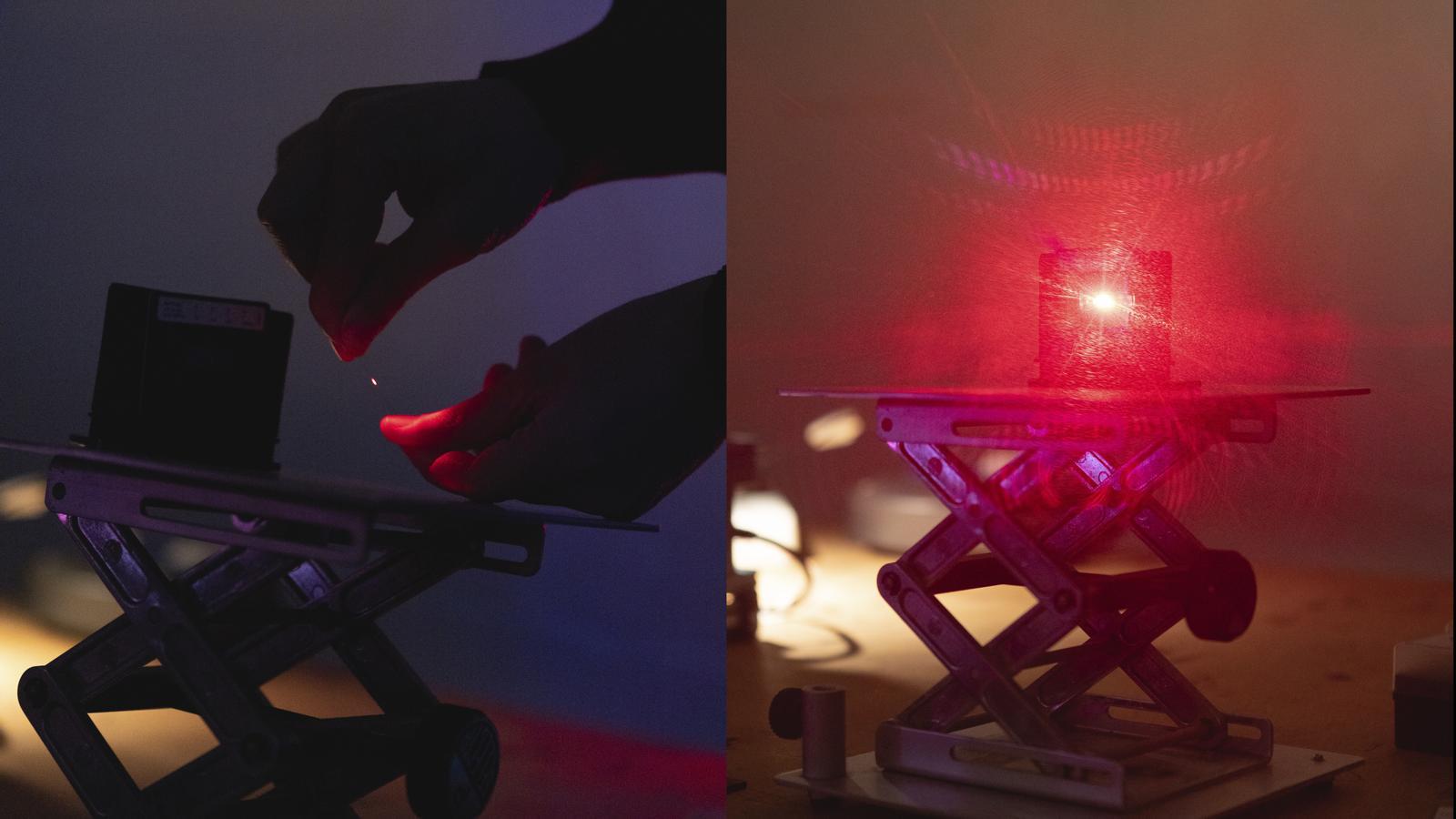
Eina Obra is an initiative of the Eina Foundation that promotes, through design and art, the transition towards socially and ecologically sustainable practices. With this festival, which has the collaboration of Puig and the Spanish Foundation for Science and Technology and the Ministry of Science, Innovation and Universities, it delves into the field of quantum physics. The name of the festival refers to diffraction, a physical phenomenon that occurs when a wave encounters an obstacle or passes through an opening and modifies its trajectory, expanding or deviating. It is a phenomenon that can be observed in light, sound or water waves and that acquires special relevance in quantum physics, where it allows us to demonstrate that particles such as electrons can also behave like waves. This wave-particle duality questioned some of the traditional conceptions about the nature of matter and our way of observing it.
"At the beginning of the 20th century, quantum mechanics transformed our understanding of the physical world by questioning some of the ideas upon which classical physics had been built, especially the possibility of describing certain phenomena independently of the conditions in which we observe them. In the quantum world, what we can measure is strictly linked to the conditions of the experiment," says Cortada. "Instruments are not limited to passively reviewing what happens or reflecting a reality that is already given, but rather they participate in the conditions that allow for the determination of the properties of that which we are observing," he adds.
The festival continues the work initiated last year in a course taught by the philosopher Karen Barad, who has developed the philosophical implications of diffraction and applied them to feminist theories. Thus, diffraction appears as “a way of questioning binary differences, of observing how they are constituted through relationships, and of asking which differences matter, how they matter, and to whom”. “If what we can know is linked to the conditions under which we observe it, to what extent can we separate what we know from the practices through which we come to know it? What changes in our ways of researching and creating if we recognize that the practices we use are not separate from what we investigate and create, nor from the results we produce? From this arises a whole series of reflections, especially ethical ones”, says Cortada. “We must be very clear that, depending on the instruments we use and the questions we ask ourselves, we will arrive at one set of results or another”, she underlines.
Four dimensions of knowledge
The festival is structured around four areas dedicated, respectively, to the epistemological, ontological, methodological, and ethics of knowledge dimensions. Each one will feature a framework lecture given by a specialist.
One of the speakers is Maciej Lewenstein (ICFO), known for his research on the connections between quantum physics and free improvisation jazz. As for Vlatko Vedral (University of Oxford), he explores the relationship between information and matter and considers to what extent information, understood as a more fundamental element than matter, can help explain the origin of the Universe. Evelien Geerts, from University College Cork, has investigated the political evolution of the woke movement, while Femke Snelting works at The Institute for Technology in the Public Interest, an institution that questions who controls the technological infrastructures we use.
On the other hand, art historian and curator Mónica Bello, director of the Dalí Platform and former head of arts at the European Organization for Nuclear Research, will offer the closing lecture.
The creative laboratories
To put into practice the concepts addressed in the conferences, the festival will include four simultaneous laboratories, two more scientific and two more artistic, which will allow applying the ideas to concrete experiences and practices. Among the participants will be artists and architects Pep Vidal, Peter Teunissen (member of Forensic Architecture), Claudia Claremi, Abelardo Gil-Fournier, Antonio Gagliano, María García Ruiz, and Lucía Ángel C. Pino.
Regarding the scientists and theorists, participating will be José Luis de Vicente, elected associate curator of the Supercomputing Center; the professor of physics Josep Perelló; the physicist and professor at Oxford Sonia Contera, and the researcher and theorist Jara Rocha. In addition, the festival includes three artistic and performative activations by Dr. Masharu, a non-binary person who founded the Museum of Edible Earth; the composer and sound artist Reiko Yamada, and the artist Lúa Coderch. All three will explore the festival's questions through languages and formats different from the lecture and the debate. "We are interested in the meetings being transdisciplinary, because this forces us, both from the humanities and from science, to see how we can change our way of understanding the questions we ask ourselves from the moment we listen to the other," says Cortada.
