Assyrian terror, power and knowledge at CaixaForum
The exhibition ‘I am Ashurbanipal, king of the world, king of Assyria’ gathers in Barcelona more than 150 objects from the British Museum
-
CAT -
CAST
BarcelonaKing Ashurbanipal defeating a lion welcomes visitors to the new CaixaForum exhibition, the result of a collaboration between the Fundació la Caixa and the British Museum, which can be visited in Barcelona until March 29th. It is an image of power, precisely what the man who commanded the Assyrian empire in the mid-7th century BC wanted to convey. “The king represents order and the lion, the dangers of forces hostile to the empire,” says Paul Collins, curator of the Middle East department at the British Museum, which is where the 158 pieces in the exhibition I am Ashurbanipal, king of the world, king of Assyria, curated by Sébastien Rey, come from.
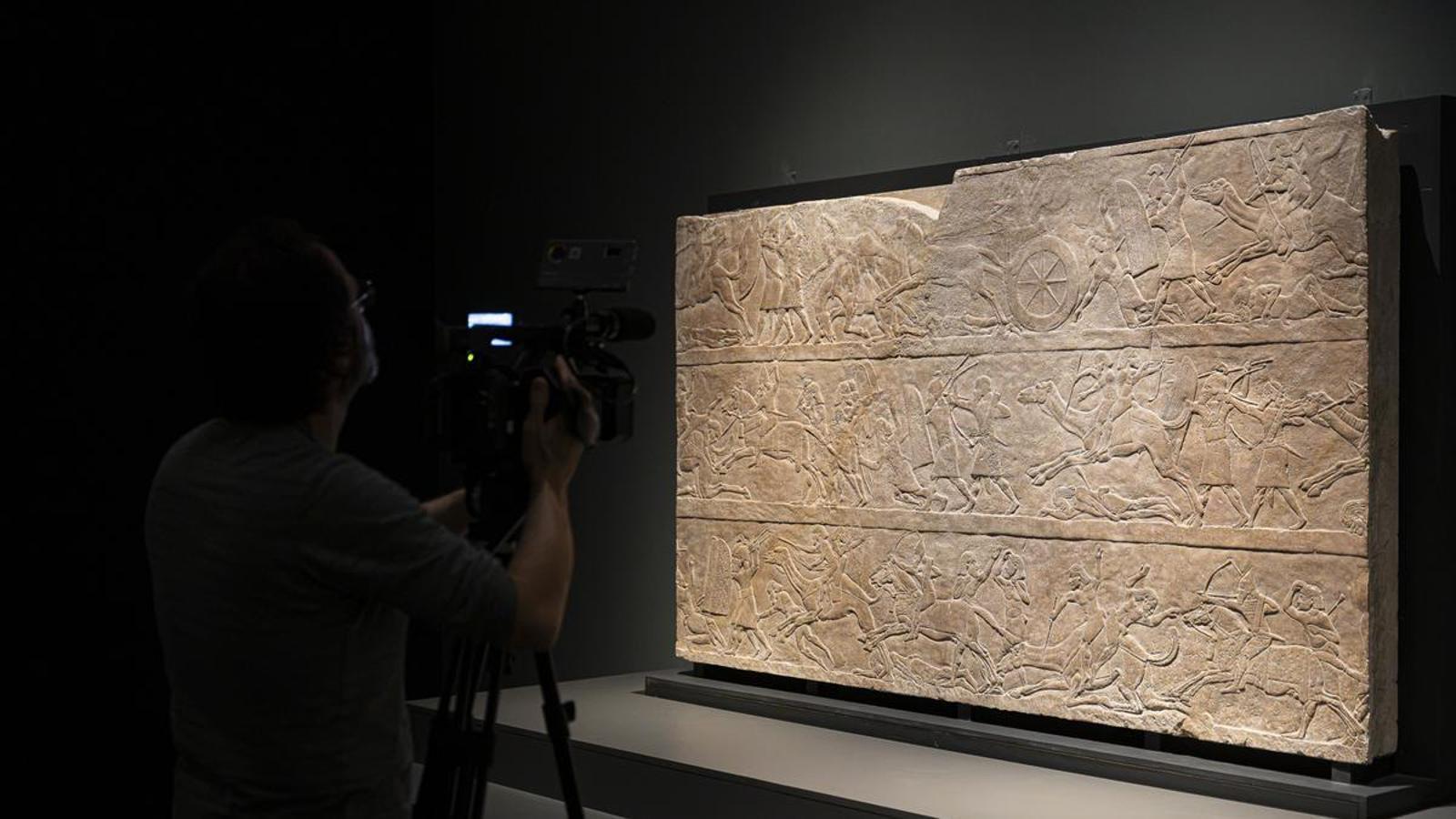
Collins speaks with a serene passion about Ashurbanipal (669-631 BC), the last great Assyrian ruler. He avoids anachronistic headlines and remains faithful to the didactic will with the purpose of profiling a figure who is both fearsome and admirable, “a powerful king and a source of knowledge.” To gauge the scope of the Assyrian empire, which had its heart in Nineveh, in the north of modern-day Iraq, and which stretched from Egypt to the west of modern-day Iran, Collins explains that it was an area that could be “effectively managed with a system of provinces and governors” woven together by roads and in which cuneiform writing was a key tool for detailing the “administrative control of the empire.” However, stability did not fall from the sky; rather, it was achieved through violence and terror, atavistic resources to subdue peoples and dissent. At the CaixaForum, this can be seen in different reliefs, such as the one showing the pursuit of Arab warriors, the one of the sacking of Thebes after an Egyptian revolt, the one illustrating the violence of combat against the Elamites during the siege of Hamanu, and the one of the surrender of an Elamite general surrounded by vultures devouring the eyes of fallen soldiers.
As has happened in other empires, violence and art, terror and scientific knowledge also coexisted in the Assyrian world. "As far as we know, for the first time in history, a space was created in one place that brought together all the knowledge of the era," says Collins about the founding of the library of Nineveh, the great historical source on the Assyrian civilization and where both an edition of the epic poem Gilgamesh and the first medical encyclopedia were preserved. "It is possible that Ashurbanipal saw himself as the new Gilgamesh. According to legend, Gilgamesh was the king of the ancient sovereign city of Uruk and held the title of 'powerful king, without rival,' which the king of Assyria assumed for himself," writes Sébastien Rey in the exhibition catalog. In fact, many of the tablets from the library bear the inscription "Palace of Ashurbanipal, king of the world, king of Assyria," from which the title of the exhibition comes. Everything is explained with great exhibition efficiency, combining large reliefs with small objects, and adding details such as a mini-workshop on cuneiform writing and devices that incorporate polychromy and even animation on some pieces.
Another documentary source is the remains of the Royal Palace, impressive reliefs that gloss the military glories of the king and also his privileged recreation in the gardens with his family, although family relationships were not always a bed of roses. Shamash-shum-ukin, Ashurbanipal's brother and king of Babylon, revolted against imperial power. He was crushed without contemplation, but the seed of revolt remained deposited there.

Before the catastrophe
At the CaixaForum, the 158 pieces are distributed into eight sections that allow for an understanding of the Assyrian world at the moment of its peak splendor prior to the catastrophe. Like all empires, the Assyrian one also collapsed as a result of tensions in the areas furthest from the center, such as Egypt. Furthermore, rivals like the kingdom of Elam knew how to take advantage of moments of weakness. “Only twenty years after the death of Ashurbanipal, the empire fell,” explains Collins. Nabopolassar, on the throne of Babylon since 626 BC, and the general Cyaxares, of the Iranian Medes, allied themselves to attack Nineveh: the city was razed in 612 BC.
The defeat was recorded in classical Greek historiography and in the Bible, in both cases adding a moral perspective, according to which Assyria was punished for the “depravity of its rulers.” Over the centuries, a romantic narrative also took hold in which the last Assyrian king, Sin-shar-ishkun, seeing that Nineveh was lost, immolated himself on a great pyre along with his concubines and eunuchs. It is the scene that appears in the engraving The Fall of Nineveh (1829), by John Martin, which can be seen in the penultimate section of the exhibition, titled Rediscovery.
This last part of the tour, which also includes the epilogue Preserving Iraq's past for the future, could give rise to an entire exhibition. In it, Collins unfolds the story of the archaeological findings that in the 19th century, in a region then under Ottoman rule, turned around the perception of the Assyrian empire, following the excavations of the French consul Paul-Émile Botta and above all the British archaeologist and politician Austen Henry Layard and the archaeologist Hormuzd Rassam, born in Mosul (in present-day Iraq) and of Assyrian descent. The logical tensions associated with the plundering carried out by the British Empire emerge here, with the British Museum as its figurehead. It also recalls the work of Gertrude Bell as director of the Archaeological Museum of Baghdad from 1926 and that of the Iraqi Directorate General of Antiquities after the Second World War which led to the reconstruction of the Nergal Gate in Nineveh in present-day Mosul. And just as in 612 BC violence destroyed Nineveh, in the middle of the 21st century the jihadist group Islamic State destroyed the Nergal Gate as part of a campaign that between 2014 and 2017 affected numerous archaeological treasures in Iraq and Syria. That is why the exhibition ends by highlighting the reconstruction tasks being carried out by the State Board of Antiquities and Heritage of Iraq, in which the British Museum also collaborates.
