The must-sees of the new edition of the video art fair Loop
The Almanac Barcelona hotel hosts until Saturday the works of 34 galleries from all over the world

-
CAT -
CAST
BarcelonaThe new edition of the Loop video art fair arrives, between Trump's defeat in the midterm elections and the next Spanish general elections. In this edition, the works of 35 artists and artistic collectives from nearly thirty countries around the world, represented by 34 galleries, can be seen in the rooms of the Almanac Barcelona hotel. Many are not oblivious to the great global problems, so the fair seems like a kaleidoscope of the images of today's world, between rawness and lyricism. One of the most striking videos is Waves 2.0: Terra, by Memo Akten (DAM Projects gallery), consisting of the image of a wave created with custom code, computational simulation technologies and artificial intelligence that seems apocalyptic.
In contrast, Éric Baudelaire is more subtle: in Sugar Water he documented, for 72 minutes, how a billposting professional puts up and takes down a sequence of photographs representing the explosion of a car bomb on a billboard in the Paris metro. The video is nineteen years old, but the Barbara Wien gallery points out that it is fully relevant. And the philosopher Pierre Zaoui explains that the video evokes the numbing effect that the incessant repetition of the images of 9/11 ended up having. With a price of 80,000 euros, Sugar Water is the most expensive video at the fair. Two of the five copies remain, while the other three are in museums. The most affordable video is The curtain of time [The curtain of time], by Julian Irlinger (Videoart at Midnight gallery), for sale for 980 euros. This artist denounces the political use of animation with a work that draws from the Zagreb School of Animated Film.

Giving a voice to those who have none
Perhaps with more intensity than the last edition, some artists give a voice to anonymous people: at the ChertLüdde gallery, Stephanie Comilang makes visible the harsh living conditions of pearl fishermen in the countries of the Persian Gulf, while the Les Filles du Calvaire gallery exhibits Protesta, the video by Laia Abril made with images of demonstrations in favor of the right to abortion and against sexual violence in Poland, Ireland, Argentina, India, Mexico, and Uganda. In the two-channel video by Igor Grubic East Side Story (Laveronica Arte Contemporanea gallery) there are also protesters: on one hand, one can see archive images of police brutality during the Gay Pride parades in Belgrade and Zagreb in the years 2001 and 2002, respectively. On the other, one can see a choreographed recreation of the events performed by dancers. With this gesture, Grubic wants to introduce “a poetic counterpoint” to violence that is like “an aesthetic act of resistance”.
The ravages of colonialism appear in several videos: in nipēhtēnān kiteh | We Can Hear Your Heartbeat [We Can Hear Your Heartbeat], Meryl McMaster, represented by the Canadian gallery Pierre-François Ouellette art contemporain, recovers the preserved diaries of my great-grandmother Bella to denounce the Canadian system of forced assimilation applied to the Red Pheasant Cree Nation.
Also in the vein of national tensions, the gallery àngels barcelona exhibits Swan Lake, by Saodat Ismailova, another one of her two-channel works. On this occasion, Ismailova brings into dialogue fragments of films from Central Asia and Eastern Europe from the end of the Soviet period and the early years of the post-Soviet stage with documentary images of collective hypnosis sessions led by the psychotherapist Anatoly Kashpirovsky, broadcast on Soviet television in the late 80s. The artist's goal is to delve into the transition period in Central Asia that encompasses the final years of the Soviet Union and the first years of independence for the new states in the region. The title refers to the fact that the ballet Swan Lake, by Tchaikovsky, was repeatedly broadcast on Soviet television during periods of political tension, such as after the death of Leonid Brezhnev, General Secretary of the Communist Party, and during the coup d'état that precipitated the fall of the Soviet Union in 1991.
The museum under suspicion
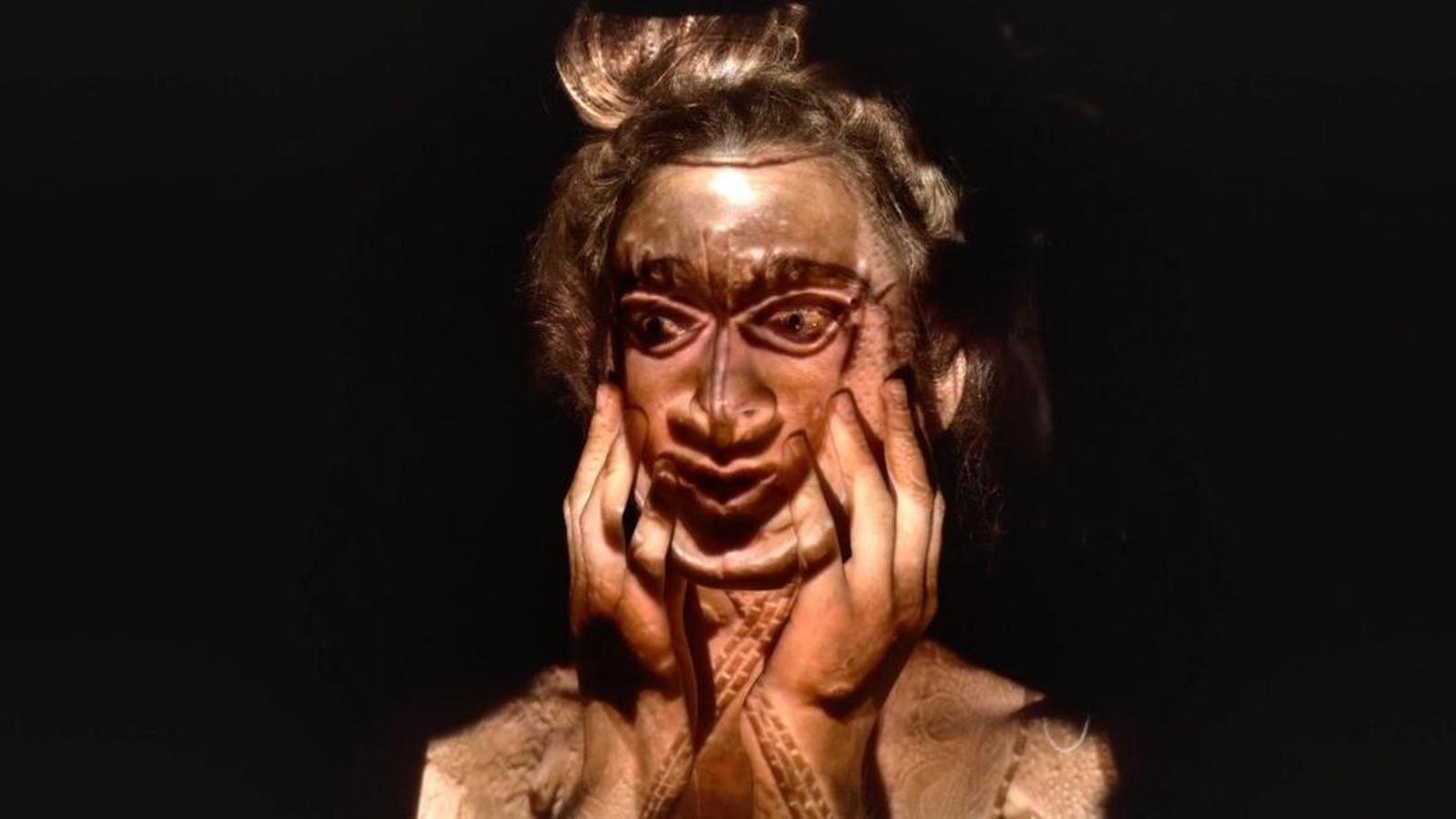
Two of the exhibited videos provide a critique of the museum institution: in Fractured bronzes [Fractured bronzes], Theo Eshetu, represented by the Barbara Thumm gallery, focuses on the diversity of the Benin bronzes by projecting real faces onto a discarded banner featuring five masks representing the five continents, originally produced by the Ethnological Museum of Berlin to be hung on the building's facade. On the other hand, Cromwell / Tunnel / Exhibition Road (Produzentengalerie Hamburg gallery) captures, with hidden camera-like images, the research that the Indian artist Prateek Vijan conducted to plan the fictional theft of Tipu’s Tiger, a wooden automaton preserved at the Victoria and Albert Museum in London, originally looted by the British during the Fourth Anglo-Mysore War of 1799 and considered a symbol of resistance to the empire.
The memory of two role models
In this edition of the fair, new developments coexist with the works of two veterans: the Argentine gallery Rolf Art presents the digitized version of Neapolitan Songs, by the pioneer of Argentine experimental cinema Narcisa Hirsch (1928-2024). After a succession of a series of abstract images, one can see the mouth of a woman with red-painted lips eating a piece of raw liver and, afterwards, a sunset. All of it seems like a punch to the most cloying romanticism.
The Esther Schipper gallery is showing the video Dancing Flames, by the British artist born in Pakistan Ceal Floyer (1968-2025), featuring the projection of two human-scale flames. In this case, the work has a touch of humor: Floyer created the illusion that the two flames move to the rhythm of the songs playing, but, in reality, one flame is the reflection of the other. Among the songs are great hits like Fame, by David Bowie, Feeling good, by Nina Simone and Walk on the wild side, by Lou Reed. “About 15 hits play randomly, chosen by myself, because the idea is that each time the work is exhibited, the songs are chosen by the curator or the collector,” states gallerist Violant Porcel.
“Ceal Floyer was one of the most radical conceptual artists of her generation,” says the gallerist, “and she was recognized for her concise humor and her profoundly subtle visual language. Her works are extraordinarily witty, full of sharp intelligence, subtle irony, and visual insight.” As in the case of the flames, her interventions are minimal, such as changes of scale, small spatial alterations, plays on words, and almost imperceptible modifications, which cause the viewer to have a greater awareness of perception. On the other hand, the Palazzo Diedo in Venice is dedicating a major exhibition to her until this Sunday.
Some artists resist AI, others embrace it
Some of the videos on display bring to the table the impact of AI and new technologies on the art world: while there are artists who reject it, others get a lot out of it. Beyond Waves 2.0: Terra, Under automata, by Eva L’Hoest (Galerie Eric Mouchet), is made from the digital recomposition of scanned images of passengers asleep during a transatlantic flight. The result is a kind of digital sculptural frieze with a tragic air.
At the other extreme, the Senda gallery presents Watch your step (Watch where you go), by Miguel Ángel Ríos, made from the analog animation of a series of drawings and paintings. The title refers to the future that lies ahead and the risk of making bad decisions. The protagonist feet and boots often remind one of artists such as Pablo Picasso and Francis Bacon. Another example of devotion to the analog is PUPIDRAMA – Dalla Notte Contemporanea, by Stefan Panhans and Andrea Winkler (Drawing Room gallery), made with the traditional puppets of the Compagnia Brigliadoro of Palermo. In contrast, the theme is completely current: female characters take the lead to find new paths after realizing that the battles and myths of the warriors, giants, and dragons they live with do not save them from “neoliberal technofeudalism, a new militarism, and the threat of war,” as the artists themselves say.
Be that as it may, the risk that new technologies could have an overwhelming effect is very present: in A_Whole_New_World.me, Klaas Hendrik Hantschel (Heejsteck# gallery) presents a dystopian world of “hybrid humans” where identity and one's own image are defined by algorithms. “Dreams that steal our time, of fame and fortune. And the willingness to give it all up in order to be seen. By whom, you might ask. Mainly, by the machines,” warns the narrator.
