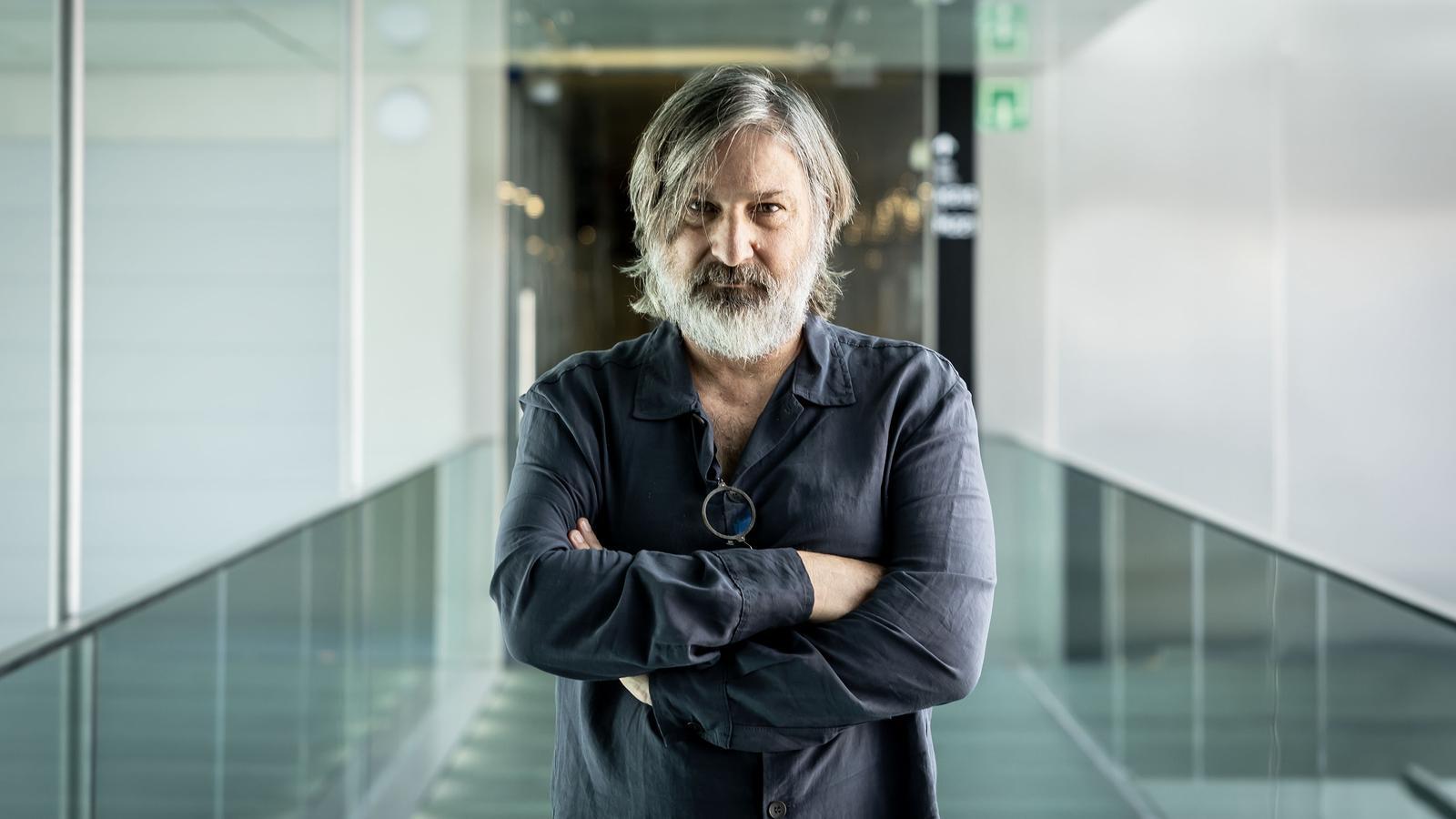
Smiljan Radić: "The political responsibility of an architect is to build a good building"
The latest Pritzker Prize winner speaks of his fragile works at the UIA architects' congress

-
CAT -
CAST
BarcelonaWinning the Pritzker Prize, the Nobel of architects, can be overwhelming. "It was a nice surprise, and it has meant a lot of work, but not architectural work, but rather doing interviews and giving talks," he tells ARA.this year's winner, the Chilean Smiljan Radić (Santiago, Chile, 1965). "It has also brought me a lot of negative things, in the sense that I have had to say no to many things, because I don't have time, and because I don't want to lose certain practices that are important, like designing or sitting in front of a computer to work. Then a kind of mediation, or a game, appears between what reality offers me and what I can really accept".
Radić is very clear that he does not want to change his way of doing things. "There are five people in the office, I don't want to have ten. I can have six, but not ten. There are critical numbers that would be totally different in any other organization, but in an architecture firm they are important. In reality, these are things that happen naturally, because I can't do them any other way," he assures.
The Chilean architect is one of the most exceptional winners in the Pritzker's historical roll of honor: the jury awarded him for works that are "at the crossroads of uncertainty, material experimentation, and cultural memory." "His buildings seem temporary – the citation also says – unstable or deliberately unfinished, almost about to disappear, and yet they offer a structured, optimistic, and discreetly joyful refuge that embraces vulnerability as an intrinsic condition of lived experience.
Architecture and poetry
Radić was in Barcelona on Wednesday to participate in the World Congress of the International Union of Architects (UIA). At a time when architects are seeking solutions to major global challenges, Radić might seem like a poet or an alchemist. "Imagination and poetry remain in the design, which is an integral part of the problem. If desired, design can promote a different reading of reality, but it can also re-promote the one that has been repeated 20,000 times," he explains. "I don't believe that all terms like sustainability, ecology, and collectivism are global, but rather particular. They depend on each context, on how society functions. What I'm saying is very obvious and evident, but it's not always taken into account. And it's not possible to apply the same regulations, the same ways of seeing the world regarding design, everywhere and in the same way," he warns.
And in a world as turbulent as today's, what role should architects play? "As an architect, one must have a certain political awareness as a citizen. I love the discipline very much, but I don't know if 'Let's give power to architects' is a good slogan; perhaps in some places it is," he points out. "I always say that the political responsibility of an architect must be to build a good building, anywhere and as well as possible. A building is an artifact that must function well in a given environment and context, and create an imaginary that people can inhabit in a good way," Radić concludes.

Among Radić's best-known works are the House of the Right Angle Poem and the 2014 Serpentine Gallery pavilion. Both resemble giant shells, without any apparent specific use. "I don't like the adjective transgressive, because it sounds like I want to violate something, and, in reality, I do what I do because it's the only thing I can do. It's not a pretense. I'm not interested in achieving something rare, special, or strange. It's not that I'm looking for a slogan or a recognizable way of doing things, it's just that I can't think any other way," he assures.
The Barcelonian project of the Pritzker
One of the projects that Radić has in hand is in Barcelona: the new Multifunctional Hall at Fira de Montjuïc, together with Miquel Mariné, Beatriz Borque and César Rueda. "Projects are like a kind of game. First, there is the baggage you carry, your obsessions and prejudices. On the other hand, the inputs that come from the context. And you interpret this personal baggage in a certain way for a certain client. In this sense, the world is quite inescapable. Not in a catastrophic sense, but it is what is given to you, and you have to face it and know how to navigate it. Architecture does a modeling job," explains Radić.
Regarding the Fira de Montjuïc hall, one of its objectives is that "the urban fabric enters the building, and that it is not a blind box in the middle of the city." In fact, Radić is still discovering the Catalan capital. "Barcelona continues to be a mystery; I come here and get lost. It's not that I have a clear idea of the city, I don't know the neighborhoods, I don't know them, but I know that I walk and that I can get lost here with considerable tranquility. For that very reason, I think it's a very good city. Although it has nothing to do with it, it gives me a similar feeling to London".
Curiously, the first architecture magazine in which Radić was the subject of a monographic issue was the magazine El Croquis, dedicated to Enric Miralles and Carme Pinós. Later he met Benedetta Tagliabue and made his own copy of the Ines-Table. "That magazine was extremely important, it interested me as something that produces strangeness and attracts me sensually, emotionally. Then I wanted to connect with Enric Miralles, more as a fan, but without being a fan".
The Barcelona-based publisher Puente Editores has published two collections of Radić's writings. Habitaré mi nombre (2022) talks about collective housing in Chile as "abnormal" architecture, an idea that can be applied elsewhere. "In general, technical standards for insulation, sun exposure, neighbors, and public infrastructure are requested, which are part of architecture, but are not architecture – points out Radić–. Nor are they architecture as a final result, but as a starting point." These requirements reflect how governments address the issue of public housing from a quantitative rather than qualitative perspective. "Each home is a refuge that accommodates the unique way of life of a particular person, even if they can be standardized," says the architect.
