Audur Ava Ólafsdóttir: "An appendicitis attack at 10,000 meters can be inspiring"
Writer. Publishes 'Rosa Candida'

-
CAT -
CAST
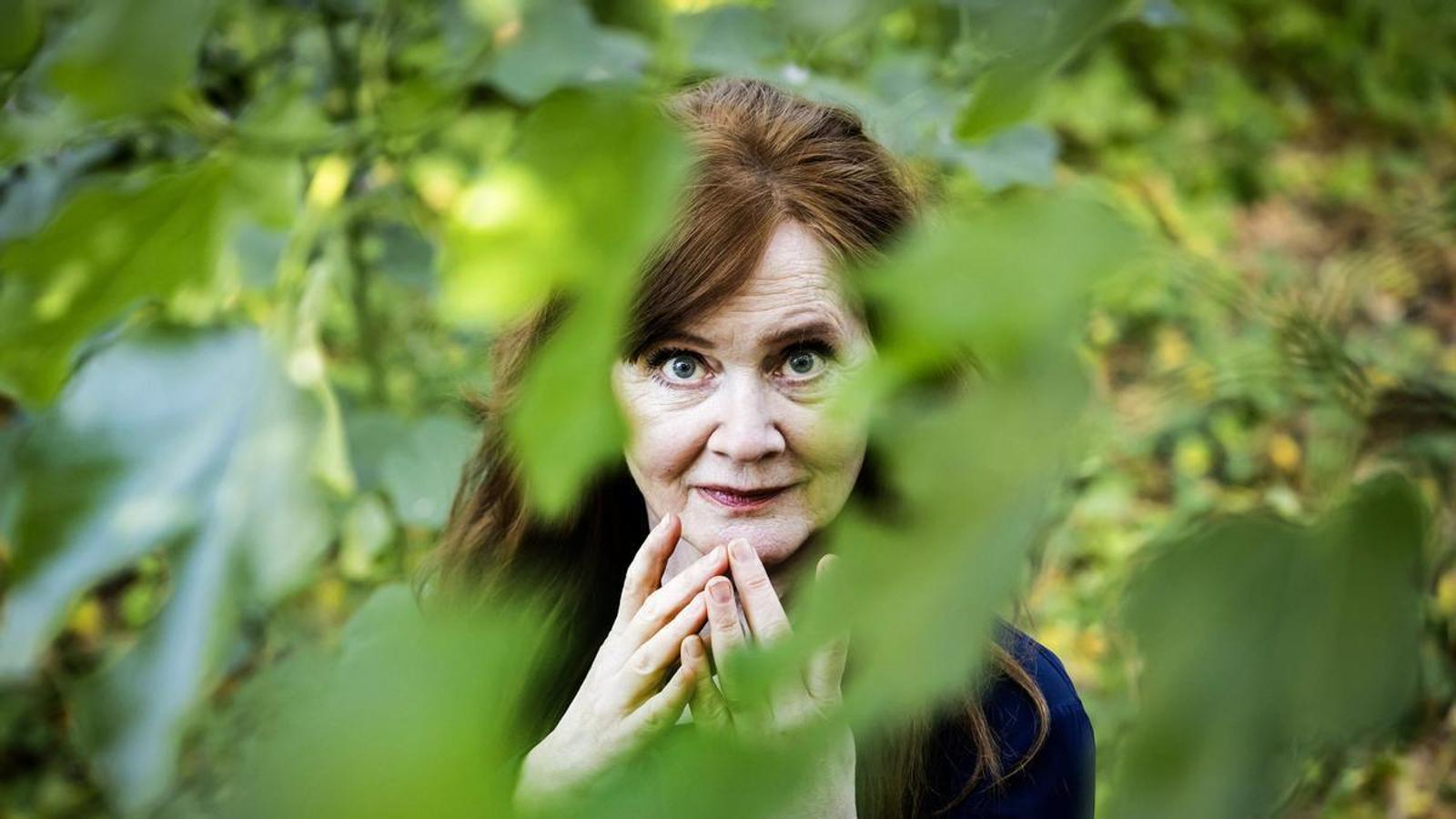
BarcelonaEven with the memory of having lived "the unforgettable experience" of her first Sant Jordi, Audur Ava Ólafsdóttir (Reykjavik, 1958) strolls through the garden of Club Editor, the publishing house that has already published three of her unclassifiable novels, where an unwavering faith in the human race shines. Accustomed to the volcanic landscape of Iceland, Ólafsdóttir cannot help but marvel at the ease with which trees and flowers of all kinds grow in southern Europe, the setting of her best-known novel, Rosa candida –available in some thirty languages–, until now unpublished in Catalan, translated by Macià Riutort, as well as La veritat sobre la llum and Edèn, with which she won the Llibreter prize 2025.
"This experience I've had in Barcelona doesn't happen anywhere else in the world," acknowledges the author, who has come after a tour that took her through countries like Canada, Norway, and France. Published in 2007, Rosa candida tells the story of Lobbi, a 22-year-old Icelandic young man, traveling to a monastery that houses one of the best rose gardens in the world, with the aim of restoring its lost splendor. The boy is the father of a nine-month-old girl, but he has barely seen her, and with the mother, he only had a one-night stand. The distance from family and country will cause Lobbi to begin to reconfigure his feelings and discover his true priorities.
If there has been a book in her career that has been considered an editorial phenomenon, it has been Rosa candida. What do you remember about the novel's international journey?
— What happened to me with this book was an absolute surprise. Everything I have written, I have done thinking of a single person, the invisible imp sitting on my shoulder.
I remember we had talked about it when, a long time ago, Alfaguara publishedThe Exception (2014).He told me that if he only had him "he would already be happy".
— The first translations of Rosa candida, which in Icelandic has another title, The Tear, were into Danish and French. Without anyone being able to foresee it, the novel became a success in France. From that moment on, it has been translated into more and more languages, and there are already about thirty.
Why do you think he captivates so many readers around the world?
— During promotional trips and presentations, I have received some interesting answers to this question. Once, a man told me that Rosa candida had found something missing in his life. Now that I have experienced my first Sant Jordi, which has been an unforgettable experience, and I say this with my heart in my hand, I leave convinced that literature allows us to build bridges between people: thanks to reading, we can know how others live and think.
Just like in her novels, she always knows how to see the bright side of reality.
— Literature makes it possible for us to live many lives. It allows us to travel without leaving home.
How did the story of Rosa candida begin?
— It occurred to me more than 20 years ago. I wanted to write a book about the paternity of a young gardener. After spending a few hours with a stranger in her greenhouse, she gets pregnant and meets him to explain that she will have the creature.
At that time you were approaching 50 and had published barely two novels.
— I was never a young prodigy. I skipped that stage. In fact, I didn't start writing until I was 38. Perhaps I started late because the books I had inside were shaped by existential issues. I needed to have had certain experiences and to have suffered before I could get down to it. Even when you have a happy life, your soul suffers. If you want to write, you have to learn to feel compassion for others. First you need to grow, change, learn some things about yourself and the world.
Before writing, he studied art history in France, right?
— Yes. For a time I even thought in French. It was from France that I began to rethink the possibilities of my mother tongue. It was as if I had become a writer long before I published anything.
But it took a long time.
— You leave Iceland to return. Then, once you are back home, you rethink many things.
How was Audur Ava who started writing Rosa candida?
— I was going through a delicate moment. I had just divorced and was taking care of my two daughters alone, because my ex-husband had left Iceland for work reasons. Perhaps for all these reasons I started to think about a young and attentive father and a mother, also young, who needs more freedom. Quite a few readers have told me that they would have loved to have a partner like Lobbi, someone who knew how to take care of them, who cooked well and respected their decisions. I was making a book where there was something that was missing in my life, as that reader would tell me years later.
Do you think there are more young fathers like Lobbi, nowadays?
— I would say that in one generation things have changed quite a bit. One of the comments I liked most from Catalan readers these days is that they find Rosa candida to be a novel about trusting others.
Would we be better off in life, if we were less distrustful?
— We live in a world where politicians use fear to control citizens and where the arms industry is increasingly powerful. People suffer more and more. In contrast to this reality, in Rosa candida I spoke of a young man who was innocent but not naive, because Lobbi is intelligent: he believes there is no reason to think that others are bad by nature. I remember a Danish critic compared Lobbi to Prince Mishkin from The Idiot by Dostoevsky, who also did not see evil in others.
The story the novel explains is that of a simple journey that begins to get complicated from the start. When he is on the plane, Lobbi starts to feel very ill, and as soon as he gets off, they have to rush him to the hospital and operate on him.
— This is a very personal detail that ended up having to do with the conception of the novel. At the beginning of the century, I came to Barcelona to curate an exhibition of Icelandic artists. It was during that trip that the chapter in which Lobbi and Anna conceive their daughter in a greenhouse occurred to me. Before I started researching more about the lives of those two characters, something happened during the trip back.
Don't tell me it was an appendicitis attack, like the character's...
— Yes. I was on a plane full of Icelandic artists, and I, as the art curator, was supposed to lead them, but I kept feeling worse and worse. I remember myself crying in pain at the back of the plane. I had to have emergency surgery when we landed. This is the most autobiographical link between Rosa candida and me.
Despite the discomfort he felt, he was able to include it in the novel.
— An appendicitis attack at 10,000 meters altitude can be inspiring.
Between this and the story of the greenhouse, Rosa candida began to take shape.
— It was a time when I was very busy. Besides taking care of my daughters, I taught art history at the University of Reykjavik. I squeezed in time to write whenever I could: in the afternoons, on weekends, or when I had a few days of vacation.
It is describing my life.
— It is a stage that many writers have had to go through. I remember that, for years, on my way to university, I used to pass by the house of an Icelandic writer. I saw him every day sitting in front of the window, working on one of his books. He was a good author. I dreamed that one day I too would get up first thing in the morning and be able to start writing one of my novels.
Did it happen thanks to the success of Rosa candida?
— No. This didn't happen to me until 2019, when I retired from the university.
Do you write all day now?
— I get up very early and get to it. Sometimes I wonder if I should stop at four in the afternoon, because I could go on and on... One of the good things about having had a professional life outside of writing is that I've learned to organize myself very well. While I'm thinking about the novels, I don't forget the practical matters of life.
One of the peculiarities of his novels is that his characters have family very much in mind. In Rosa candida, for example, Lobbi leaves, but is in contact with his father and with Josef, his autistic brother.
— There are many twin brothers in my literature. The idea of the double has always attracted me. In the case of Rosa candida, Josef is autistic: he cannot tell lies and is always silent. At the same time, Josef likes to dress well and is always very elegant. Lobbi's father is an older man who misses his wife, who died a year earlier in a car accident. He takes care of his two sons as best he can. It is true that the idea of family is central in the novels I have written, and this departs from much contemporary literature, which is focused on solitary characters, without many ties, who ponder philosophical ideas about their lives.
Sometimes the protagonists are young, but he has a weakness for elderly characters. This happens here, but also in The Truth About the Light.
— In the novel I will publish in Icelandic this autumn, one of the main characters is 103 years old and still has plans for the future. She is the protagonist's grandmother. They live together.
How is it that Lobbi, who has had no relationship with her daughter, agrees to take care of her as soon as her mother, Anna, suggests it?
— At first he is not aware of his responsibilities, but he quickly accepts them. Being a father must be a very abstract matter. A mother has physical contact with the creature from gestation, because she feels it growing inside her. A father is different. Furthermore, if we think about Lobbi, he doesn't even know he got Anna pregnant... But one day he receives a call from her to meet. He goes to the cafeteria and finds that she, instead of ordering a coffee, has a glass of milk. This is when he begins to suspect that something is wrong. It is not the only case where a man learns about his future paternity this way. In fact, the story I tell is based on that of a friend of mine.
Did your friend also take care of the creature?
— Yes. He shared custody with the creature's mother, but they were never together, except on the day of conception. Luckily, both became good friends and, later, they got married, each on their own. He has always had a good relationship with this daughter, and now that the girl – who is a visual artist – has made him a grandfather, he picks up his grandson from daycare every Friday. They are a close-knit family, in their own way.
Sometimes, reading a book of yours gives us the feeling that what happens in it is better than what we have had to live in the real world. This young and attentive father could have neglected the girl. In fact, you yourself had recently divorced when you were writing Rosa candida, but instead of writing a novel of revenge against men, you wrote one of love. Why?
— In real life I am more pessimistic than within my novels. In fact, each of my books has been born out of a specific situation of despair. In Rosa candida there was the personal issue, in Edén it was climate anxiety. The world is not as I would like, but I refuse to be crushed by dark forces. Life is simpler than they tell us: we need to eat, a bit of fun, and peace. We also need hope. Even when we know things won't go well, we need to believe they will. It's like the character of the father in Roberto Benigni's Life is Beautiful, a film I found marvelous. The father invents that everything that happens inside the concentration camp is a game, even though he knows that sooner or later he will be killed. Above all, he wants the child to survive.
