The National Court places Zapatero as "leader" of an influence peddling scheme and attributes to him commissions of two million euros
The judge believes that he "would have put" his "personal contacts" and his "access capacity" to high-ranking officials of the administration at the service of third parties

-
CAT -
CAST
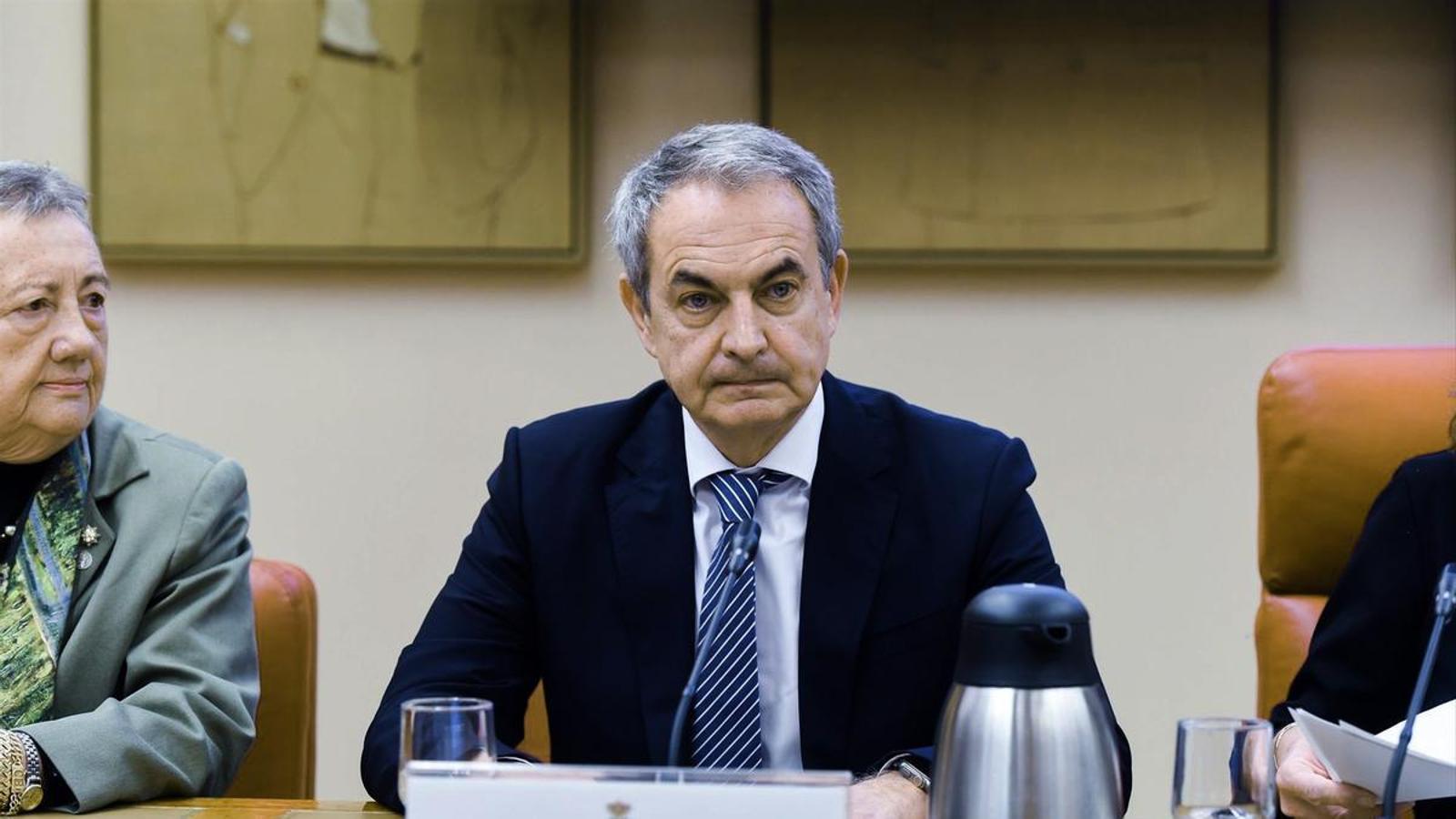
MadridThere was an "organized scheme of illicit exercise of influence" and a "stable and hierarchical structure" that was "led" by José Luis Rodríguez Zapatero and that had the purpose of obtaining "economic benefits" through "intermediation and exercise of influence before public bodies in favor of third parties." This is the conclusion reached by a judge of the Audiencia Nacional to indict the former Spanish president for the alleged crimes of criminal organization, influence peddling, and document forgery and to summon him next Tuesday, June 2, within the framework of the Plus Ultra case. In a ruling of 85 pages, José Luis Calama considers that Zapatero "would have put" his "personal contacts" and his "access capacity" to high-ranking officials of the administration at the service of third parties interested in "obtaining favorable decisions." The judge calculates that Zapatero would have received 1.9 million euros in commissions through three companies: one and a half million directly to him and 400,000 euros to What The Fav, his daughters' marketing company.
According to the judge, his role was to "select clients, give instructions to create companies in off-shore territories, and adopt strategies to formally disassociate from the structure." It will be the first time a former Spanish prime minister has to testify as an investigated person in a criminal corruption case. What is under scrutiny are possible illegal commission payments in exchange for the €53 million bailout that the Spanish government gave to the airline in March 2021 and alleged maneuvers to launder money from Venezuela.
José Luis Calama has also ordered searches at the former prime minister's office and at three companies, including What The Fav. The investigation was initiated following a complaint filed by the Anti-Corruption Prosecutor's Office against seven individuals for an alleged money laundering offense, pointing to a supposed criminal organization based in France, Switzerland, and Spain. Until now, the case was under summary secrecy, as the judge considered it most convenient to "avoid incidents" that could affect the investigation's objective and taking into account the "gravity of the facts." This is evident from the order issued this Tuesday to lift the secrecy, to which ARA has had access, which also lists the crimes being investigated: misappropriation, influence peddling, money laundering, and membership in a criminal organization.
Former Spanish prime minister José Luis Rodríguez has defended his innocence. In a video sent to the media, he assured that all his private activity "has been carried out within the law" and guaranteed that he "has never carried out any action related to the Plus Ultra bailout." He also stated that he has never owned a company "I will exercise my right to defense with all firmness and all conviction" —reports Núria Orriols Guiu.

Who was Julio Martínez Martínez?
The key figure is Julio Martínez Martínez, a businessman and friend of Zapatero. He is the one he used to go running with and who was arrested five months ago. According to the investigation, his companies "channeled" the "economic considerations" that were directed to Zapatero and his "closest circle" –his daughters– through "ad hoc consulting or advisory contracts" that were used as "mere documentary justification". The "direct and indirect payments" came from Plus Ultra and other companies.
The judge also argues that the "triangulation of payments" and the intervention of straw men "reinforces the appearance of a structure designed to hide the origin and destination of the funds". Likewise, Julio Martínez Martínez acted as "habitual interlocutor for the network's clients" and acted as "receiver and executor of direct instructions" from Zapatero. José Luis Calama speaks of an "international corporate and financial structure" that would be "designed to channel funds of illicit origin, hide the real ownership of assets and move capital outside the territory".What three influences did they try to exert?
What three influences did they try to exert?How was the capacity for influence made evident?
How was the influence capacity demonstrated?What did Zapatero defend in the Senate?
Two and a half months ago, José Luis Rodríguez Zapatero appeared before the Senate's investigation committee on the Koldo case to explain himself. And he denied having any connection: "Nobody asked me for anything, I didn't do anything, nor was I interested in the bailout," he said. However, he did admit that he received money from Análisis Relevante, the company of Julio Martínez Martínez, of which he is a consultant and which is at the epicenter of the judicial investigation. He recounted that it was his friend who proposed hiring him and admitted that he earns an average of 70,000 euros gross per year as a freelancer. "It's a market price that, logically, takes into account the consultant's career, personality, and ability," he defended.
What money laundering is being investigated?
What money laundering is being investigated?Political reactions
The opposition to the Spanish government has not waited at all to react. According to popular sources, after the cases that splash President Pedro Sánchez, the Zapatero case is another proof of the PSOE's "corruption". "Zapatero is the muse of sanchismo and this muse is charged in the National Court", they have assured, before adding: "The principle that links the last two presidents of Spain from the PSOE is corruption". In their opinion, without taking into account the presumption of innocence, "the honor of being president of the government is incompatible with the indecency of having the rank of fixer".
For its part, the Spanish government has come out in defense of Zapatero. The executive's spokesperson, Elma Saiz, has called for the presumption of innocence to be preserved and has said that she has the same affection for Zapatero as the right-wing has animosity towards him. "He defeated them. His mandate meant the greatest social transformation of our country and he also defeated ETA", she declared. Furthermore, she added that he exercised a "loyal and clean opposition", something that the PP —she said— is not complying with.
In turn, the PSOE defends the presumption of innocence of the former Spanish president. Party sources express "calm" and "respect for justice". In this regard, they recalled that during the two legislatures he was president, "pioneering" advances were made in rights and equality: "The right and the far-right have never forgiven the advances of his mandate". The organization secretary, Rebeca Torró, and the spokesperson Montse Mínguez have gone further. "It is what he can do to the maximum expression", said Torró, alluding to what José María Aznar said to fight against the Spanish government, while Mínguez sentenced on X: "They will not stop".
