Alba Aguilera: "Salmon is pure advertising!"
Fisherwoman and shipowner

-
CAT -
CAST

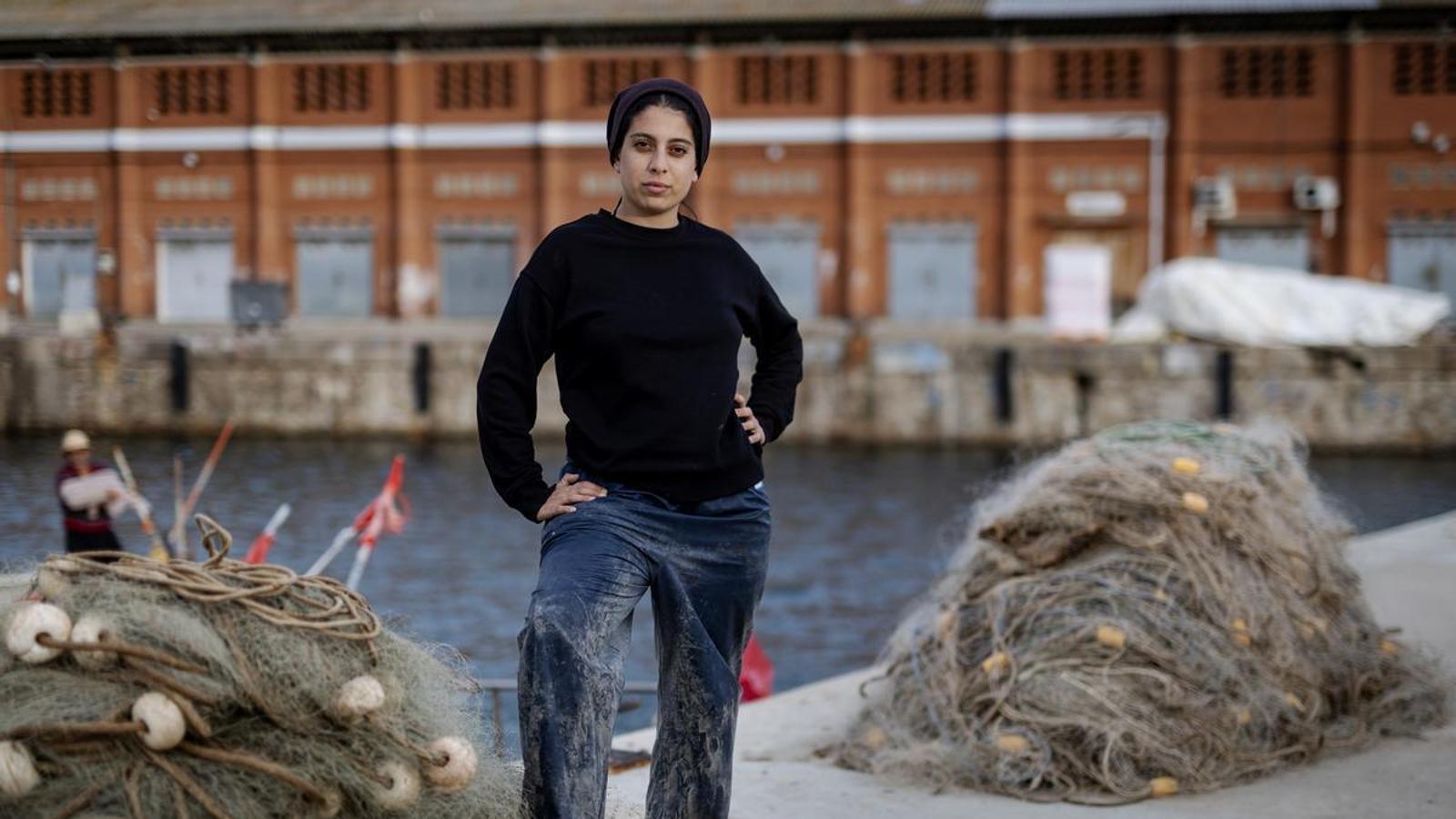
On WhatsApp you see her as a little girl, hugging her father, who is holding a sea bass bigger than her. The generational shift in fishing is the topic that most concerns Alba Aguilera, a gillnet fisher and boat owner who, at 25 years old, is the youngest in all of Spain. This youth has led her to be a modern fisher, who promotes her trade on Instagram and TikTok, where she has more than 100,000 followers, and participates in Xarxa Oberta, a project that connects art, science, and community to reconnect Barceloneta with its fishing heritage.
What did you do this morning?
— I got up at four in the morning, we went out to catch hake, then we tried for a while here, at the breakwater, we came to shore at one in the afternoon, we had lunch and at four in the afternoon we sold all the fish. Now we will have to lift all the net and head back home.
What kind of fishing do you do?
— The trammel net, a type of artisanal fishing, the most sustainable one that exists. With my father, we are the last two trammel netters left in Barceloneta.
Why is the craft dying?
— First, because the numbers don't add up: I sell monkfish for six euros a kilo at the auction and at the fishmonger's they sell it for thirty. It's not fair, because the ones who go out to sea and risk their lives are us. In the past, my father would make a day's wage with twenty pieces [a piece is a section of net]; today, with eighty, he doesn't reach it.
What else has changed since father's time?
— Climate change is very real: it tells me things that I have never seen before. And the treatment plants: in the past, the waters carried nutrients that attracted octopuses, sea bass, clams… Now we all want to bathe in crystal-clear waters, but, for them to be that way, the water comes down with chemicals that kill all of that.
And the neighborhood?
— La Barceloneta has lost its essence. When I was a child, you would find fishermen and net makers on the street; the port had its huts open. But now La Barceloneta is touristy and that atmosphere is not liked, because they are poor people. People prefer the Hotel Vela or a yacht to appear in the photo rather than the fishermen.
And what about the many immigrant fishermen?
— We have a very good relationship with them. Without immigrant labor, we would not be able to go out and do the work.
Now I will provoke you: what comes to your mind when you see people buying salmon at the market or ordering it in restaurants?
— Salmon is pure advertising! We have more than 250 species of fish in the Mediterranean and people are eating a foreign species? And they are the same ones who later fill their mouths talking about local products and zero-kilometer food.
What should we eat?
— A good hake, an amberjack, which is in season now, or a gilthead sea bream. And, if you are more posh, a prawn, a Norway lobster, a lobster...
Is there no overfishing in the Mediterranean?
— That word is nonsense! How can there be overfishing if 80% of the Barcelona fishing fleet has been lost? Fifteen years ago there were sixty-eight trammel net boats; now there are two of us. This talk of overfishing is only said by people who do not work at sea nor know it.
Are the scientists and marine biologists who say so wrong?
— No. We fishermen work in a sustainable way. We are the first who want to take care of the sea because we make a living from it.
Well, the European Union is once again asking you to go out fewer days for Christmas.
— They are wrong. We need solutions, dialogue with the sector and real alternatives. We cannot continue imposing restrictions year after year without providing stability to the families who make a living from fishing. The problem with fishing is not just how many days they allow us to go out to work. The problem is the constant uncertainty.
What should we know about fishing that we do not know?
— People do not realize how hard it is. When people go to the supermarket they focus on the product, but they do not see what is behind it.
Why do you do this if it is so hard?
— Any fisherman will answer you the same: because it is in my blood, I have seen it at home since I was a little girl. In my home, there has always been talk of the sea and fish. I am in love with the sea, and your boat is your second home.
Are you worried about being the youngest fisherwoman in Spain?
— It is very serious that there is no generational renewal. Will my generation be the last to dedicate itself to this and will fishing die afterwards? How will we feed ourselves when no one works in the primary sector anymore?
You have tried to combat it by promoting the craft.
— I wanted to bring fishing to young people, and I thought TikTok was the right tool. I have been gaining followers and I already have more than one hundred thousand.
What is the most surprising thing on social media?
— That I am a woman. In the world of fishing, it is still said today that a woman on board brings bad luck. But my boat earns a living exactly the same as the others. What has been hardest for me is being called "fisherwoman": until two years ago, they still called me "fisherman".
Any reason for optimism?
— Together with the Oceanographies collective, we held a workshop to bring the trade to the people: how to rig nets, how to cast them, preparing signaling buoys... It had been a long time since I last saw the port so full of young people. Just as in school you are prepared to be a doctor, teacher, or astronaut, children should be prepared to be farmers, ranchers, or fishermen.
