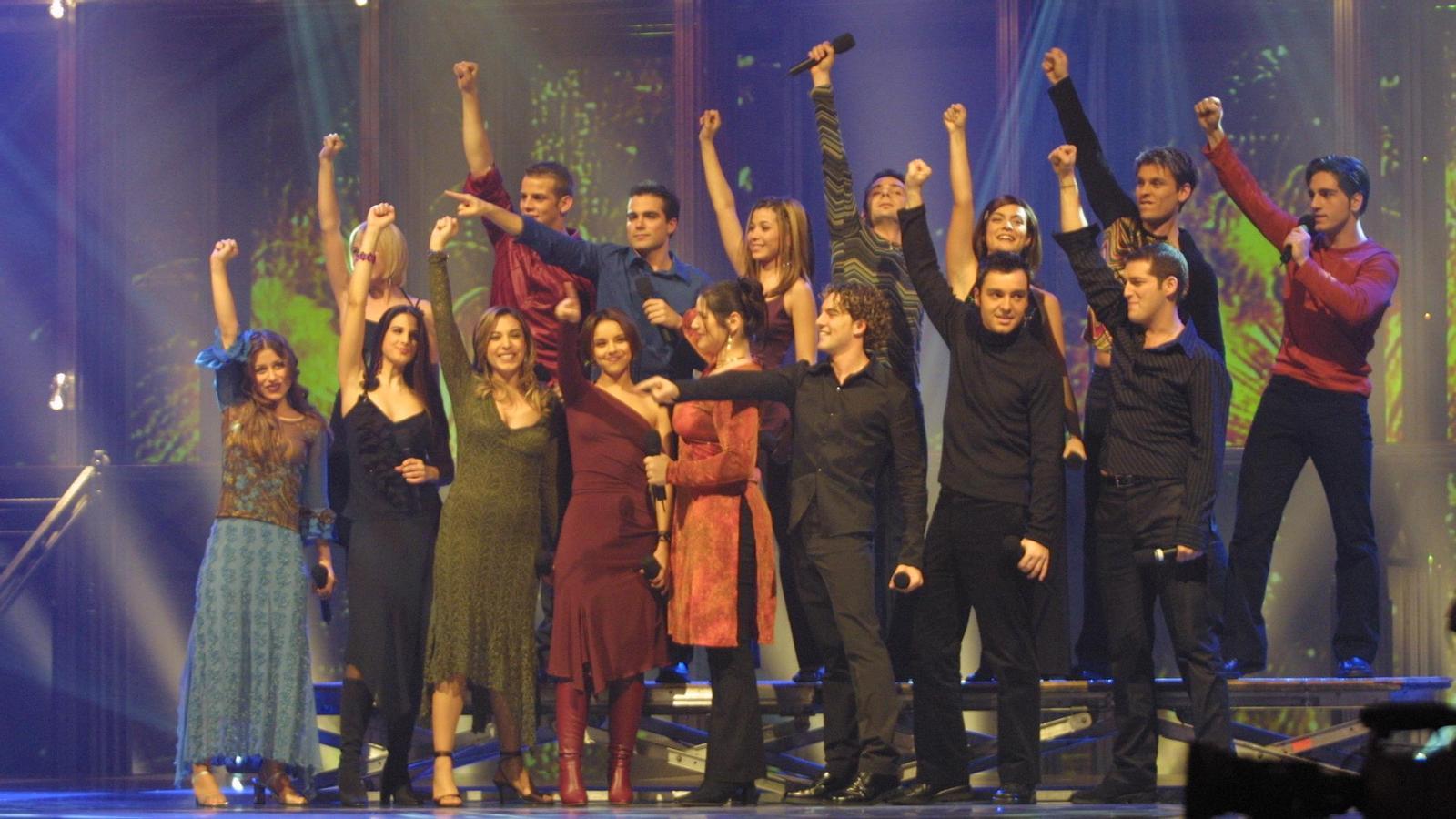
Barcelona"Cross the catwalk!" It has been 25 years since this television cry became popular. It was one of the key moments of every broadcast of Operación Triunfo, the talent show that revolutionized Spanish television and music and that this October celebrates a quarter of a century. On the night of October 22, 2001, TVE kicked off a new format that mixed elements of the reality genre, which was just beginning to emerge, and musical contests. After the third gala, when the phenomenon exploded, nothing was ever the same again, neither on Spanish television nor in the lives of the sixteen young contestants who had signed up for the program with the hope of making a career as singers.
Operación Triunfo was a creation of Toni Cruz and Josep Maria Mainat, founders of the Catalan production company Gestmusic, and they gave a twist to the idea of televised coexistence, which had become fashionable a year earlier with Gran Hermano, the first reality show that had premiered in Spain. "One of the things that was criticized the most about Gran Hermano when it came out is that it was people who were locked in a house doing nothing. They came from the world of musical creation and they thought 'gosh, instead of being locked up doing nothing, maybe what we should do is have them locked up for a purpose'," explains Tinet Rubira, who was the director of the galas of the first edition. Thus, Cruz and Mainat, who had a musical past with La Trinca, and who had already done musical contests like Lluvia de estrellas, decided that the objective should be to improve as artists and that the confinement should not be totally hermetic, but rather that each week there would be a gala and the contestants would play for their continuity within a training academy.
David Bisbal, Rosa and David Bustamante, the three winners of the first editionEFE
After 25 years it would be very easy to say that success was easy to predict, but the reality is that at that time not even some of those involved in the project, like Rubira, were sure that it could work. The reason? The music industry was not at its best and music, in general, was not attractive for television. In fact, before ending up on TVE, Gestmusic offered the program to Antena 3, which rejected it with the argument that at that time musical programs were not liked. "It was much more than a musical program, but they couldn't see it," explains Josep Maria Mainat. "At the beginning of 2000 there was the problem that records were not being sold: there were leaks and you could download them without paying anything. On one hand, the record industry was not going through its best moment. On the other, television-wise, it was a time when there had been a lot of abuse of musical performances in playback and everyone said they were not interesting. Even on TV, there was talk of something called the Phil Collins effect, which meant that when people saw musical performances they would leave to take a pee," explains the current director of Gestmusic. What made it succeed, despite everything? A casting that stole the hearts of the viewers.
Innocent contestants
David Bisbal, Chenoa, Rosa, and David Bustamante signed up for Operación Triunfo without knowing what real impact it would have on their lives. They were young people of very different origins and profiles, from the orchestra singer, to the bricklayer and the girl from a humble family who helped at her father's rotisserie. Most of them had a powerful story behind them, a narrative that could make them connect with the viewers. "Rosa López was a unique case: a girl who had never left her home, depressed, with no personal spirit, who when she opened her mouth sang like an angel. Bisbal and Bustamante were good, but the one who surprised us was Rosa, and people fell in love with her," says Mainat. However, Rubira asserts that when they were chosen in the casting directed by Noemí Galera, they were not looking for there to be a story in each one. "They all had a story to tell, but the goal was for them to sing. This has always happened to us. The primary goal is for people to sing, because what do you do in a singing show if you don't sing? The first thing we have to do is sing and sing well," he argues. Musical talent was important, but the personal component was not superfluous: one of the keys to the program is the 24-hour follow-up of the activity inside the training academy which, in that first season, was directed by Nina.
Fans supporting Rosa López.JUAN FERRERASNúria Fergó escorted by the police.RAFAEL MARCHANTE
Operación Triunfo was not an immediate ratings success. The first gala obtained a 22.1% share and 2.7 million viewers, figures that at the time were not considered especially good, although nowadays, with more fragmented audiences, any program would kill to have such numbers. "The truth is that the first and second galas passed without much notice. It was from the third one onwards that this falling in love occurred. The public discovered the characters we had, they discovered our contestants. They fell in love and the audience curve went like a rocket, upwards," recounts Rubira. The third gala reached a 33.3% audience share and 4.9 million viewers. The final gala, broadcast in February 2002, had almost 13 million viewers and a 68% share, figures that at that moment made it the most-watched program in the history of Spanish television. That audience record was surpassed a few months later by another broadcast that also carried the stamp of Operación Triunfo: the performance at Eurovision by Rosa López, winner of the talent show, which reached an 85.2% audience share.
"When you make a program you always hope it will be a success, but the thing is that OT was not just a success: people went crazy. It broke all records for audience and social impact. The country was not talking about anything else but that program. Nothing like it had ever happened and it hasn't happened again," says Mainat. For the team behind the program, the social phenomenon was also a learning process that was done "on the fly," as the creator of the format admits. "I don't remember any particularly difficult moment. Things happen and you solve them, especially because when 16 young people live together, issues always arise: some fall in love, others fight. In the end, they were all very good people," he says.
The director of the Operación Triunfo Academy, Noemí Galera (l) during a casting held in Zaragoza, to select the contestants for the 2025 edition.Javier Cebollada/ EFE
"We were a production company that was already making musical products and all that, but we were not prepared to manage a social phenomenon of these characteristics nor the thousand and one requests we received from that moment on. All the mayors in Spain wanted the town's main festival to have contestants from OT", explains Rubira, who details that at that time the production company had neither a marketing department nor a commercial department. Nor did it have a management agency that could manage the contestants' careers. "We had initially thought that, once they left the program, there would be some record label that would sign one or two contestants. But all 16 contestants had interest. Something very huge happened. An entire infrastructure had to be created that went far beyond TV production", he recalls.
Impact on the music industry
However, the passion for the program was not shared by everyone. Many well-known faces from the struggling music industry firmly criticized the format because they considered that it monopolized the record market and because they did not agree with the discourse of success that they believed it fostered. Some of those who complained at the time, such as Alejandro Sanz, ended up warming up to the program. In November 2002, a few months after the first edition of OT had ended and the second had begun, several artists signed the manifesto Otro timo no, promoted by the association Journalists Specialized in Music, Leisure and Culture (PEMOC). The text called for a boycott of OT and was signed, among others, by Ramoncín, who later ended up being a judge on the contest. At the time, he explained that the manifesto was against TVE and not against the format.
Mainat assures that, despite the initial criticisms, the program contributed to revitalizing the music industry. "When OT came out, practically no records were being sold; not even the most established singers were selling records. And Operación Triunfo sold millions of records and a new audience was created, which the music industry has lived off ever since," says Mainat, who admits that the success of the first edition was "excessive" and the industry could not handle it. "They said: 'It cannot be that these kids come out of the television and take away our jobs, those of us who have been working all our lives'," he recalls. The monoculture, however, gradually diluted and, finally, the market ended up rebalancing itself, explains the creative.
"Operación Triunfo" members David Bisbal and Chenoa during the Disney Gala held in Barcelona in 2002Lluis Gené/ EFE
A program that has been a social phenomenon and has created stars like David Bisbal and Aitana is also accompanied by urban legends and controversies. In 2005, Gestmusic managed to stop the publication of the book OT. La cara oculta, written by journalist Wayne Jamison and in which the mother of Naím Thomas, a contestant from the first edition, participated. The production company requested precautionary measures because it considered that it could "damage the honor and good reputation of the program." One of the recurring rumors that the book supposedly explained was that the evictions were decided in advance and that the program favored some contestants over others. "Things are much simpler and much more transparent than people think. Sometimes the contestants' relatives say, 'It's just that they don't promote my child as much.' And you think: 'Let's see, you yourself are saying that this is a business; if a record label can have three Bisbals, do you think it will give up having them?'", reflects Rubira.
When the fan ends up being a friend
The show changed the contestants' lives, but also those of some viewers. Francesc Moreno was 13 years old when 'OT' began airing and his world was turned upside down. He fell in love with Rosa López, winner of the first edition, and became one of her main fans and defenders to the point that today they are friends. "'OT' changed my life, it swept it away. After so many years I have understood that the show, in the most beautiful way possible, filled a void that existed in my life. What started as fanaticism for Rosa has ended up being a beautiful friendship in which we have both grown together," he explains. He assures that thanks to the show "I made friends, I traveled, and I lived many adventures."
In his first years as a fan, he remembers "having done many crazy things." "From taking taxis after the contestants to find out which hotel they were staying at to sneaking into the airport. The truth is that I feel very lucky to have chosen 25 years ago a person who is a special support in my life. There are people who choose soccer; I chose Rosa," he explains.
The heirs
Beyond the ratings, 'Operación Triunfo' paved the way for Spanish television in terms of the types of formats that were encouraged from that moment on. Its influence reaches to the present day.
'Popstars: Todo por un sueño'
Just a few months after the end of 'OT', Telecinco launched its own musical talent show. In this case, the ultimate goal was to create a female pop group. The twenty girls who entered the program received training as singers at the so-called Music Workshop. Each week, a participant was eliminated until five remained, who were given the opportunity to join a girl band and record an album. The program had only one season and, therefore, only resulted in one group, Bellepop, which was active between 2002 and 2004. In 2020, they made an attempt to return to the musical forefront. However, in Catalonia, the most well-known name to emerge from 'Popstars' is Roser, who was not part of Bellepop.
‘Supermodelo’
In its eagerness to capitalize on the reality genre, Cuatro adapted America’s next top model, a program that followed criteria quite similar to those of OT. The program offered a training center for girls aspiring to be Spain's representative in the Elite Model Look contest. Each week, there was a gala in which the aspirants played for their continuity at the center. The format had three seasons, and from the first one emerged names that are still well-known today, even if not as models. This group includes Alba Carrillo, who has converted into a presenter and contributor for television programs, and Paloma Bloyd, who has made a career as an actress.
‘Fama, a bailar’
In 2008, Cuatro launched an artistic reality show. In this case, the goal was to find the best dancer in Spain. The contestants lived together in a house-school where they received training in three dance styles – funky, street dance, and lyrical – and their daily lives were followed minute by minute. Sundays were the day of the weekly gala and elimination. Curiously, the winner of the first season, Vicky Gómez, ended up becoming part of the 'OT' universe: in 2017, she joined as a teacher at the academy. The program had several seasons and remained on air until 2011.
'Eufòria'
One of the programs that has received the most comparisons with OT is the TV3 talent show. In fact, in 2023, Josep Maria Mainat and Toni Cruz filed a lawsuit against the program and the Catalan Corporation of Media Audiovisuals (CCMA) for plagiarism. Ultimately, the court dismissed it.