Leave the house to the bones: a radical intervention in the heart of Palma
Can Gabriel. TED'A Architects. Jaume Mayol and Irene Pérez (Palma)
-
CAT -
CAST
Can Gabriel is a house that explains how it is made. Also how the building in the historic center of Palma where it is located is made. The radical intervention carried out by the architects of TEd’A, the team led by Jaume Mayol and Irene Pérez, is explained through an architecture that turns construction processes into part of the daily experience of living. This is a work that claims the beauty of bare materials, of joints, of seams, of textures, and of visible imperfections. And it shows that, sometimes, a good way to transform a space is to start by leaving it to the bones. This project has become one of the most celebrated works of recent Spanish architecture: awarded at the XVII Spanish Biennial of Architecture and Urbanism, distinguished with an award by La Casa de la Arquitectura, finalist of the FAD 2025 awards, and selected for the Mies van der Rohe awards.
But beyond the awards, what makes this intervention unique is its quiet radicality. A way of understanding architecture that does not consist of adding layers of sophistication but, paradoxically, of removing them (perhaps to reach another kind of sophistication).

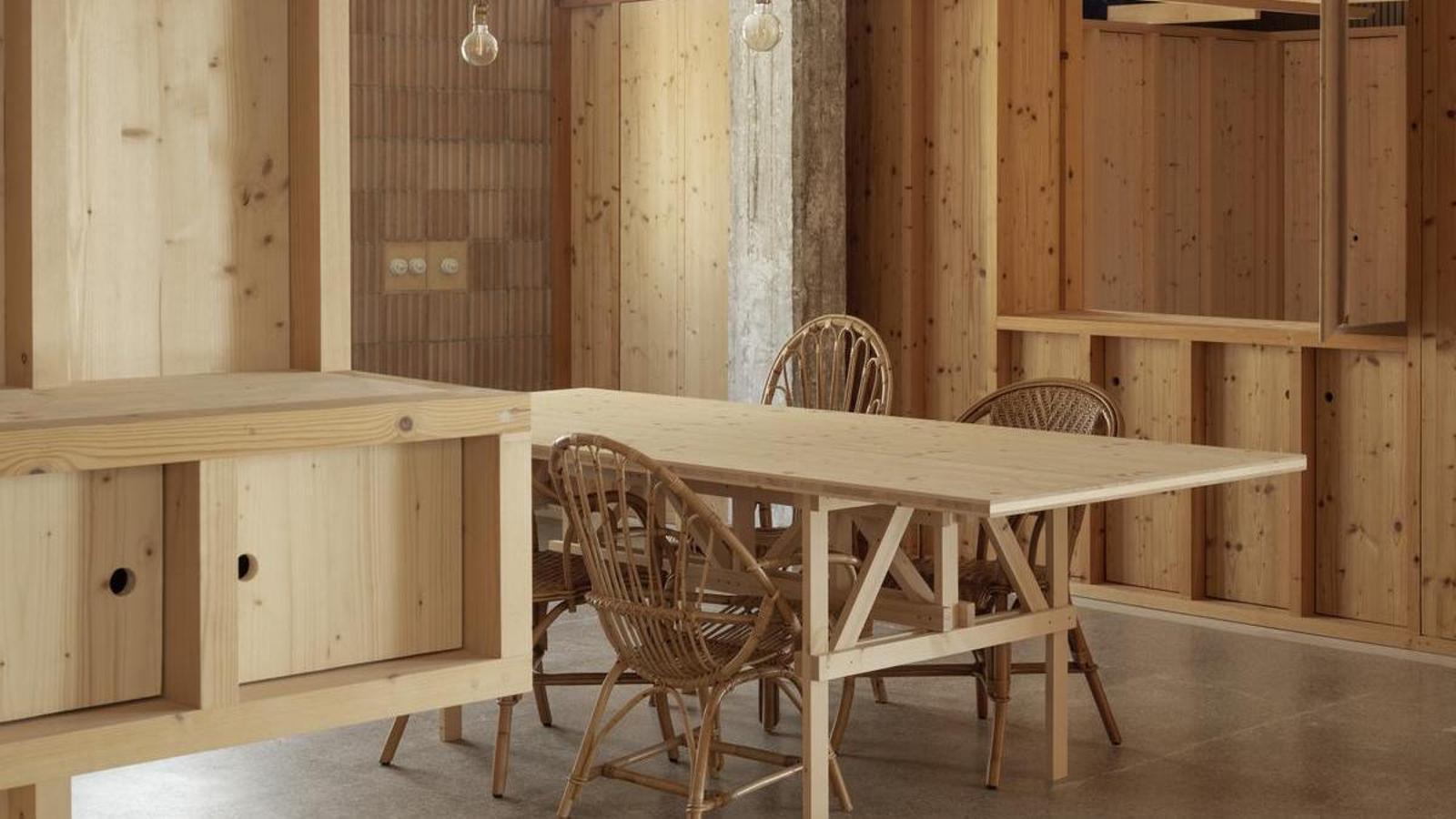
When the TEd'A team entered the apartment, they found a practically empty space. A dwelling from the sixties, around 160 m2, reduced to its structure, facades, and basic installations. And instead of rebuilding it according to conventional schemes, they decided to go even further in stripping it down. The concrete structure is left completely exposed, without cladding or makeup. As if the house had its skin removed and was shown flayed. This gesture marks the entire intervention. Nothing is hidden here. The materials are shown as they are and explain their function. The perimeter walls are insulated with cork and covered with ceramic pieces placed in an unusual way. The teeth of the blocks face outwards, creating a rough texture that turns the walls into tactile surfaces.
The floor also preserves the memory of the previous dwelling. The existing concrete pavement is polished, and the scars left by the old layouts are sewn with marble pieces. It's not about hiding the wounds but making them visible. The same logic extends to the smallest details. Switches and sockets are not recessed into the walls but placed on top of them. Electrical installations are shown without complexes. Lighting is achieved with simple bulbs connected to visible cables that run along the ceiling through brass tubes. Everything is part of the architectural language.
In the middle of this large, bare container, there are three wooden pieces that organize domestic life. They are the boxes that house the rooms and the most private spaces. Made of fir, light and independent of the structure, they look like objects placed inside the large original volume. Here too, conventions are turned upside down: their structures are visible on the outside, while the linings are reserved for the inside. These boxes, however, do not divide the house into closed rooms. Between them appear large diagonally connected spaces that form the common areas: kitchen, dining room, living room, or workspaces coexist in a single domestic landscape, flexible and changing. The dwelling leaves room for daily life to complete it.
