Jonathan the tortoise is the longest-lived animal known, but only in the terrestrial world. Greenland sharks can live for more than three centuries and perhaps more than four. In 2016, a study was conducted on 28 females of this species that had been caught accidentally, and one was found that, according to radiocarbon dating of its eyes, was 392 years old. The margin of error for the dating, however, is 120 years, which means it could have been between 272 and 512 years old. But the living animal considered the longest-lived is one that, in fact, never dies, or at least not from aging: the immortal jellyfish. With the scientific name Turritopsis dohrnii, this jellyfish has the ability to revert its cellular cycle indefinitely, so it never ages.
Jonathan, the 194-year-old tortoise that can help us live longer
Scientists study the DNA of the longest-living land animal in the world, a tortoise from the Seychelles islands

-
CAT -
CAST
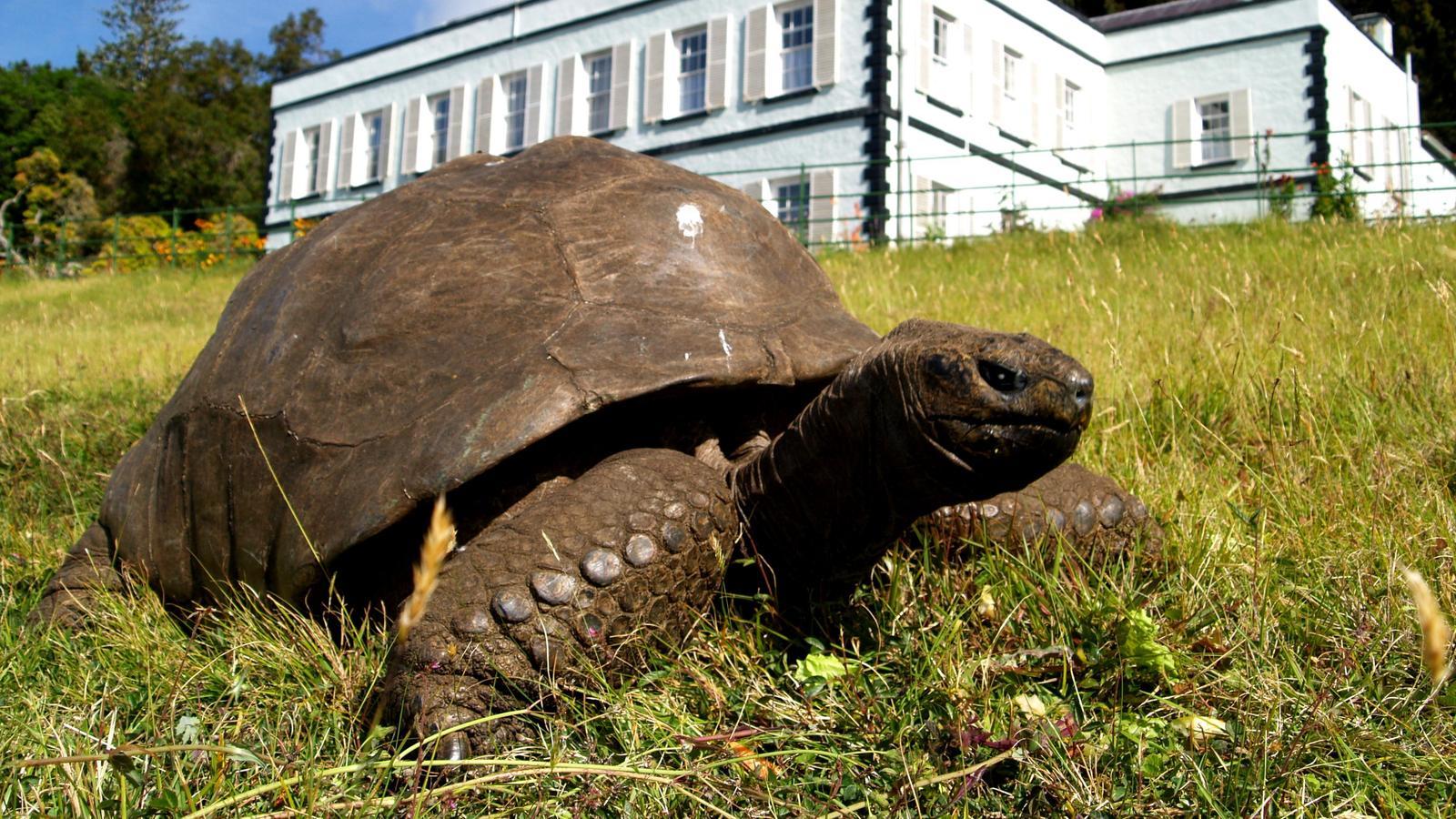
When Jonathan was born, Charles Darwin was only 23 years old. This giant tortoise of the Aldabra species is the longest-living (terrestrial) animal in the world known to date. It is 194 years old and still today it walks, at a very slow pace, through the gardens of Plantation House, which is the residence of the governor of Saint Helena, one of the Seychelles islands. It has lost its sight and sense of smell, and it must be fed (basically lettuce and carrots), but it is still active and weighs about 180 kilograms. Now, scientists have studied its DNA to try to extract data that will help us live longer.
Its date of birth, officially recognized as December 4, 1832, is an approximate calculation. It is known that it arrived on the island of Saint Helena in 1882, as a gift for William Grey-Wilson, a British colonial administrator who would soon become the governor of the island. It is believed that at that time, when it settled to live in the gardens of the governor's residence -where it still lives today-, it was already 50 years old. And we are talking about 144 years ago. At that time, giant tortoises were beginning to be seen as scientific curiosities and that saved it from the fate that condemned several species of turtle in the area: hunting on the high seas as food for sailors.

Aldabra giant tortoises (Aldabrachelys gigantea) are especially long-lived animals, but Jonathan's case exceeds all expectations. For this reason, an international team of scientists wanted to analyze his DNA and published the results in the journal Science Advances. They collected samples by scraping the inside of his cheek, to avoid pricking him.
The study confirmed that Jonathan's metabolism is much slower than ours, and than that of other animals of his species. But not only that. The study identified up to 287 genes with unique genetic variants that only Jonathan possesses. Of these, at least 22 were especially positive for preventing cellular aging, because they control key body processes, such as DNA damage repair, inflammation reduction, insulin regulation, and cancer suppression.
Jonathan's epigenome, that is, the "tags" that turn genes on and off, has remained extraordinarily stable throughout his two centuries of life. In most animals, including humans, these gene activation mechanisms eventually fail, deteriorate, or become disorganized, and this causes cells to age and DNA damage to go unrepaired. But those of this Seychelles tortoise still work like clockwork.

"Jonathan's genome offers us a model of cellular resilience. Now our goal is to leverage this evolutionary knowledge and immediately translate it into practical and affordable treatments for ordinary people," another of the study's authors, Stephen Clark, director of the Kallel Foundation, which studies aging processes, told Efe.
In his two centuries of life, Jonathan has lived through the rise of the Industrial Revolution, two world wars, the entire process of colonialism and decolonization in Africa, several pandemics and technological revolutions, and a climate crisis that now threatens his own island. But perhaps he will still live long enough to see how his DNA offers humans the long-awaited elixir of longevity.

