Iran, ready to play football in the country that has declared war on it
The Iranian selection has moved its headquarters to Tijuana, but will have to enter North American territory to play its matches

-
CAT -
CAST
BarcelonaThe Iranian national team will be one of the main protagonists of this World Cup. The team of a state at war with the United States will play precisely in the United States. Two clashing governments, enmities, with bombings every so often, have finally agreed to prevent the Iranian team from making a sports boycott. Never in the history of the World Cups has a qualified team boycotted. There had been boycotts in the qualifying rounds, such as when the Soviet Union withdrew from the play-off prior to the 1974 World Cup in protest of Pinochet's coup d'état in Chile, but never has a qualified team renounced the championship for political reasons. Nor will Iran do so.
The president of FIFA, Gianni Infantino, has demonstrated his talent as a diplomat in achieving what seemed impossible. When the draw for the final World Cup bracket was made, the Iranian team was placed in group G. The first two matches, against New Zealand and Belgium, were to be played in Los Angeles on June 16 and 21, and the third match, against Egypt in Seattle. Playing in California was already significant enough: one of the largest communities of the Iranian diaspora lives there, and many associations opposing the Islamist regime are active. Iran decided to set up its training base camp in Arizona, while negotiating with FIFA to order the removal of Iranian flags with the crest of the monarchist regime of the Shah, overthrown by Khomeini in 1979, from the stands.
But after the draw, war broke out, and this led the Iranians to announce that they were withdrawing from the tournament, something FIFA never accepted. The solution has been to allow the Iranian team to move their base camp from Arizona to Mexico to avoid problems with American visas. “With this change, the visa problem will be largely resolved,” stated the president of the Iranian Football Federation, Mehdi Taj. The new Iranian base camp is located in Tijuana, a Mexican city bordering San Diego, in the United States. The Trump administration will allow Iranian players to enter its territory to play the group stage matches and then return to Tijuana.
A pin to remember a bombing
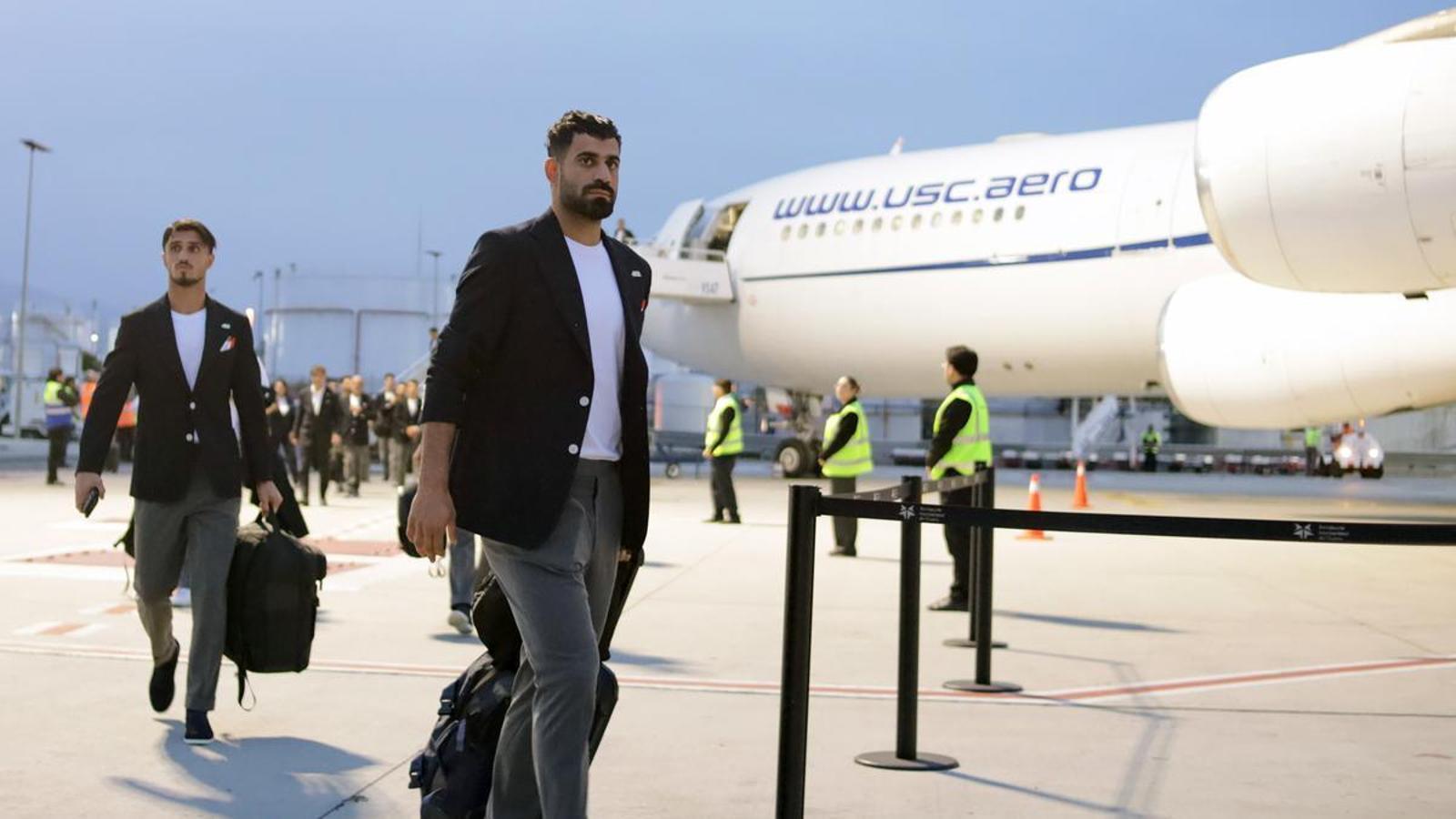
The Iranian ambassador to Mexico, Abolfazl Pasandideh, has denounced that fifteen members of the national team, members of the technical staff and executives have not yet received authorization to enter the United States with just over a week to go before their debut. The national team is already in Tijuana, where they have arrived with pins on their clothing bearing the number 168, in memory of the 168 girls who died in the American bombing of the Minab school on February 28. Players who, according to Abolfazl Pasandideh, have received permission from Washington to enter their territory but "with limited permits that allow them to enter only for the time necessary to play the matches and leave the country that same day." The Iranians complain as they consider this to be a disadvantage compared to other national teams that will be able to concentrate near the venues and reduce travel times. Iran will play its first World Cup match on June 15 in Los Angeles against New Zealand.
Iran had previously conditioned its participation in the World Cup on the acceptance of ten points, including guarantees in terms of security, travel, and respect for the symbols of the Islamic Republic, as well as the issuance of visas for the entire squad. Now we have to see how the permits for all members of the Federation are managed, as the Trump administration's idea is not to allow Iranians to spend the night in their territory. They would fly in on the same day as the match, play, and return to Tijuana, where more than 300 police officers would watch over them.
In the last World Cup, in 2022, the Iranian national team's matches were already held in a context of anti-government protests in Iran that left hundreds dead. At that time, the team's players refused to sing the anthem in protest of the repression carried out by their government. And during their second match against Wales, there were even clashes between fans with opposing views on the Iranian government, and the television signal attempted to censor banners of opponents in the stands, as well as the image of unveiled Iranian women cheering their team. In that World Cup, a very tense Iran - United States match was played, just as when they played in 1998 in France.

