Paula Leitón: "There are elderly people who tell me that now they can put a name to their suffering"
Olympic water polo champion
-
CAT -
CAST
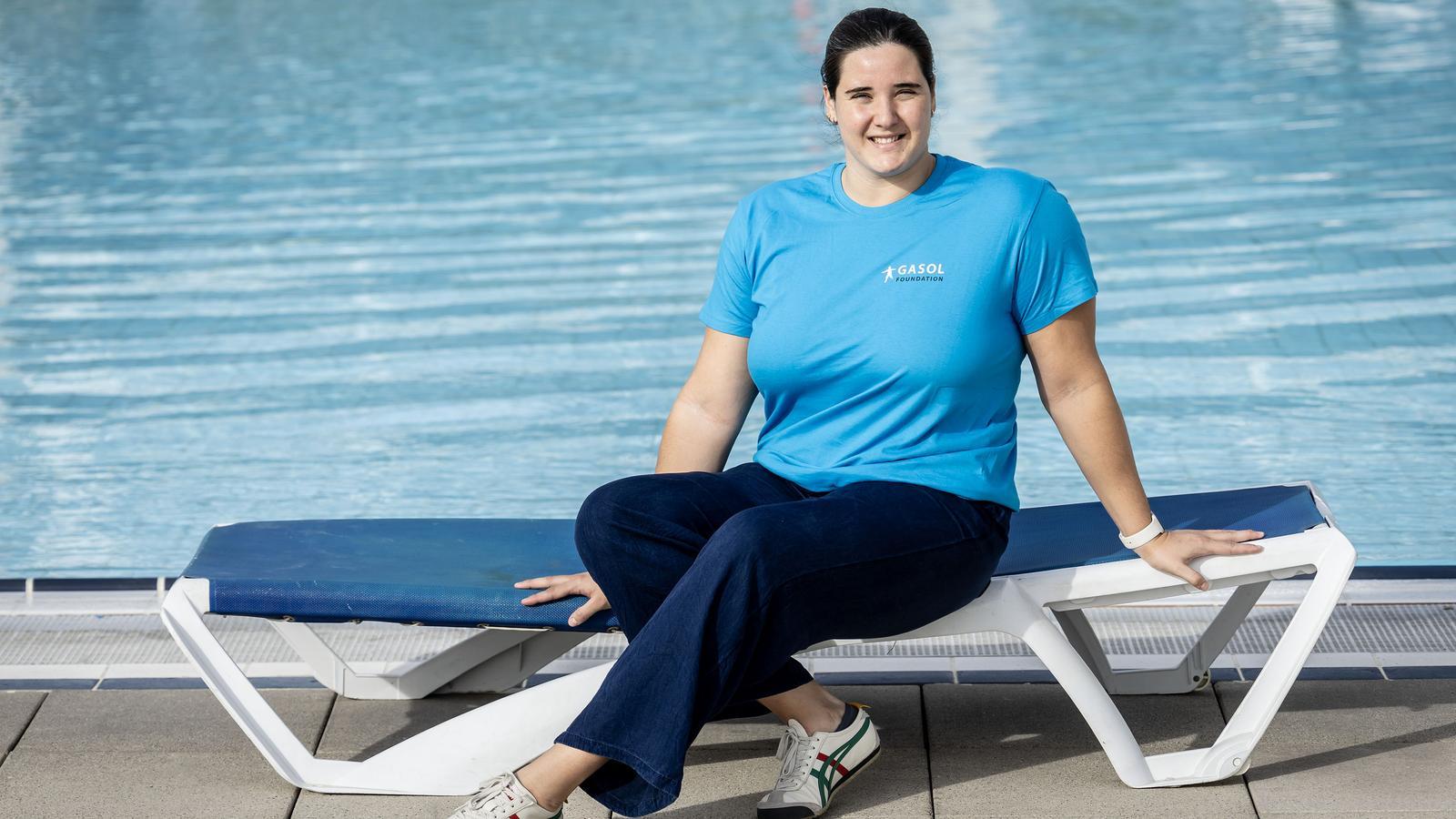
BarcelonaPaula Leitón (Terrassa, 2000) walks in the early morning through the CN Atlètic Barceloneta and the most veteran members of the club, those retirees who go every morning to get a tan while chatting, greet her by her name. The water polo center from the Vallès, 2024 Olympic champion, has already been at the seaside club for a year. She already knows the members and the tables of the lifelong local spots in Barceloneta, such as La Cova Fumada. Barceloneta wants to create a women's team that wins titles, and that is why they signed her. A woman who has just become the new ambassador for the Gasol brothers' foundation thanks to her work in favor of mental health and her fight against fatphobia, which she suffered on social media after winning gold in Paris.
How did the idea of collaborating with the Gasol brothers' foundation come about?
— I was invited to a charity golf tournament in La Línea de la Concepción. I don't play golf, but I went and I ran into Pau there. It was the first time I could talk to him calmly. And talking to the people who run his foundation, we saw that we shared values.
Values like helping young people?
— Above all, but also more things. I try to help society by speaking in schools, but also in other places, such as companies. I want to help children and young people. They are the future, but it is also very important that the message reaches adults, because they are the ones who can change things immediately. We want to create healthy habits, take care of mental health, nutrition... It is important to talk about it with the little ones so they can grow up in environments where everyone can be who they are, with normality.
Just to say that there are many normalities.
— Yes, we are lucky to have many normalities, and it is something I try to show everyone. Everyone is unique, everyone has their own body. Sometimes we forget this and want to be like someone we see on television, on social media, and no, we must be ourselves, and what we can contribute is enough. There is no single normality to which one must adapt, it is the opposite, we have many normalities coexisting every day.
How do you feel when you explain your case to schools?
— It is a moment that fulfills me. Because girls and boys are so real and innocent... They have great curiosity. I want to promote values that I have learned in grassroots sports. I want to explain to them that doing sports goes beyond taking care of your health. It also gives you friends, confidence, a spirit of improvement, work ethic... I want them to feel curious about sports. Hopefully, they will practice them.
In water polo, the strength of the group is very evident. In the national team and the clubs where you have played, you have found a second family.
— The first rule that sport has is that you have to communicate. You have to live with more people. Sport helps you move in all areas of your life. We live in an era where with social networks everything is fast, everything happens flying by and is immediate. More and more there are fewer personal relationships, often young people find it hard to communicate, to say what is happening to them, to ask others how they are... Sport helps us in these cases.
You explain in your book, XXL, that you were a girl without a childhood, because at 12 years old you were already debuting in the First Division with CN Terrassa. What remains of that Paula?
— What remains is that I like what I do. That I try to keep enjoying every day, especially the little moments, like a coffee with a friend I haven't seen for a long time. That capacity to see the good things after hard training sessions, when you can't go on anymore, still remains. I believe that above all, the innocence and kindness that little girl had when she started still remain.
At 12 years old, you were already playing against your heroines.
— Everything started very early. It arrived without me expecting it. It is true that my body was prepared, because it has always been big, but I was not as ready to handle the pressure, the nerves, the frustration. And when you are so small and you play against the best players, you do not understand why something does not work out for you and it does for them. And it frustrated me. In the end, you end up understanding that many years of training are needed. And everything ended up arriving. I am very happy with my beginnings. I think I was very fortunate to grow up in the group I grew up in.
Then you arrive at the national team at 14 years old. Do they still tease you by reminding you that on the first day of the call-up you went wearing a Mickey Mouse t-shirt?
— Still, still. They always remember it, they are very annoying [smiles]. And I tell them that I don't have that t-shirt anymore! I was a 14-year-old girl and I was 1.83m tall. And they welcomed me by saying I was a baby, they adopted me. In 2012, at 12 years old, I watched on television how that team won a medal at the Games and two years later I was already training with them. It was very intense.
And both you and they are role models. You are a generation that raises its voice to achieve improvements. You cannot just be athletes, you also fight to improve, as has been seen with the case of Maica García and the fact of being a player and a mother at the same time...
— Ours is not a professional sport. And besides, water polo remains a minority sport that is not even broadcast on television. In other words, we do not have the visibility that other sports have. We fight to improve, but we must keep our feet on the ground. Since I was very young, I have experienced how all my teammates trained for many hours, left with the national team, and all of them studied, all of them were pursuing a degree. They all told me that I had to study because when I finished my degree, I would have almost nothing.
But women's water polo has been improving. More and more clubs are committing to having a strong team.
— Yes, but many clubs cannot offer double training sessions, they pay little or do not pay at all. We are the best league in the world, all the great players want to come here to play, but we still have so much left to do for our sport... If the best league still cannot offer stability to most players, imagine what is left to do.
Barceloneta has certainly bet big. Champions of Europe in the men's division, now they want to do the same with the women's. It's a lot of pressure.
— We already like it... An athlete is driven by projects, to be able to continue achieving the goals you set for yourself. The fact that Barceloneta is making a commitment to be able to have both teams playing in the highest competitions is a club commitment. And I love it. I like that the girls see us competing in a club that thinks in this way.
What role has your family played when things were not going well?
— They are the most important thing I have. Because they were the first to hold my hand and accompany me on my first day of swimming lessons, when I would cry if they left. They have always been there, like those weekends when they had to take me from one game to another with a bathrobe and swimsuit in the car because I didn't have time to arrive and change. I still let them know when I play and ask them to come. Now that they can enjoy the weekends more, sometimes they don't come because they go away, and I look up at the pool, don't see them, and it makes me angry [smiles]. Afterward, I send them a message saying how the game went and asking them to come to the next one.
How did they experience the Paris Games? You win the gold, but then you receive insults on social media from people attacking your body. It must have been hard for them.
— They suffered for me and I suffered for them. They have always helped me to see that there are very bad people in the world, but we suffered. I told them that I had it under control, that we would talk about it calmly at home. I feel a lot of pride because they congratulated me for having been able to transform all those negative comments into good things. They like how I am and I like to see that nothing has changed. What makes them suffer the most is when I go away for two days to play. I have to tell them that we have arrived at our destination safely.
When you received those insults you could have closed your social media accounts. You chose to speak about it openly. Giving talks, interviews, publishing the book XXL... You were very brave.
— The bad comments lasted for a few days. Then, very lovely comments arrived from people who have supported me. Through social media, I have received messages and testimonials from people whom my words have helped. If what I do reaches even one person, for me it is already enough. Helping any boy or girl, or even older people, who also need it! We always talk about bullying as if it were only a thing for children, when it also happens among adults. It happens in all areas of life. It happens now and it happened before. There are older people who tell me that now they can put a name to their suffering. It can happen to you for being fat or thin. For many things. And you need to have tools to fight against this.
Do you want to stay involved in water polo for your whole life?
— I think I will never stop being linked to it... Not to water polo anymore, but to the world of water. I would love to be able to help my sport once I am out, because water polo has given me a lot and I want to maintain the connection, I want to give good things back to it. Before that, however, it is time to think about the 2026 Games, and before that about next year's World Championship, which I have never won. The challenges never end.

