"It was a city without law": the years of Quique Cárcel, sporting director of Girona, in Cádiz
Two decades ago, the Girona sporting director lived an experience full of adventures at the Ramón de Carranza

-
CAT -
CAST
GironaFor Quique Cárcel, Cádiz is like his second home. He lived there from 1996 to 2000, a period in which he accumulated 131 matches as a midfielder for a team that was then competing in the Segunda División B. This Saturday he will return to the Ramón de Carranza, now renamed as the JP Financial Estadio, in what is his thirteenth season as sporting director of Girona (9 PM, LaLigaTV Hypermotion).
“Quique was a hidden leader. Cádiz is very particular and we Catalans are Catalans, more wait-and-see and diplomatic. But from a distance and in silence, he knew how to treat the team and make himself important and necessary,” says Jordi Gonzalvo (Barcelona, 1947), the coach of the Andalusians in the 1998-99 season. “He had the right amount of intelligence to connect the midfield with the forward line. He was technically very good and tactically he was always well positioned. He knew how to read where he had to be and correctly interpreted what he had to do,” he says regarding the performance of a footballer who had a long career in modest football, where he played for the Barça, Sabadell, and Hospitalet youth systems, and who barely tasted professional football, with about ten matches in the Second Division with Leganés.
Cárcel has very good memories of his time in Andalusia. At 22, that was his first experience away from home. “When I arrived there, he had already been there for two seasons and was very well adapted,” recalls Gonzalvo, for whom the experience turned out to be a bit bitter: “People didn’t forgive me for replacing a local coach, as if it were my fault. And Catalans are not very well regarded in that area. So if you add it all up… I always felt I had to fight against those prejudices. Besides, the city is beautiful to visit for three weeks of vacation, but living there permanently is a different matter. At that time, it was very tough.”
What was Cadiz like at the end of the nineties? “It was a lawless city. The per capita income was very low and there were a lot of labor problems. The mayor was far-right and the people were far-left, with everything that entailed. I was stopped more than once on the highway because there were workers protesting because they weren't getting paid or had been fired, and the police responded by shooting rubber bullets at them,” replies the former coach, who has quite a few stories to tell. “At four in the afternoon, they would let the kids out of school, and they spent more hours on the street, surrounded by drugs, than staying at home, in a healthier environment. The most normal thing you would see was three guys without helmets on a motorcycle. I always wondered how it was possible for that life to be normal there.” Gonzalvo's team stayed three points away from making the play-off for promotion to the Second Division, which Cárcel had already played the year before, when he was eliminated in a mini-league that included Barça B with Francesc Arnau, Carles Puyol, Xavi Hernández and Óscar Álvarez, now the assistant coach of Girona.
The 'cazón', a moat and a priest
The extreme passion with which the Cádiz fans devote themselves to their team was already being felt, back then. And there is a reason for it. “When we were returning from any away game, we would enter via the Puente de Carranza. It might have been three in the morning and there were three hundred men fishing. They would stay there until seven in the morning, fishing. What they caught the most was the cazón, a small shark that is cooked. When the sun came up, the fishermen would go off to sell it to the restaurants and with the money they collected they would buy a ticket, because before, not everyone could afford to go to the football. Since being able to enter the stadium involved a beastly sacrifice and effort for them, they demanded the maximum from us because they felt they had the right to. The stadium was always full,” he explains.
Cárcel also left some unforgettable anecdotes in Cádiz. In his second match at the Carranza, in October 1996, he scored a goal against Realejos. Mad with euphoria, he jumped towards the stands thinking there would be a fence to climb, but he found that, in its place, there was a moat, into which he fell headfirst. The moat was two meters deep, with half a meter of water, and was covered by a fine net to prevent the balls from falling inside. Fortunately, it was just a scare.
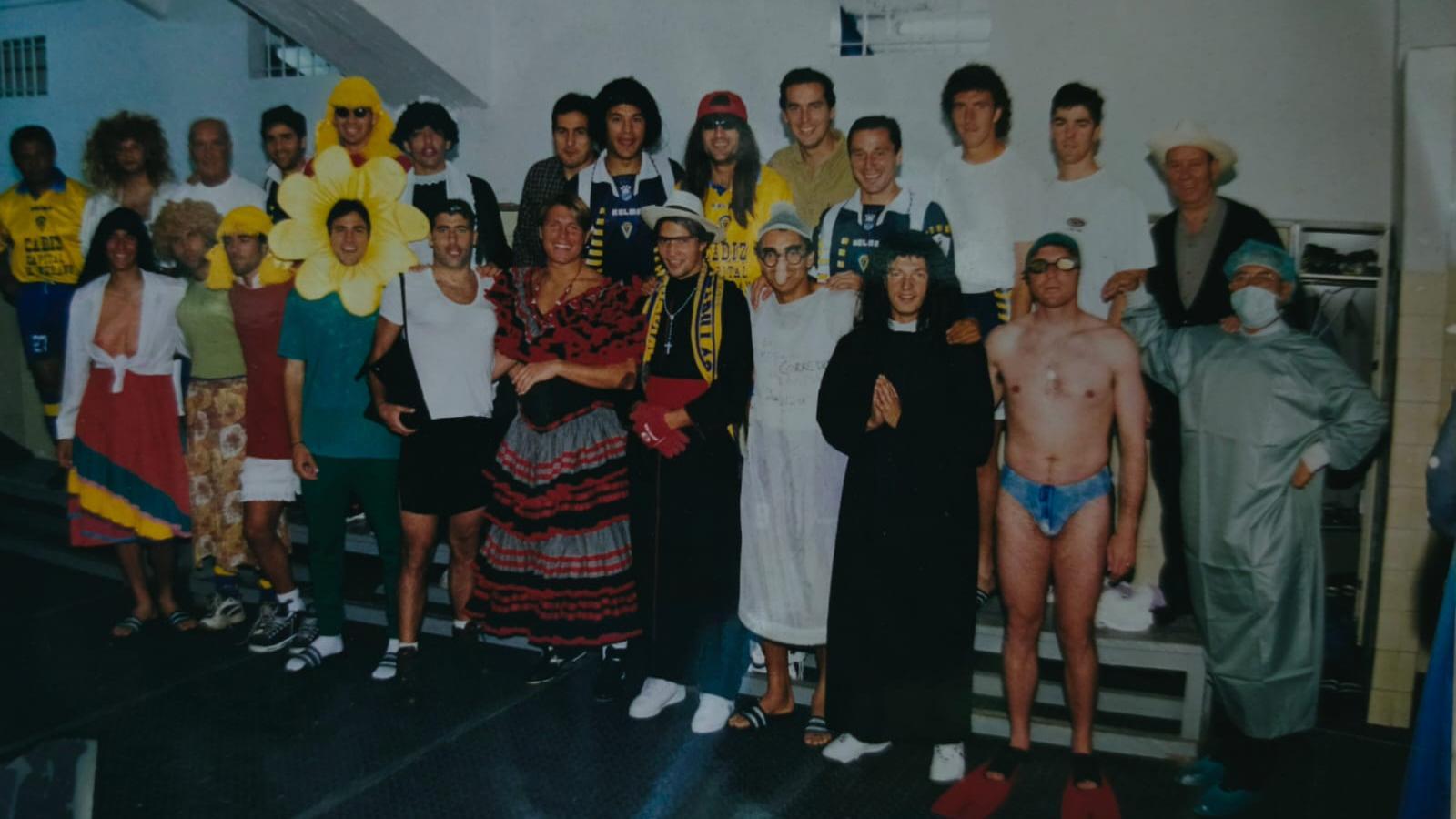
Gonzalvo laughs when his memory takes him to Holy Week and the Carnival. “Everyone gave themselves over to it in those days. Quique and the rest loved going to a pub or a cellar and having a finito. In fact, I have a picture in the office where they are all dressed up. Quique is the third from the right in the front row and he is seen dressed as a priest, with his hands in prayer. We had good times, yes,” he says, before adding that “it is very meritorious to be at Girona for so many years and achieve what he has achieved”: “He is the ideal man to build a sustainable project over time,” he concludes. Cárcel has completed 545 matches as the red-and-white sporting director, of which he has won 226, and is looking for his third promotion to Primera with the Girona side.

