Veolia drives environmental safety for future generations
Coinciding with World Environment Day, Veolia claims the key role of ecological transformation in the face of major environmental challenges as a global benchmark in the fields of water, energy, and waste management
-
CAT -
CAST
This year, the United Nations is promoting climate action on World Environment Day. The slogan "For the climate, now" invites us to act united for a world that is moving towards a paradigm shift through two strategies: mitigation, to limit global warming, and adaptation to protect people and territories.
Veolia, a global leader in ecological transformation initiatives, works in the fields of water, energy, and waste with the aim of decarbonizing, decontaminating, and regenerating natural resources, making a clear contribution to both mitigation and adaptation. In 2025, with a team of over 18,000 people in Spain, the group has supplied water to more than 13.5 million people in over 1,000 municipalities, has treated 1,280,910 tons of waste, and has contributed to avoiding the emission of 363,440 tons of CO₂ equivalent.
Environmental safety in the face of climate change
Veolia's solutions offer environmental safety to citizens in the territories where it operates through three key pillars: ensuring the availability and quality of essential natural resources such as water; implementing a circular economy to give new life to waste; and reducing pollution and decarbonizing to protect both human health and industrial activity.
Environmental safety therefore means ensuring the availability of essential resources for daily life under all circumstances. Water is vital for agriculture and food; energy is essential for critical infrastructure such as hospitals; and waste management is fundamental for protecting human and environmental health.
For this reason, the company works to continue maintaining its services even in critical situations such as drought episodes or geopolitical conflicts. This is fundamental for people's well-being and for industry, agriculture, and public administrations, as natural resources sustain our economic and social system, protecting the lives of communities.
Veolia makes its operational capacity, expert knowledge, and consolidated technology available for efficient natural resource management, thereby generating a positive environmental, social, and economic impact.

Mitigation
The mitigation strategy consists of significantly reducing CO₂ emissions and improving the environmental footprint through energy efficiency solutions, waste valorization, recovery of resources derived from wastewater treatment, or local renewable energy production.
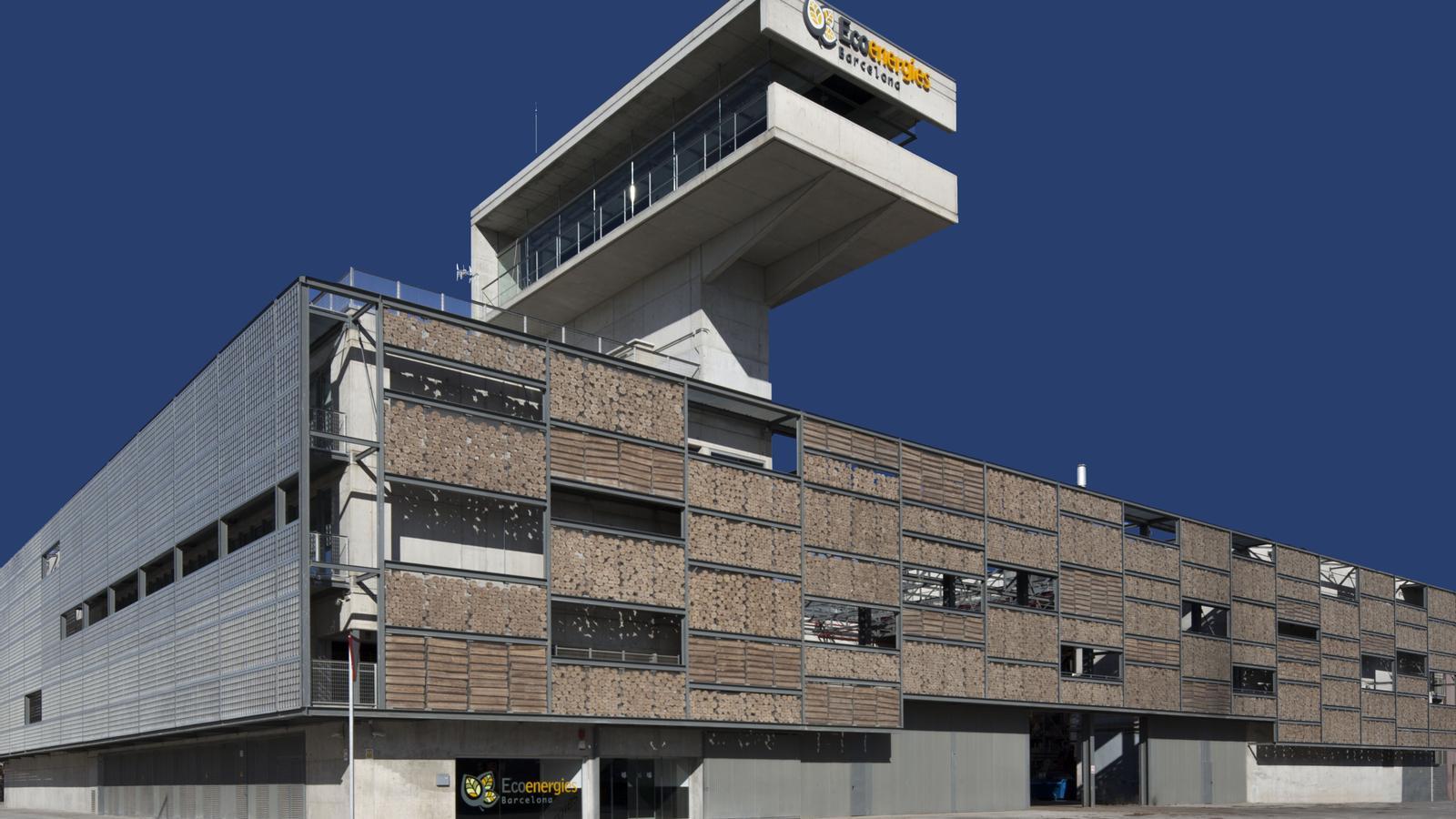
In this area, some of the company's initiatives stand out, such as Ecoenergies Barcelona, a pioneering project for the recovery and distribution of cold and heat for residential and industrial uses, carried out in collaboration with the Barcelona City Council through BSM.
On the other hand, the company transforms forest, agricultural, and urban pruning waste into thermal and electrical energy, integrating the entire biomass supply chain, from the forest to the final facilities. Veolia also promotes geothermal energy as a key technology for decarbonization, using the heat from underground to provide heating, cooling, and domestic hot water.
In the field of recycling, infrastructure such as the Badajoz plant, specialized in food-grade PET recycling, and the Seville plant, in industrial, post-consumer, and agricultural plastics, stand out. Both have processed 130,000 tons of plastic in 2025, giving them a new life.
Adaptation
Concurrently, Veolia implements comprehensive adaptation solutions to guarantee the preservation and availability of water resources, from both conventional and unconventional sources, in the face of climate change. Water regeneration and reuse, desalination, and infrastructure resilience are fundamental pillars of this strategy.
The company is a pioneer in the ecofactory model, which transforms old treatment plants into infrastructures that generate resources and environmental benefits. In these facilities, in addition to regenerating water for new urban, agricultural, and industrial uses, waste is converted into new resources, renewable energy is produced, and the surrounding biodiversity is preserved.

The BioSur ecofactory in Granada, which produces close to four million kilowatt-hours, is today a benchmark for energy self-sufficiency. The ecofactory in Baix Llobregat in Barcelona can produce, in a drought context, two cubic meters per second of regenerated water, intended for uses as diverse as aquifer recharge, agricultural and urban irrigation, or industrial supply.
On the other hand, desalination stands out as an essential solution to guarantee the continuity of supply, diversifying supply sources and protecting communities from prolonged droughts. Veolia's innovations in this field have improved energy efficiency by 85% and reduced operating costs by 90%.
Veolia demonstrates that environmental safety is possible when innovation and commitment lead to solutions that guarantee resource availability and territorial resilience. Acting for the climate is a shared responsibility that Veolia assumes every day for the benefit of present and future communities.
