Sniffing drugs at the entrance of a Barcelona festival: "You carry: the dog doesn't lie"
The Guàrdia Urbana seizes substances from 14 people during a checkpoint at the entrances to Brunch Electronik

-
CAT -
CAST
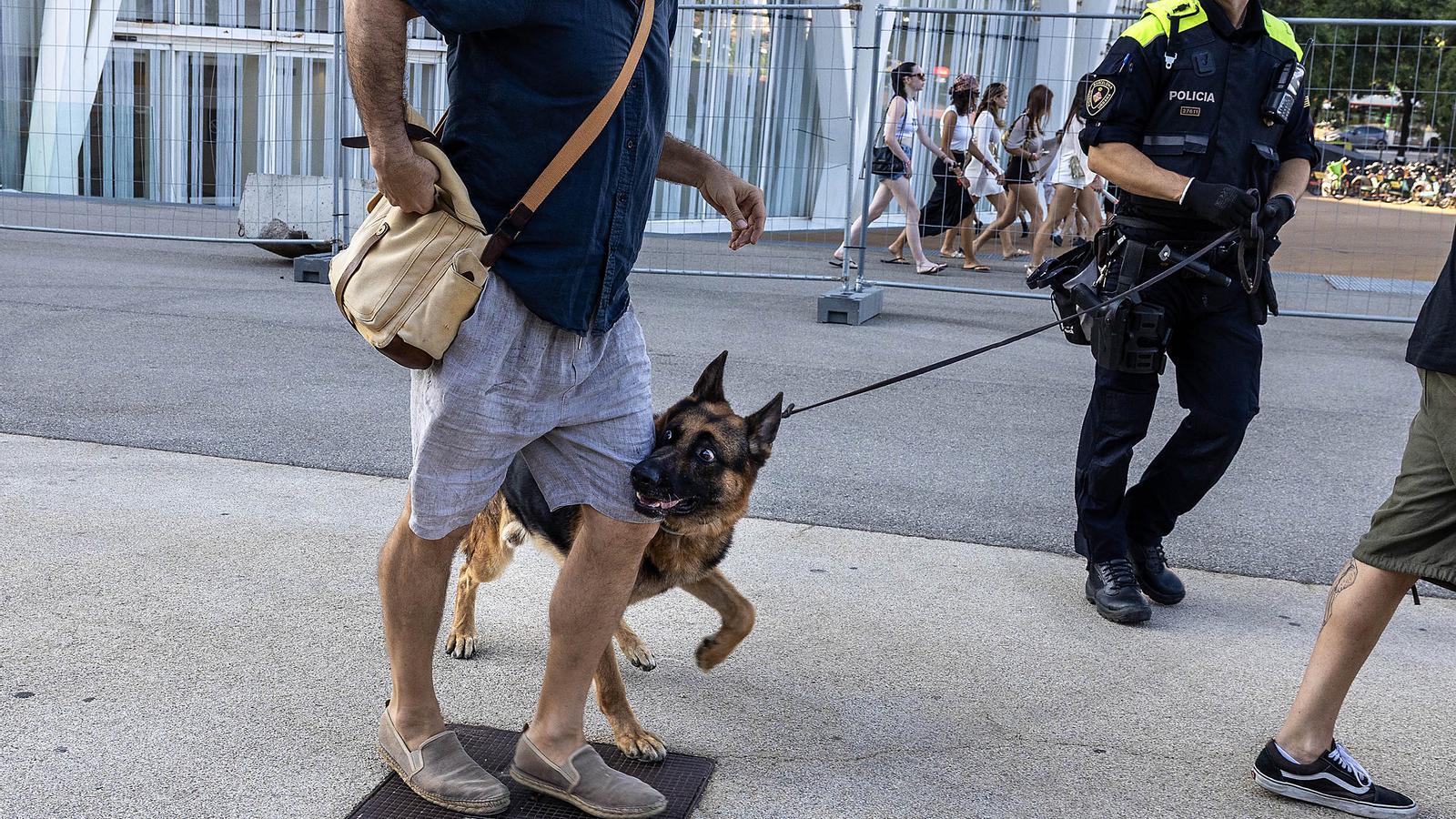
BarcelonaFiru agilely gets out of the van where he was waiting –with the air conditioning on– wagging his tail. He wants to play. His handler leads him towards the ramp leading to the festival entrance, with a crowd of people heading towards the access controls. The handler lets himself be led by Firu, who, hyperactive, weaves between the legs of the attendees. Some pet him, others comment on how beautiful he is, this German Shepherd, until he starts to circle a young man and sits down in front of him.
The young man doesn't quite grasp what's happening as he affectionately pets the dog and smiles. The surprise comes when the handler, an agent of the Guardia Urbana de Barcelona, tells him that the dog has just indicated that he is carrying drugs. First, the guy says no, then he comments that it's CBD (a cannabis compound that has no psychoactive effects), but the handler states, with a response that is repeated throughout the afternoon: “The dog doesn't lie”.
The scene takes place at the entrance of the Fòrum this Friday at 6:30 PM, the time when most people attend the Brunch Electronik festival. Indeed, Firu doesn't fail: it still needs to be taken to the laboratory for analysis –as is done with all confiscated drugs–, but the young man receives a fine of about 400 euros for carrying marijuana. And Firu, who interprets everything as a game, receives his prize: a kind of chew toy that he gnaws with the enthusiasm of a child.

Valeriano Lucas Casado, deputy inspector of the UREP of the Guàrdia Urbana, explains that dogs can also detect synthetic drugs, as they smell specific molecules that coincide in the vast majority of substances. They also have those that detect cash, banknotes, useful especially when entering drug houses or places where they suspect money is hidden.
The deputy inspector adds that this method for detecting drugs is minimally invasive and, at the same time, preventive: there are people who, when they see the dog, throw away the drugs before entering the festival or the next day they are no longer carrying any. The police commander explains that it is important to prevent the entry of these substances, especially to avoid fights. "We are not party poopers," he clarifies, specifying that they always try to ensure that the person attends the festival anyway, but without the drugs. When they see the dog, many try to discreetly distance themselves while in the background the electronic music that has brought them – many are tourists – to the Catalan capital is already playing.
At a distance
The ramp leading to the festival is not the ideal setting for Firu. There are a lot of people and it's windy, which scatters his sense of smell a bit. Even so, he doesn't fail. He catches some at a distance, heading directly for the target, knowing, from 10 or 20 meters away, that he's carrying drugs. Attendees accept it with good sportsmanship, except for one who denies everything and after a thorough search, it's discovered he was carrying two MDMA pills in his sock. Firu lasts about 20 minutes and then it's Hutch's turn.
He arrived with his brother, Starsky –in honor of the detective duo—, two puppies for the Guardia Urbana from Alicante. Although they have been raised together, now, for reasons unknown, the brothers don't get along and can't stand each other. It happens in the best families...
The officers have completed all their training and also take care of them, walk them, and in many cases, they live in their homes. However, they must be very careful where they walk them: “I avoid places where people might be consuming, as it could be thought that he is working.” His reward is a small ball that he enthusiastically chews after marking, from a great distance, a young man in a summer shirt. “I'm carrying all of it for my friends,” he replies, worried. Crystal meth and cocaine are found on him, among other drugs. The quantity is so high that it becomes a criminal offense and he will have to go to trial. “I was carrying all my friends' drugs,” the young man repeats as his friends wait for him. “Normally, people don't make it difficult for us,” comments the sub-inspector. At this moment, there are 15,000 people at the festival, and it is expected that there will be 22,000 by the end of the night.
The phrase “the dog doesn't lie” turns out to be completely true. In just over an hour, the two dogs flag 14 people at the festival entrance. All 14 people were carrying drugs, in the vast majority of cases, pre-rolled cigarettes with marijuana or hashish. The sub-inspector explains that the objective is to conduct “qualitative and non-invasive” checks.
Since the beginning of the year, his unit has carried out 1,200 drug interventions, and 60% of them have been thanks to the dogs. They rarely fail, sometimes because they smell the gasoline from a lighter – various drugs, although it may sound surprising, are mixed with gasoline during chemical processes–. Normally, they are retired between five and seven years old and are always kept by either their handler or another member of the force.
