The new roadmap of sustainability: resilient companies and aligned value chains
Sustainability is a key factor for business growth. A meeting organized by BBVA highlights the need to involve suppliers and clients in a transformation that must be viable and fundable to gain competitiveness and resilience.
-
CAT -
CAST
Reducing costs and gaining efficiency is no longer enough. Companies are incorporating new priorities into their roadmap, such as resilience, supply security, diversification, and decarbonization.
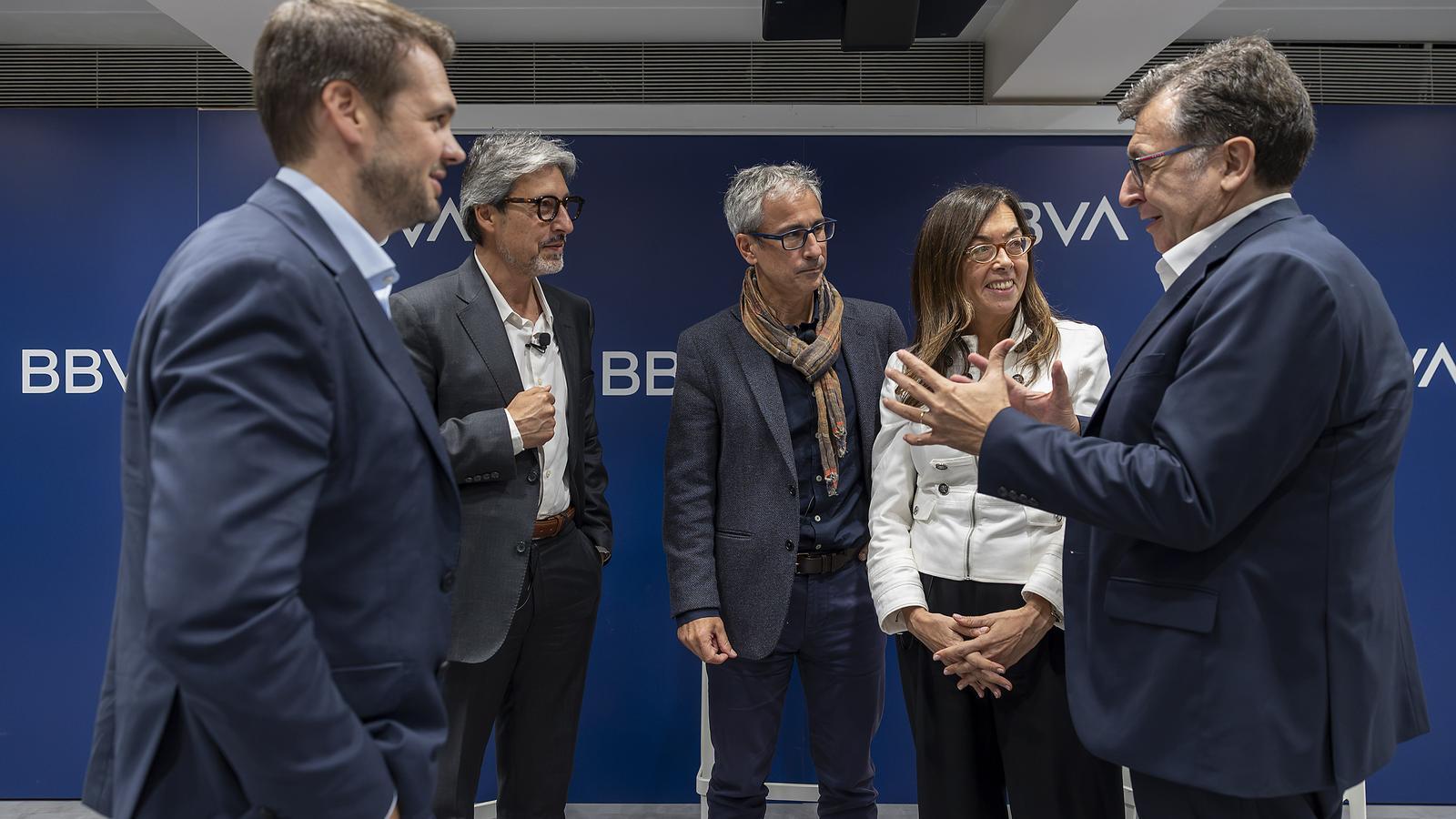
The challenge is to make a transformation that also involves the entire value chain viable, productive, and financeable. This was made clear at the meeting on sustainability organized by BBVA, in which representatives from the economic, energy, and industrial sectors analyzed the challenges of the energy transition and its impact on business competitiveness.
“In 2019, at BBVA, we decided to make sustainability a strategic priority. We started by analyzing our carbon footprint and we realized that only 1% of the emissions corresponded directly to our activity. The remaining 99% came from our suppliers and clients, that is, from the companies we finance,” opened the director of Sustainability at BBVA in Spain, Ángel Giménez Palazón. Since then, BBVA's financing plans also involve analyzing risks, taking into account the companies' transition plan, “regardless of their size”.
Why now?
The geopolitical moment, rising prices, variations in transport routes, and energy supplies are disrupting the market. Hence the need to change value chains, as highlighted by Julián Cubero, Lead Economist – Economics of Climate Change, BBVA Research.
Conflicts such as those in the Strait of Hormuz, the war in Ukraine, tariffs, or the high concentration of trade of certain strategic products in China and other Asian economies, await a response: the decarbonization of our economy. “China is the elephant in the room,” and in view of this, it is necessary to develop and strengthen domestic industry.
The importance of moving towards an energy model based on renewables is fundamental, when nearly 85% of the energy consumed in the world still comes from oil, gas, and coal. “In the last fifteen years, we have reduced this dependency by about ten percentage points. We can see the glass as half full or half empty, but it is clear that there is still a long way to go.”
According to Julián Cubero, Spain has the capacity to generate solar and wind energy, and this represents a competitive advantage. It is necessary, however, to get ahead, have energy at a competitive price, and, above all, adapt the electrical grid. “Companies must understand that investing in decarbonization is also a way to gain competitiveness and resilience.”
Transversality
Sustainability must be integrated and transversal to the company. “A company’s emissions are not limited to those it generates directly, but also include those derived from energy consumption and the entire value chain, both from suppliers and from the use and end-of-life of products,” explained Joaquim Daura, vice-president of the Efficient Energy Cluster of Catalonia (CEEC).
The fight against climate change and the loss of competitiveness derived from energy dependence are two of the great European challenges. “In Catalonia, this dependence stands at around 69%, and if we include nuclear energy, the figure exceeds 90%. This situation places us at a disadvantage,” he warned.
The sun, wind, water and other renewable sources must guarantee our future because “we are talking about an energy bill of billions of euros.” Also, talent, innovation and cooperation are key and Europe must develop this industry to stop being vulnerable.
Empathy
Joaquim Daura, also an executive at Schneider Electric, and Carlos Velázquez, Service & Sustainability Senior Managing Director at Roca Group, concluded the event with a panel discussion moderated by Olga Escriu, Director of Business and Institutional Banking Solutions at BBVA in Catalonia, sharing some of their experiences and initiatives.
At Roca Group, large investments have been driven in recent years to transform production processes. For example, cooking kilns have been electrified, and there has been a commitment to training and offering free tools to suppliers to measure their emissions. The goal is to make sustainability part of the commercial relationship from the very first moment and for "the supplier's objectives to be aligned with those of the company," explained Carlos Velázquez.
Schneider Electric has extended decarbonization throughout its entire value chain and, since 2021, has been accompanying 1,500 suppliers in this process, with plans to incorporate 500 more by 2030. Despite progress in emission reductions, "the big challenge remains scope 3," pointed out Daura, who advocated for a relationship with suppliers based on "transparency and empathy." He also explained how, at the Capellades plant, the insufficient capacity of the electrical grid prevented them from taking advantage of a European subsidy of 800,000 euros, highlighting the need to strengthen it.
Olga Escriu underscored BBVA's commitment to achieving net-zero emissions by 2050 and highlighted that the bank "accompanies its clients so they can advance in their own sustainability commitments, with comprehensive solutions that allow them to turn their commitment to the energy transition into a real competitive advantage."
