Open the gaze of children and adolescents through art
The educational activities that the Joan Brossa Foundation makes available to schools and families propose practicing poetry and art from a playful, experimental, and radical perspective.
-
CAT -
CAST
Each year, the Joan Brossa Foundation adds more and more educational centers that want to practice poetry and art from a playful, experimental, and radical perspective, just as the poet Joan Brossa created. To break away from canons and innovate, to try new ways of writing, to play with the forms of language as if they were objects you can hang on walls... Brossa is intuition, play, and freedom, and so too is the educational program that the Joan Brossa Foundation's Centre for Free Arts makes available to schools and families.
As Berta Fontboté, from the Education and Mediation team, points out, working with language in its most plural sense (artistic, literary, philosophical, and scientific), as the artist did, from an early age, "serves to broaden the perspective of the children and adolescents who participate." Fontboté alludes to the interdisciplinary work that Brossa did with language, "as he worked with words, but also with images and the world of the stage or the body." And this, she states, "together with his attitude of constantly trying to transcend disciplines, allows children, adolescents, and even adult audiences to want to look at things from another perspective and ask questions," laying the groundwork for the curiosity and creativity that should accompany them throughout their lives.

Joint work with active artists
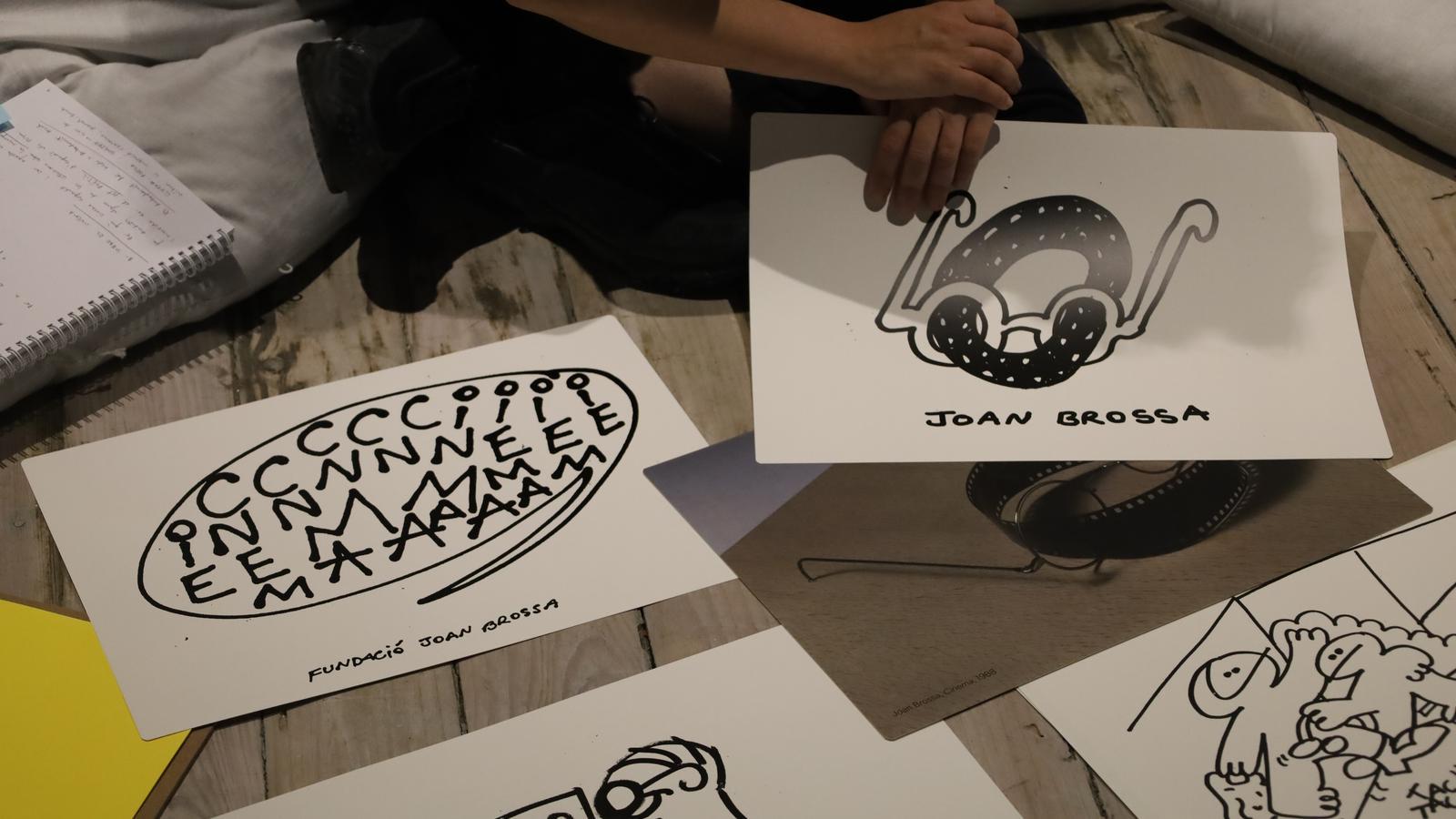
“Not everything has a single answer; things can be turned and looked at in different ways,” points out Fontboté. An open mind that the Foundation promotes through playful activities, where play, humor, and the element of surprise are key elements and where the mediator leading the proposal adapts it according to how the group is feeling. It is about, continues the mediator, dynamics that seek for the child to put themselves in a situation, to stop, to listen to themselves, and to notice those things in everyday life that normally go unnoticed. A range of activities designed jointly with active artists, as is the case, for example, with Poem for this moment, created by Itxaso Corral, which allows practicing poetry through a pencil and paper. Or also the latest to join the catalog of guided tours, on expanded cinema, created with the artist Mar Reykjavik and titled ccccciiiiinnnnneeeeemmmmmaaaaa.
The schools that carry out the activities also tour the rest of the rooms at the Joan Brossa Foundation's Centre for Free Arts, which makes the visit a 360° experience. “We propose a dialogue between the works of Joan Brossa and those of contemporary artists,” explains Fontboté, who points out that, during the tour, the children, “in addition to observing the works, spend time in the rooms, inhabiting them and debating what makes them feel.” An exercise, he acknowledges, that “awakens varied reactions, especially among the youngest, whose reading is less subject to prejudice or less conditioned.”

Cross-disciplinary that connects
Beyond connecting with the figure and work of Joan Brossa, the Joan Brossa Foundation aims to become a reference educational agent in the city, promoting this with the activities it makes available to schools, with weekend workshops and summer camps offered to families, and with the dynamics it is currently carrying out in three local schools through the Caixa d'Eines de Pla de Barris program. It also seeks to highlight "art as a transversal discipline, with which each of us can connect based on our experiences or our life stage and which, in turn, affirms Fontboté, serves to respond to challenges such as diversity within classrooms, student well-being, or respect for difference".
This constant collaboration that the Joan Brossa Foundation maintains with active artists has also resulted in three educational games available to anyone who wants them. These are Variar, created with Condegalí, a game for dancing with the possibility of infinite combinations of words and poems; Operations on paper, a game designed by Itxaso Corral that explores the possibility of creating visual poems from instructions of revealing simplicity, inspired by all the suites and series of visual poems by Joan Brossa; and Like a fleeing dog, by Alexander Arilla, a game that invites you to practice free association between images and text.
