The widespread delays on high-speed trains can last for days
The convoys only circulate on one track because of a fire in Aragon on Monday afternoon
-
CAT -
CAST
BarcelonaThe high-speed rail between Barcelona and Madrid continues to experience widespread delays caused by the fire of an AVE train near Ricla, in Aragon, and, for the moment, there is no set schedule as to how many days this incident might affect the network's operation. The Minister of Territory, Sílvia Paneque, explained that the disruptions will depend on the days it takes to remove the affected train and that the network will likely continue to suffer delays of about 15 minutes on average over the coming days. "At this moment, they are analyzing how to remove the train with maximum safety; this is what Renfe has conveyed to us. For now, therefore, trains are circulating on a single track, which is what is causing the delays," stated Paneque, who prioritized the need to ensure safety over the full resumption of service.
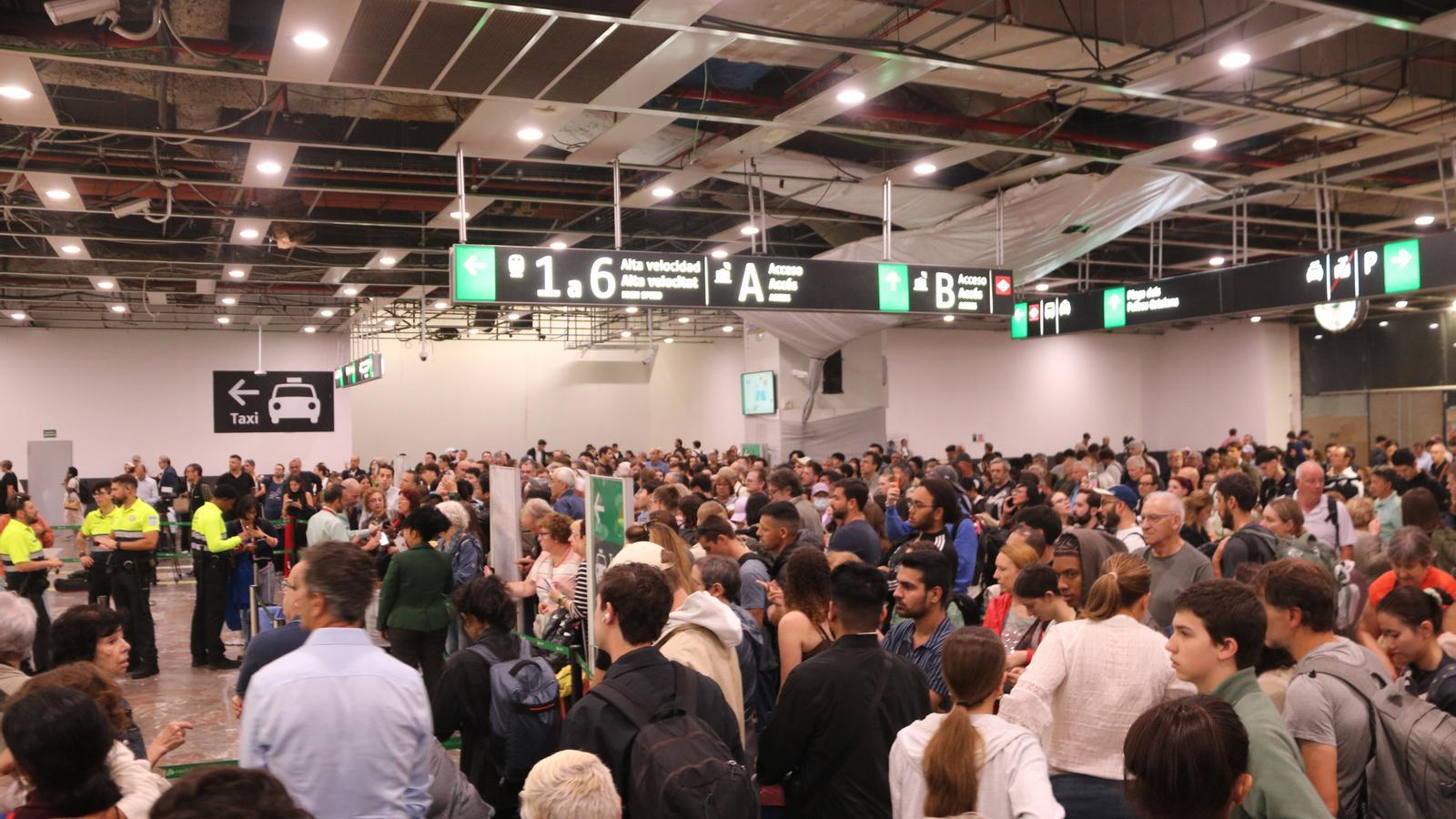
On Monday at noon, coinciding with the return phase of the Pilar long weekend, the tail locomotive of a train caught fire in Ricla and nearly 300 passengers had to be evacuated, with no injuries reported. After an entire afternoon without service, on Monday night trains were able to return to the tracks but at half capacity, as Adif was only able to reopen a single track between the stations of Ricla and Plasencia de Jalón, in Aragon. As a consequence of this incident, this Tuesday – the first working day of the week – the complications caused crowds and long queues at Barcelona's Sants station, with situations that some users have described as "chaos".
Dozens of people crowded into the station lobby, outside the access points to the high-speed trains, because only users who had an assigned track could access the waiting area and go down to the platforms. Some trains departing from Barcelona recorded delays of more than two hours, and the situation was repeated at other points on the line, such as Girona or Tarragona, where users saw early on that their trains were experiencing major delays. In the afternoon, the public address system reported that trains continue to run off their usual schedule and recommended that travelers check the information with their operator. A situation that comes only a few days after the rainstorm that affected Catalonia also paralyzed some sections of the service or caused delays on several lines.
The Minister of Territory has stressed that high-speed rail "is not the direct responsibility of the Government." Meanwhile, on the platforms, Samantha Simon, who is a high-speed rail user, assured the ACN that her train was supposed to depart at 8:30 a.m., but that, ultimately, it was postponed until 11:00 a.m. As she explained, the most "intense" crowds took place in the station's lobbies around 8:30 a.m. David Garcia, another passenger who was supposed to travel to Zaragoza at 7:50 a.m. on an Iryo train for work reasons, received a message from the operator early in the morning warning him that the trip had been delayed by two hours. Because of this, he went to Sants later than planned to avoid having to wait in the lobby. For him, the delay means "the loss of two effective hours of work and the postponement, surely, of a meeting" he has in Burgos, where he will arrive later by rental car from Zaragoza.
Reorganization of traffic
The blockade began on Monday afternoon, when the Barcelona-Madrid section was cut off for practically the entire afternoon, from four until eight in the evening. At night, the line began operating again, but the resumption was slow and traffic had to be routed through a single track between the stations of Ricla and Plasencia de Jalón, in Aragon. This Tuesday morning, traffic has been maintained on a single track, with a temporary speed limit of 80 km/h between Ricla and Plasencia de Jalón, and work has continued to remove the material affected by the fire and to repair the infrastructure. Renfe has reorganized several services using double-composition trains, grouping certain services and adjusting their departure times. This operation will continue throughout the day on several of the scheduled services.
