The police evict the housing encampment at Puerta del Sol in Madrid
The Spanish government justifies the intervention, while the campers and the left-wing denounce "violence" from the agents and point to the PSOE

-
CAT -
CAST
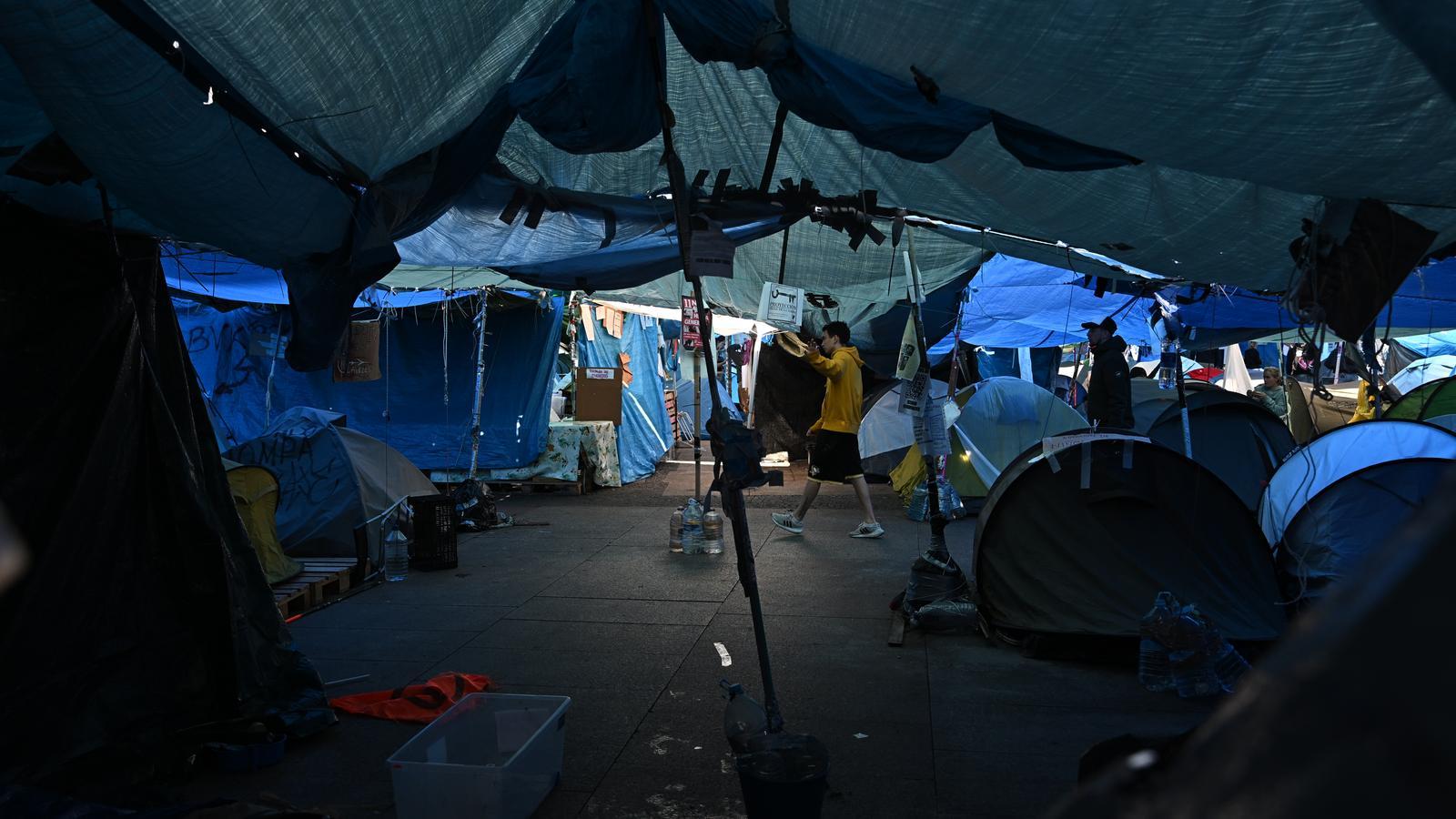
BarcelonaUp to 400 officers from the National Police and the Madrid municipal police executed the eviction of the housing protest camp at Puerta del Sol early this morning. After the campers began to leave the site in recent days to prepare for the general strike on November 11, riot police proceeded with the eviction of the space by order of the Spanish government's Delegation in Madrid. A total of 334 people were removed, and two ended up arrested for "disobedience and resistance," according to the Delegation.
The organizers of the mobilization have denounced a "violent intervention" by the police. According to a post on Instagram, they received blows and were sprayed with pepper spray. "There are several colleagues injured," they state. "We are working to check the status and integrity of all our colleagues," they add in the post, uploaded around five in the morning and in which they point directly to the delegation "led by the PSOE." Parties to the left of the socialists have also described the police action as "disproportionate."
The Delegation, on the other hand, has ensured that "the eviction took place without unrest or episodes of violence" and has defended the criteria of "opportunity, congruence, and proportionality." This is how it was defined in a statement in which it asserts that the dismantling of the camp is a measure adopted after a mediation process and "gradual action," and after considering that the protest had lost its "common protest purpose."
The Spanish government argues that, after more than a month of protests, a "change in the circumstances and nature of the encampment" has been noted and defends that the right to assembly and demonstration is not "unlimited." It points out, in this sense, that the main participating organizations had withdrawn and that a large part of the people sleeping in the square were "homeless people" and "vulnerable groups." It also points to "the existence of various presumably criminal acts" inside or around the encampment.
The encampment at Puerta del Sol, started on September 26th in the image of those of the indignados of 15-M, had become the epicenter of the housing protests following the eviction of Maricarmen Abascal and had been replicated in many parts of the State, including Plaça Catalunya in Barcelona. The organizations involved, and especially the Tenants' Union (Sindicat de Llogateres), pressured the Spanish government for the approval of the anti-eviction decrees that Congress ended up striking down, which precipitated the calling of early general elections.
The protest was in the crosshairs of the Madrid government of Isabel Díaz Ayuso, which had even attempted to end the protest in the courts. And this morning, after the eviction, she accused Pedro Sánchez of having consented to an encampment for 38 days "in the square of all Spaniards." "Either communism or freedom," she adds in a message on X, accompanied by two images of the half-dismantled square and workers cleaning the space. Also, the leader of the PP, Alberto Núñez Feijóo, celebrated the eviction, with the argument that it is "good news for public health" and because, in his opinion, "the rule of law is working again."
On the other hand, left-wing parties have been very critical of the eviction. The Broad Front, Sumar's new electoral brand, believes that the police intervention was "totally disproportionate". Gerardo Pisarello, a deputy for Comuns, recalled that many spokespersons had announced they would lift the encampment and demanded that it be "clarified" whether the eviction order came from the Spanish government delegation or from the National Police itself. Along similar lines, the Podemos candidate, Irene Montero, considers that the agents acted with "gratuitous" and "disproportionate" violence and criticized that it "always" goes in the "same direction". In her view, the "only objective" of the eviction was to "try to prevent new mobilizations from taking place". It remains to be seen to what extent the eviction will politically affect the PSOE, which until the train accident in Toledo intended to capitalize on the protests for the right to housing in the general elections.
Dismantling as a "last resort"
For the moment, the state executive's delegation insists that the eviction was not unexpected, but rather the result of a mediation process that formally began a week ago. As it explains in its extensive three-page statement, on October 26, a written notice was sent to the campers warning that a "reasonable" amount of time had already passed to submit their demands and proposing the end of the protest. According to the official version, this notice received no response, and on October 29, a second request was sent demanding the "dismantling of the encampment as soon as possible." On October 30, the encampment's interlocutors announced the dissolution of the organizing committees, but "some campers remained residually" in the space who refused to leave the square, the Delegation recounts. It thus justifies this Tuesday's eviction as a "last resort".
