The train accident commission and Iryo had already reported anomalies in the safety systems
A passenger dies in the hospital and the victims from the crash between two trains in Toledo rise to 69
-
CAT -
CAST
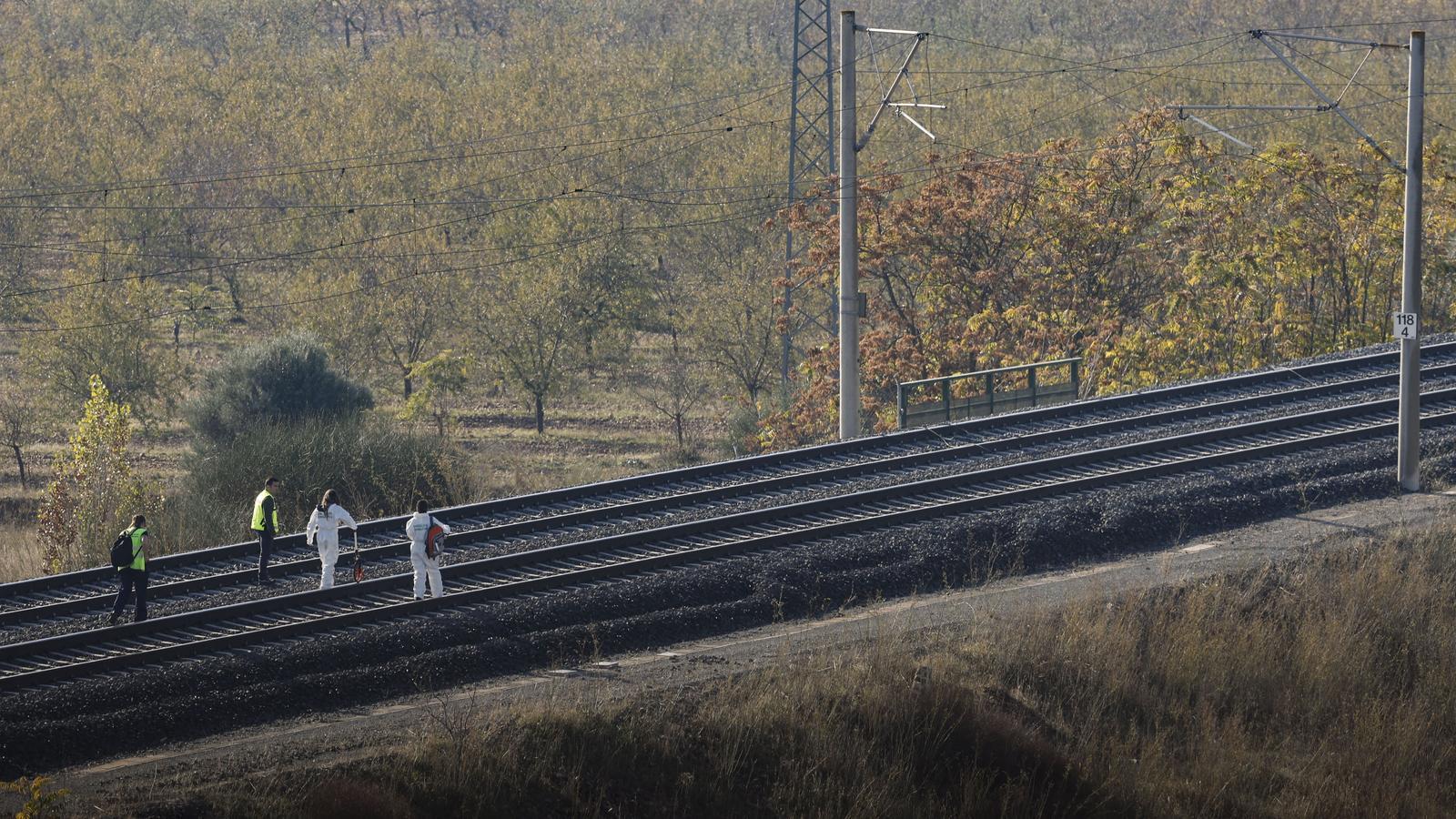
Madrid / Barcelona"We need to broaden the focus. How many parts have failed?". This is asked by a union voice in the railway sector who, like many other workers, has not yet recovered from the tragic train accident in Urda, Toledo, which has caused at least 69 fatalities. They have lost a colleague – the driver of the Renfe train –; the trainee who was accompanying him remains missing, and they have expressed their unease over what they consider a direct finger-pointing by the Ministry of Transport at the operator of the Adif regulation and control center (CRC) in Atocha, who has been placed in the spotlight regarding the cause of the accident.
The investigation is now just beginning to move forward, and beyond looking at the Adif CRC in Atocha, it will also examine other elements, such as the LZB safety system, implemented in 1992 on the Madrid-Seville line, which failed at 8:30 AM on the day of the fateful accident. It is the beginning, according to what the Ministry of Transport has explained, of an unfortunate chain of events. For the moment, the President of the Spanish Government, Pedro Sánchez, has assured that "safety will be reinforced" to avoid accidents like this one, he said this Thursday in a brief institutional statement from Toledo.
The Iryo warning
The Minister of Transport, Óscar Puente, said that it was not common for the system to fail, but that it did happen. In any case, the systems do not give "wrong" orders, he stated. But the person who acknowledged these errors 23 days earlier was the CEO of Iryo himself, Fabrizio Favara, in a public appearance at the Senate, specifically at the commission for the fatal train accidents in Adamuz (Cordoba) and Gelida (Barcelona). While answering the senators' questions, Favara said that the "most frequent" incident on the Madrid-Seville line, beyond "extraordinary" events such as fires, was linked to the LZB system. Sources from the railway sector consulted by ARA agree. Favara explained that when the system disconnected, the company had detected that its trains not only stopped but became immobilized and restarting was not immediate.
"Every time the train signal disconnects from the ground signal, the train stops. It cannot move," he recounted, adding that it took "a considerable amount of time" to recover the connection and resume service. The CEO of Iryo acknowledged that the system was "safe, but quite old." Furthermore, he said that when this happened, the driver would communicate the anomaly to Adif's regulation and control center – as has been confirmed in the leaked audio from the accident in which the Iryo train driver informs the Adif operators that she cannot resume the journey with the LZB and that, therefore, she remained stopped in front of the Urda entry signal–. In fact, the answer was in response to a question asked about the anomalies detected by Iryo workers and reported to Adif.
The coincidence of the accident with these words does not prove it was the cause, nor is it known if the anomaly of the crashed Iryo train was the same as the one described by Favara. In any case, they take on a new dimension considering how the railway accident in Toledo began, and which, for the moment, has resulted in at least 69 fatalities. ARA has asked Adif and the Ministry of Transport how frequently these security system failures were being recorded and what the accumulated knowledge was, but has received no response.
The CIAF and a similar case in 2024
Looking further back, it is the Railway Accident Investigation Commission (CIAF) – since last July the Independent Administrative Authority for Technical Investigation of Railway, Maritime and Civil Aviation Accidents and Incidents (AAIITAI) – that puts the safety system in the spotlight, but not the LZB, rather the ERTMS system. This is the European Rail Traffic Management System standard that is replacing the LZB on the Madrid-Seville section where the accident occurred this Wednesday.
In 2024, the CIAF analyzed an incident at the Cuenca station in which a Renfe AVE train traveling on a section with the ERTMS Level 1 system improperly passed a signal that ordered it to stop. In this case, the initial error was the driver's, upon confusing the signal aspect, but the Adif traffic controller subsequently made a second error because they authorized it to continue. The TRIP system (a safety mode of the ERTMS system) automatically braked the train, but neither the driver nor the traffic controller had identified the improper advancement.
At that time, the commission recommended adopting technical measures and strengthening protocols, after pointing out that human verification is "susceptible to failure" in cases where it replaces the automated system. For this reason, it recommended that "technical mitigation" measures be taken.
11.5 million additional
However, this Tuesday's Council of Ministers approved a budgetary item intended, precisely, to modify the maintenance services contract for the traffic control facilities and complementary systems – including the LZB safety system – of the high-speed lines Madrid - Seville, Cordoba - Malaga and the La Sagra - Toledo branch, awarded to the joint venture called UTE GTS Sistem Mantenimiento Madrid - Seville, with an additional amount of 11.5 million euros.
ARA has consulted whether, from 2024 until this last Council of Ministers, the maintenance budget for this service had been increased. This is the only additional item approved within the framework of this award and which was published in the Official State Gazette (BOE) on March 22, 2024, as ARA has verified. It was awarded for a value of 72.1 million euros. The increase in the item, in any case, does not prove that the system suffered from wear and tear nor that it is the ultimate cause of the accident. This will have to be investigated by the ongoing inquiry.
