The Spanish government demands from Ceuta that it authorize the transfer of the 700 minors
The Minister of Youth says that half of the protected minors are girls and that "it is essential" to bring them to the Peninsula
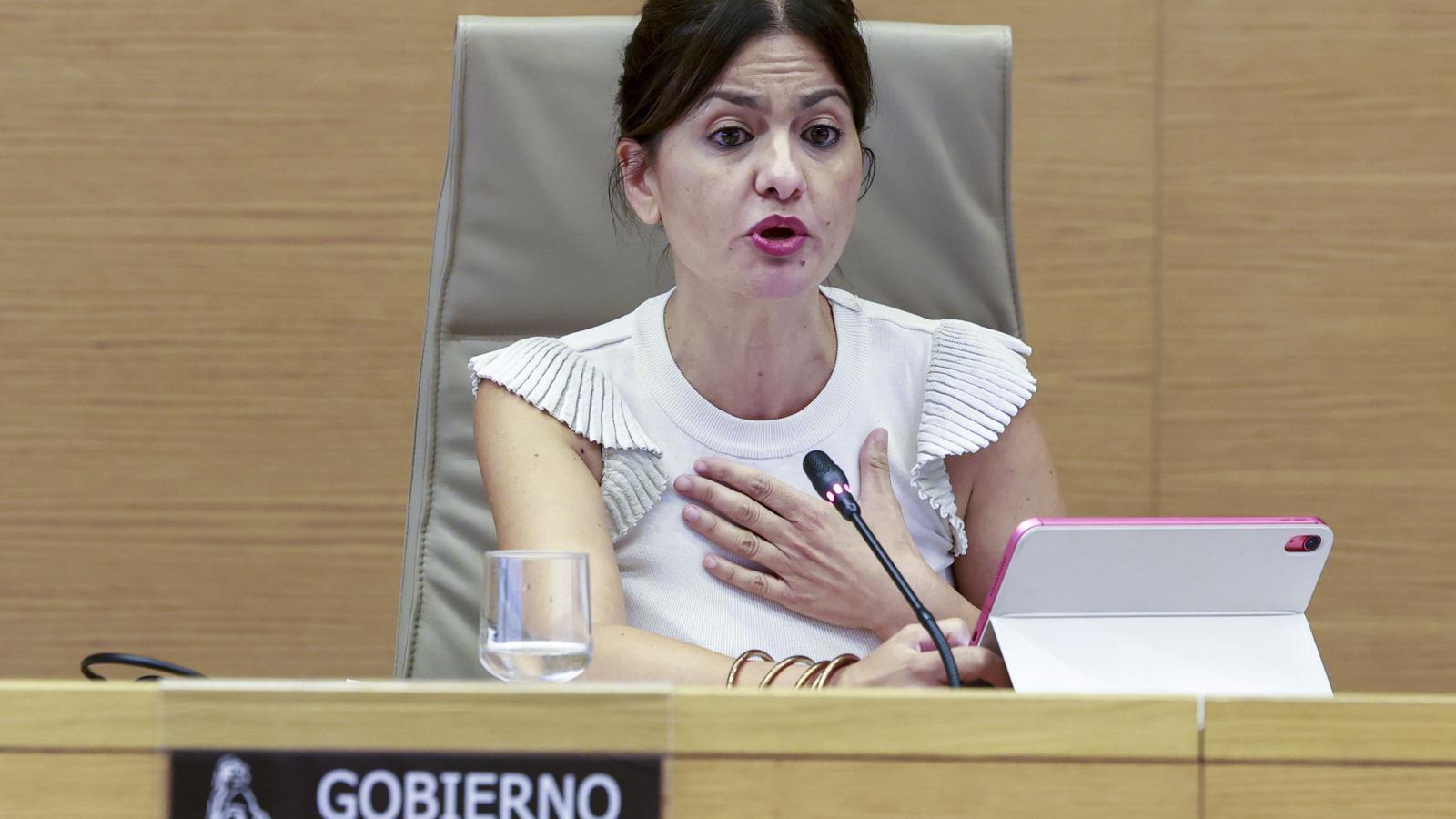

BarcelonaThe head of Youth and Childhood, Sira Rego, stated this Monday that the child protection system has registered 1,478 unaccompanied migrant children in Ceuta, while estimating that around 1,200 more are still awaiting identification. She indicated that their transfer to the Peninsula is "essential" because the city "cannot be left alone," having exceeded its reception capacity. In a appearance before Congress to report on the Spanish government's management of the migratory crisis, the minister was clear in defending the "superior interest" of minors as a "democratic conquest" that distinguishes "the rule of law from an autocracy" in the face of increasingly numerous positions demanding to set aside the law and expel migrants, both adults and minors.a "democratic conquest" that distinguishes "the rule of law from an autocracy" in the face of the increasingly numerous positions of those who demand to set aside the law and expel migrants, both adults and minors.
Rego stressed that the "change in profile" of the minors who arrived in Ceuta during the massive influx a month ago has forced her ministry to change its approach, in an attempt to justify why, a month after the massive influx, there are still no official figures and hundreds of children are not yet receiving institutional care. Thus, of the 1,478 registered children, 760 are girls "of special vulnerability," as they belong to the threatened LGTBIQ+ collective, are fleeing sexual or domestic violence, were living on the streets, or have been victims of human trafficking or forced marriage. Of these, 223 are under 13 years old. Traditionally, girls migrating alone were a minority. For example, in Catalonia, they represent less than 5% of unaccompanied minors under the tutelage of the Generalitat. Furthermore, according to the minister, "many minors under 13 years old" have entered Ceuta, a group that until now was also practically testimonial in the reception system, with a clear predominance of 16 and 17-year-old boys.
In this first intervention, the minister insisted that the family reunification of minors in Morocco remains the "priority" of the Spanish government, but indicated that returns cannot be made without following the legal procedures, such as assessing the families' capacity and the children's opinions. However, this is not always possible: as of July 30, the Spanish executive has sent 600 files to Morocco to verify if the biological families are capable of receiving the migrant child, but so far they have only received "silence," the minister clarified. "If reunification is safe, reunification happens," she insisted.
The minister indicated that the ministry is working on three alternatives for these minors. On the one hand, the transfer of 500 girls to the Peninsula, a step for which she has given neither a date nor which entities will be responsible for their reception. She only indicated that it is a possibility that can be done "immediately" and that they will be housed in "small centers" in different cities, but for now, we are waiting for the president of Ceuta, the popular Juan Jesús Vivas, to authorize the transfer.
Ceuta will maintain guardianship of these children, while custody will pass to the reception entities and not, as is normally done, to the autonomous communities. The other avenue the government is working on are "bilateral agreements" between communities, a formula that has already been used successfully on other occasions, the minister reported, who also thanked the predisposition of many families to welcome and care for these children.
In parallel, the Attorney General's Office has registered 22 sexual assaults against migrant women and children in Ceuta since the massive entry. Nine of the victims are girls and adolescents between 14 and 17 years old. There is also a man who is part of the LGTBI collective who has been assaulted. For the moment, there are eight men being investigated as alleged perpetrators.
Defense of the best interests of minors
At the beginning of her speech, Sira Rego warned the deputies: "I will not discuss whether a boy or girl deserves to have rights or not. If a girl suffering violence on the other side of the border deserves a right or not." And she was firm in making it clear that children "are not invaders but subjects of rights." Along these lines, she insisted that she will not allow "childhood to be criminalized" and reproached those who "irresponsibly" have been encouraging for weeks to "hunt migrants" in Ceuta. "Hate does not solve the emergency," she concluded.
Sexual assaults
On the other hand, since the massive entry a month ago, the Prosecutor's Office has recorded 23 sexual assaults – five of them rapes – among the migrants who entered Ceuta. Nine of the victims are girls between 14 and 17 years old, and there is also a man from the LGTBI collective, according to Efe. So far, eight suspects have been identified, four of whom are Moroccan, three Spanish, and one of Belgian nationality. The rest of the aggressors have not been identified.
In this regard, the Minister of Equality, Ana Redondo, has announced the intention to strengthen the specialized teams for the care of the attacked women in Ceuta, which currently assists nine minor girls. In another appearance in Congress, Redondo announced that the institutional response will be adapted to the needs of these children and, therefore, the maximum period of 72 hours of stay in this specialized service will be extended until a more definitive solution is found for these girls.

