The present: rice, a slice of bread and water. The future? How to avoid expulsion
A thousand people, especially young Moroccans, are sheltering in the old El Tarajal industrial estate as uncertainty grows about what will happen to them

-
CAT -
CAST
CeutaApproaching the El Tarajal border, which separates Ceuta from Morocco, these days means seeing more military personnel and Civil Guard agents than usual. Also, the maritime containment barrier installed by the Spanish government after the entry of thousands of people on Thursday, July 30th. Or that mobile phone coverage starts to fail.
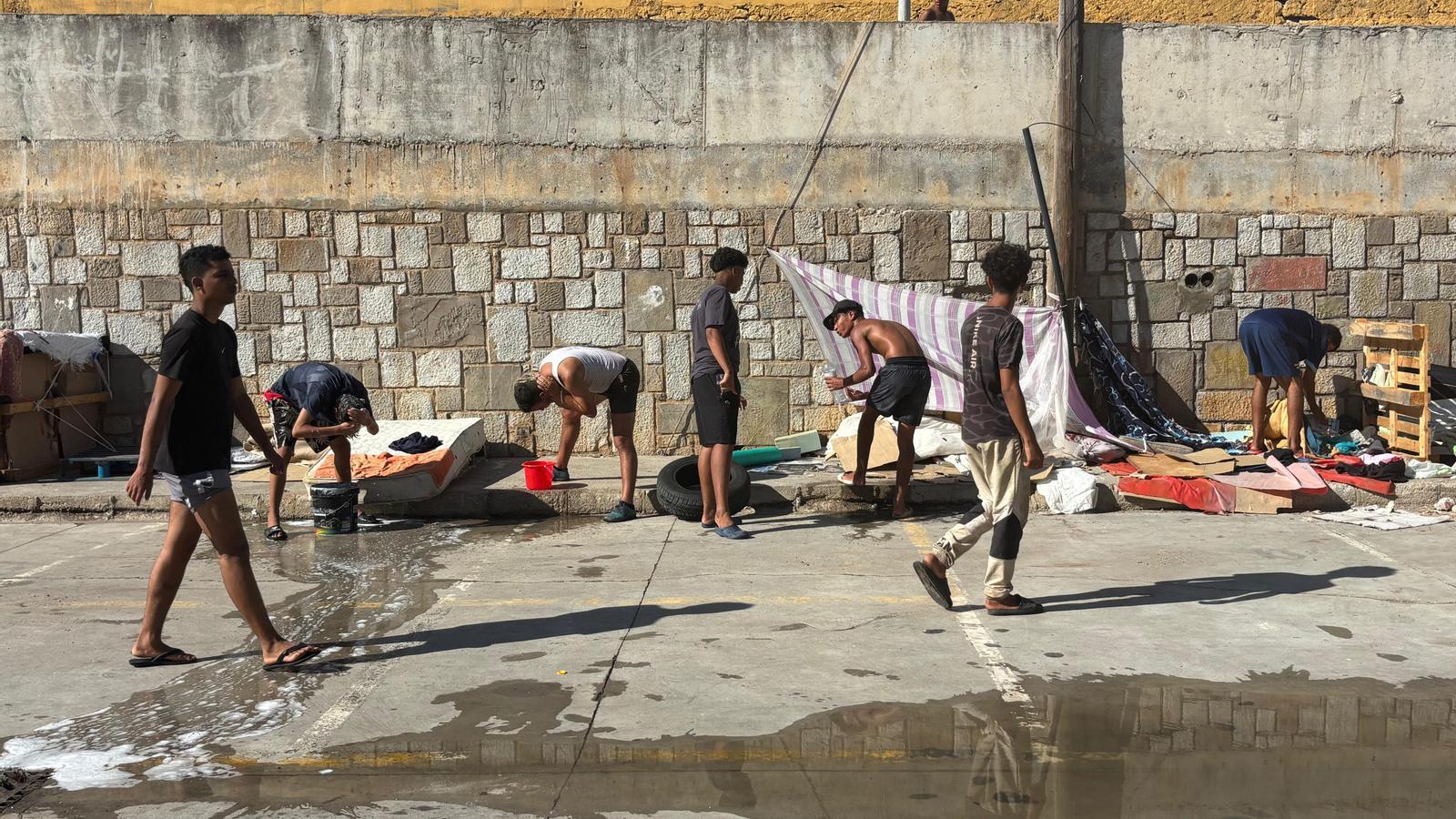
A few meters away, you can also see the so-called El Tarajal warehouses: the first of three industrial estates – the other two are La Chimenea and Alborán – which in a few days has become the settlement for a thousand people, mainly young Moroccan men, some of them minors. To a lesser extent, as their reception is being prioritized, there are women with children and some girls. From Thursday until this Saturday afternoon, ARA has been there on several occasions.
Those who remain are people who have not been returned to Morocco. Social organizations point out that there had been up to triple the number of people. Some since Thursday, ten days ago; others have been pushed by security forces due to their patrolling of the city center.
In the labyrinth of corridors connecting the warehouses, they have found a place to shelter from the abandonment they suffer while, among them, uncertainty grows about what tomorrow will bring: “Will they send us to Morocco?” “Can we stay here [in Ceuta]”? “Can we go to Spain?”, ask many young people like Muhammad (Tangier, 19 years old). He rubs his thumb with the tip of his index finger and middle finger to explain why he left Morocco. We understand each other with effort: he wants to work and send the money he earns in Spain back to Morocco. These are precious remittances for many families. “The people who are still here must know that the only way out is Morocco [...] Immediate deportation and return. That is why the army's [presence in Ceuta] must continue,” stated this Saturday at noon the president of Ceuta, Juan Jesús Vivas (PP).

Few speak Spanish. Some, in addition to Arabic, master French. The walls of the large warehouses – all closed – serve as a support wall where they have built small shacks with found materials: wooden pallets, mattresses, some old appliance... Sheets and blankets as a roof. In fact, as a result of the abandonment of the place, some of the spaces were opened up for many Moroccans trapped in Ceuta during the health crisis, when the border was suddenly closed.
There are no portable toilets. The unhealthiness is becoming heavy. Cleaning crews from the local government of Ceuta enter throughout the day with water hoses, as this newspaper has been able to verify. Sources from the Spanish government delegation in Ceuta assure ARA that the Red Cross is attending to the injured and, if necessary, they are referred to health centers and the hospital. “Solutions are arriving, but coordination is difficult. Everyone wonders who has competencies and the days go by,” describes Halima, a social educator from the Luna Blanca organization. “There is a lack of political will,” they add from the NGO.
Water and food
This Friday afternoon, for the first time in seven days, a large army tanker arrived with water so they could shower. In line, supervised by the army, people with plastic bottles and buckets of water are directed one by one. They drink and take the opportunity to wash themselves. Some are doing it for the first time since arriving in Ceuta. They see it as a godsend.

“The [water] bucket isn't for fooling around,” exclaims one of the men controlling the army cistern's tap when one of the children runs off with the water and heads, with a smile under his nose, towards the others to get them wet. They are playing.

Luna Blanca, one of the organizations in Ceuta that is in charge of distributing food, they distribute a hot meal a day. “We are distributing 1,200 to 1,300 rations,” says Mustafà, president of the organization. This Sunday it’s rice, a slice of bread, and water. The National Police are in charge of organizing a queue. Impatient to reach the volunteers, many young people try to cover themselves as best they can from the harsh sun. It is 3:30 PM. Today, 86 people will be able to repeat.
“This easterly wind makes the humidity stickier. [This climate] bores you, agitates you, overwhelms you,” says the NGO representative while distributing food. The tired faces of those who have seen water and food arrive drop by drop for days are evident. Some cannot imagine that just a few meters from where they are, returns have been occurring throughout the week, and that the Spanish government has always declared them as voluntary, even though some NGOs have warned of possible illegal expulsions. “Is a return in these conditions, with almost no water or food, voluntary or is it a forced voluntariness?”. This is a reflection that hovers over Ceuta among the entities, while the humanitarian emergency situation shows no sign of ending soon.
