A hot meal a day for 5,000 people
White Moon is one of the organizations in Ceuta that distributes food among migrants due to the saturation of institutions

-
CAT -
CAST
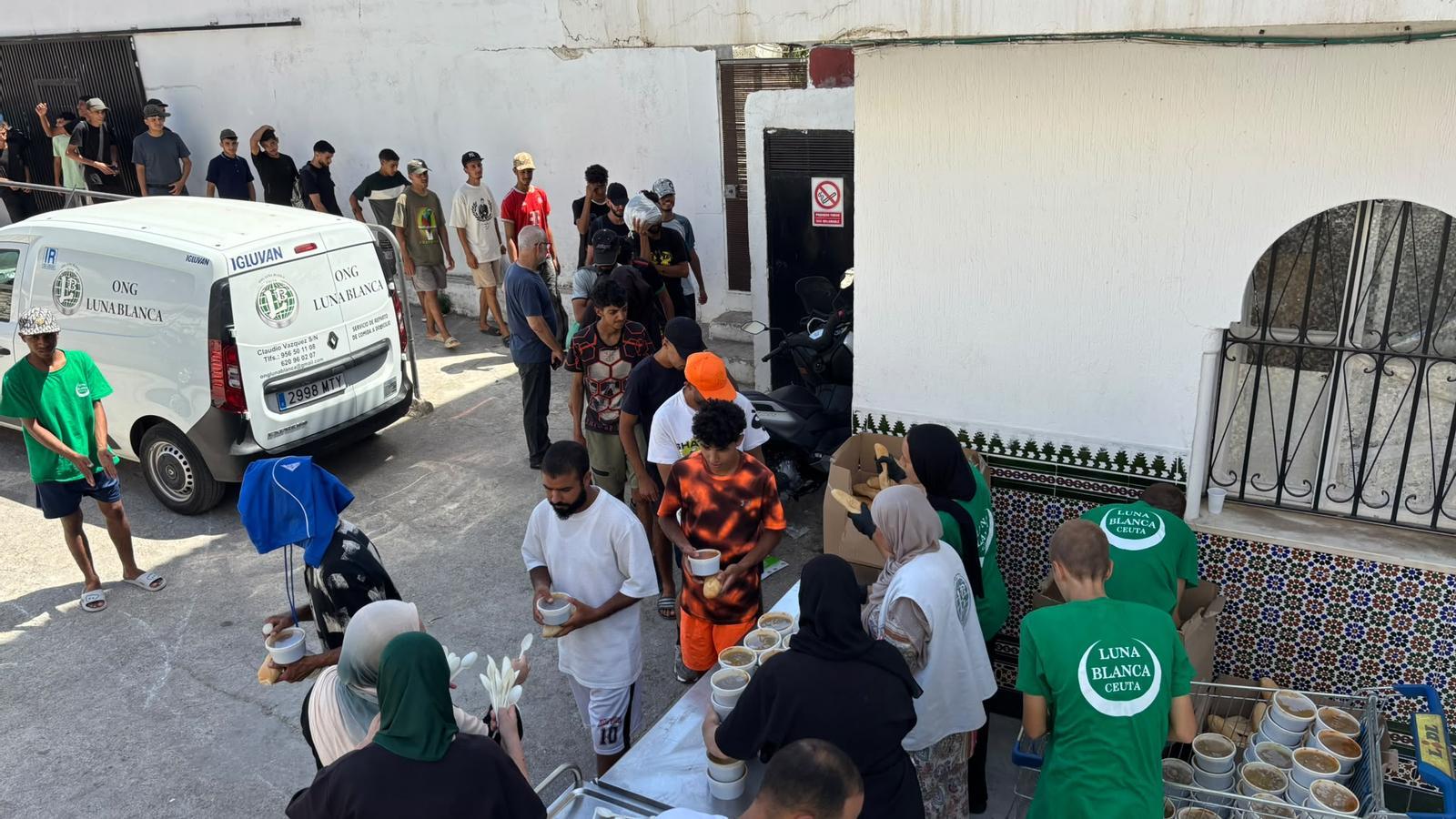
CeutaThe kitchens of the NGO Luna Blanca, located in Ceuta for more than 40 years, start up early in the morning. They have to cook many pots of food for midday. This Friday it's time for harira, a traditional Moroccan soup made with tomato, legumes, vegetables, noodles, and aromatic spices. Also a small piece of bread and lots, lots, lots of water. It will be the only hot meal of the day for many of the people who on Thursday swam desperately from Morocco to Ceuta and who continue to be in the autonomous city. Pasta with tomato, legumes, beans, or broad bean soup, a typical Ceuta dish, have been the menu on other days. "Very good, very good, very good!", exclaim many of the young people who haven't yet found shade to sit and eat, in broken Spanish, as they hurry to take the first spoonful.
The food distribution begins at half past three, once they have finished their rounds around Ceuta. Mousafa, the president of Luna Blanca, and other volunteers travel by vans to different points in the city: the industrial estate, some peripheral neighborhoods, or even to the headquarters of other organizations. They also leave lunchboxes among small groups of young people they find on the streets, the organization explains. "This doesn't look like it will end soon," anticipates Halima, the organization's social educator. A message that all the citizens of Ceuta have internalized. "This situation these days is unusual," she adds.
Around Luna Blanca, located on the ground floor of the Sidi Embarek mosque, people gather hours before distribution to collect their food. The luckiest wear caps; and those who don't, use a cloth, even their t-shirt, to protect themselves from the scorching sun. These days, Luna Blanca is serving an average of 5,000 people. Not only migrants who arrived in the autonomous city a few days ago, but also many other people from Ceuta whom they were already assisting and who did not have a guaranteed hot meal a day. The volunteers, whose numbers have grown in recent days, are responsible for establishing an order to avoid rushes or tensions, ensuring everyone leaves with a bag of food in their hands. Hunger bites. In small groups, they enter through a makeshift corridor with fences until they approach the table where Halima, Mousafa, and other volunteers distribute the lunch.
These entities, but also many organized neighbors from different neighborhoods, have become an "executive arm" of public administrations. This is how Halima defines it. "They can't cope. Institutions turn to associations like ours that know we have infrastructure like a kitchen or vans, and therefore, they send us raw material aid [food], so we can cook it," she explains. The truth is that in a few days, the ground floor of the mosque has gone from being a space with rooms for workshops or training, to being an immense pantry where durable products like pasta, legumes, or rice are accumulated, but also milk, cookies, or muffins that they distribute at other times of the day.
Once the food distribution is over, the interior of the organization opens so that women and children, especially, can use the toilets and showers. "Women cannot clean themselves in the mountains, men have it easier," reflects Halima, who says that "what they tell us most is that they want to shower," indicates Halima, who has been asking for more towels for days. The truth is that Luna Blanca has also become a supply point for basic items such as basic hygiene products, sanitary pads, diapers, clothing, or shoes. Also a kind of health center. Some people still with injuries from the sea crossing are treated there.
