Teachers make themselves heard in the street but respect the first day in the classrooms
Education puts the strike turnout at 12%, while the unions raise the figure to 30%
-
CAT -
CAST
BarcelonaThe unions were clear that this Tuesday's strike call was a “difficult” one. Difficult because they did not want to lower the tone or the demands, but, at the same time, the first day of school "is a very important day," the sector's union leaders admitted to ARA just a few days ago. Thus, the turnout for this new day of protests –the sixth this year– has been much lower than in previous calls. Education assures that 12.6% of teachers have joined the strike, while the unions raise this figure to 30%.
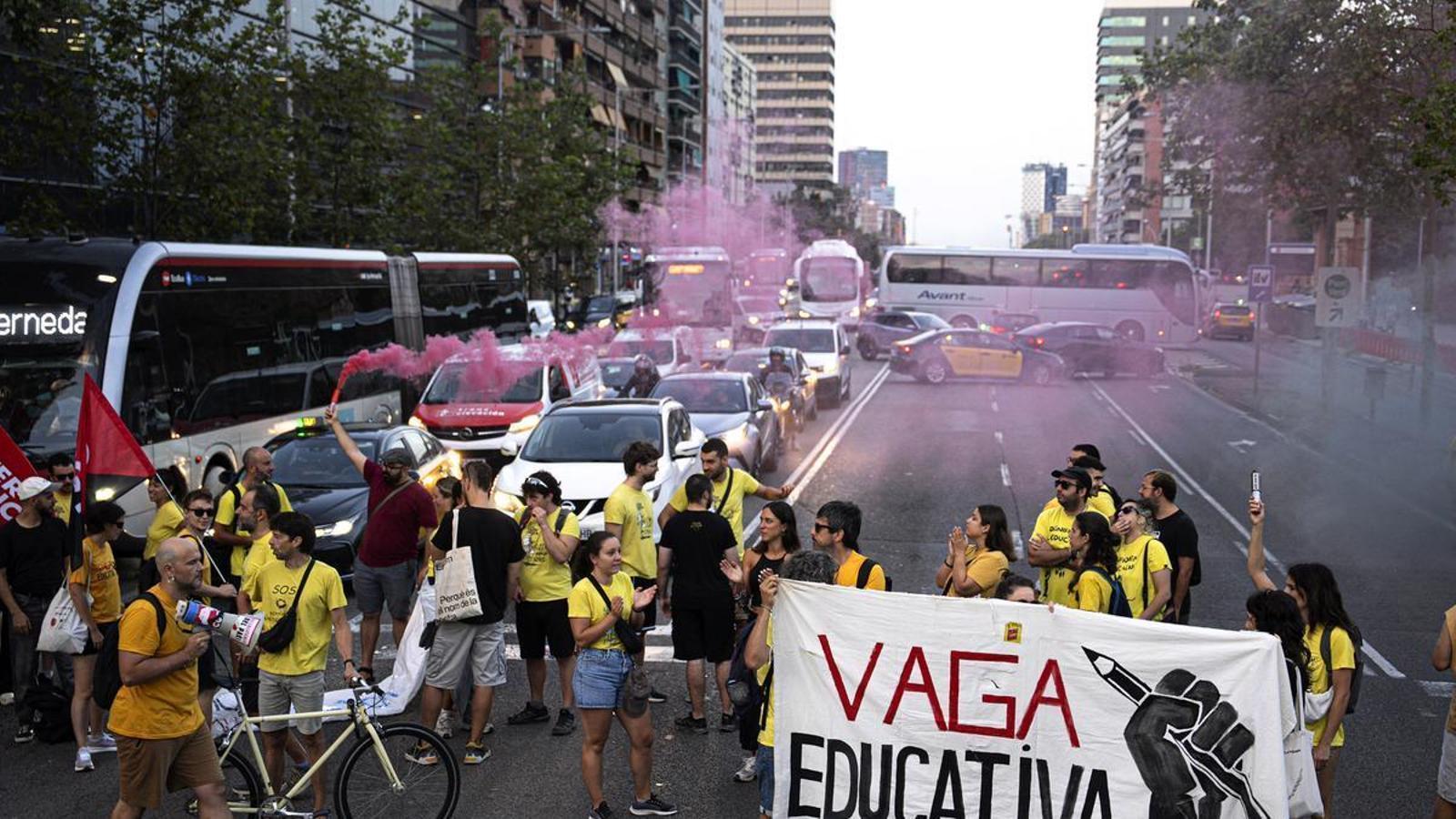
However, those who took to the streets made an effort to convey their discontent. At 7:30 in the morning, almost simultaneously, different columns of protesters began to cut off the main access roads to Barcelona and also those in other parts of the country. They started with the Ronda Litoral and the Ronda de Dalt in the Catalan capital. At practically the same moment, another group of dozens of teachers and professors organized to paralyze the Gran Via de les Corts Catalanes. At this point, there were even some moments of tension when the Mossos d'Esquadra deployed a large number of officers, who arrived in six police vans. Union sources claimed that they intended to evict them and the protesters received them with shouts of "We are teachers, not criminals".
The pickets and roadblocks were not limited to the Catalan capital. In Lleida, teachers blocked the AVE high-speed train lines and in Tarragona, protesters disrupted mobility in the area of the Francolí Industrial Estate. There were also road closures on the C-58 in Sant Quirze del Vallès heading towards Barcelona and on the C-55 in Manresa, among others.

Reunions in the classroom
And while this was happening, at 9 in the morning the centers opened their doors and the school year began quite similarly to previous ones, amidst doubts, excitement, reunions, and some gestures of resignation in front of the yellow signs hung outside. “There’s Lola, I hadn’t seen her in a long time!”, “I think there are spaghetti for lunch today”, “Surely they’ve changed the balls”, some children commented at the doors of the Institut Escola Eixample, in the center of Barcelona. The image of teachers reuniting with their students has also been practically the same as in other years in many centers, despite the strike.
On the street, parents were also reuniting –not with the same joy as the students– and were commenting, among other current topics, on the new day of teachers' strikes. “The boy wants to come to class, he needs to go to class”, Maria defended. “We haven’t considered whether or not to bring the boy because we work, there is no option”, Carlos and Dauli explained. “They have explained to us that there would be minimum services and we trust that the children will always be well cared for”, add Ramiro and Tere.
At the gates of another school, in Sant Antoni, another mother was doing everything possible to reconcile it all: "I'm bringing the little one for the adaptation, because she's starting I3, but I'll keep the older one with me because if there's a strike I don't want her to be in the playground all day," she argued, visibly unhappy. Other parents, however, viewed the strike management by their school positively: "Today it's their turn, tomorrow it might be mine. We are all workers," comments Carlos. Ramiro also does not express disagreement as long as minimum services are maintained, and celebrates that there are protests at the school entrance: "Otherwise, we would leave the children at school and we wouldn't know what is really happening inside the classrooms," he says.
Once the moment of opening the doors had passed, the focus of the day returned to the street. At 10 in the morning, the protesters gathered to begin the demonstrations. In Barcelona, the march moved from Plaça Urquinaona to Sant Jaume, where an assembly and speeches were held. The Urban Guard estimated that about 1,800 protesters gathered at this point, far from the 30,000 that USTEC calculated during last November's demonstration.
Niubó: "It's not the start of the school year we would have wanted"
At the same time the demonstration ended, around 12 noon, Minister Esther Niubó appeared at a press conference. "It is not the start of the school year we would have liked," she admitted, in clear reference to the results and errors in the PISA tests and also to the teachers' strike. The minister insisted that, beyond labor negotiations, the department wants to hold a debate "with the entire educational community" about the challenges the system must face in the coming years with the goal of reaching "new consensuses".
The goal, the minister said, is to have representatives of school leadership, families, teachers, and pedagogical entities sit at the same table. "It is a leap forward to see what education we want for the next 10 years," she stated. Among other issues, this debate must address what model of inclusion or reception should be in place, what teacher training should be like, and the use of technology in classrooms.
The minister did not specify dates, but said they have the willingness of the parties (including Health, Social Rights, and the local world) and assured that in the coming days "there will be news." Meanwhile, Niubó said she will continue meetings with the unions to address the more labor-related aspects.
The head of Education did not go into, during her appearance, assessing Catalonia's results in the PISA tests and maintained that doing so would be "political fiction." However, she admitted that the tests mark a generalized decline, both in reading and mathematical competence, a fact that prevents her department from being satisfied. In fact, she said these results are one more reason to open the debate with the educational community and be able to "talk about everything and with everyone".
Regarding the debate surrounding her figure, the minister was clear in an interview on RAC1: "I am not resigning because it would surely be the easiest thing to do in the face of a complex scenario. I am very clear about my job," defended Niubó. "I am not proud of the educational system I inherited, I want to leave a stronger system and in better conditions for our sons and daughters," she concluded.
