The dilemma of sending the ES-Alert or not: "Moving in the Ebro was not safe"
The deputy director of Civil Protection, Imma Solé, admits that it is an intrusive tool, but that sometimes it is difficult to predict if the effects on the territory will be large

-
CAT -
CAST
Barcelona"I wish we had the absolute certainty that it will rain a lot or a little, but we don't," begins the deputy director of Civil Protection, explaining after another complex week, with strong torrential downpours that have once again put the country on alert, the latest being in the Terres de l'Ebre. She describes how meteorologists use models based on statistical data that mean they always have to work with probabilities, even if they are high, regarding whether the rain will be a risk to the population or not. And all this added to a territory like Catalonia, with diverse orography, with mountains near the coast, valleys, plains, and mountain ranges, which makes it all even more difficult to predict.
And it is in the midst of this situation that Civil Protection has to make decisions such as whether to send an ES-Alert or not – "We know it is an intrusive tool in people's lives," admits Solé – or to limit mobility and close services. The deputy director distinguishes between two types of ES-Alert. One type is more preventive, like the one sent to the coast this Monday night or to the Terres de l'Ebre on Thursday evening in view of the forecast for torrential rains. According to Solé, they are activated when the meteorological warning reaches the upper levels, specifically a level 5 or 6 out of 6. "In the south, we had a high probability that the rains would impact the territory, and that has been the case," the deputy director states this Friday.
The second type of alert is the one that warns of something when it is already happening, when the storm has been stalled for a long time in one place, for example, as happened in the Baix Empordà on Tuesday afternoon or as has happened this Friday morning in the Delta, when the population was asked to confine themselves. These alerts, which sound the same as the first ones, also usually order specific things to the population, such as not approaching riverbeds or directly staying at home.

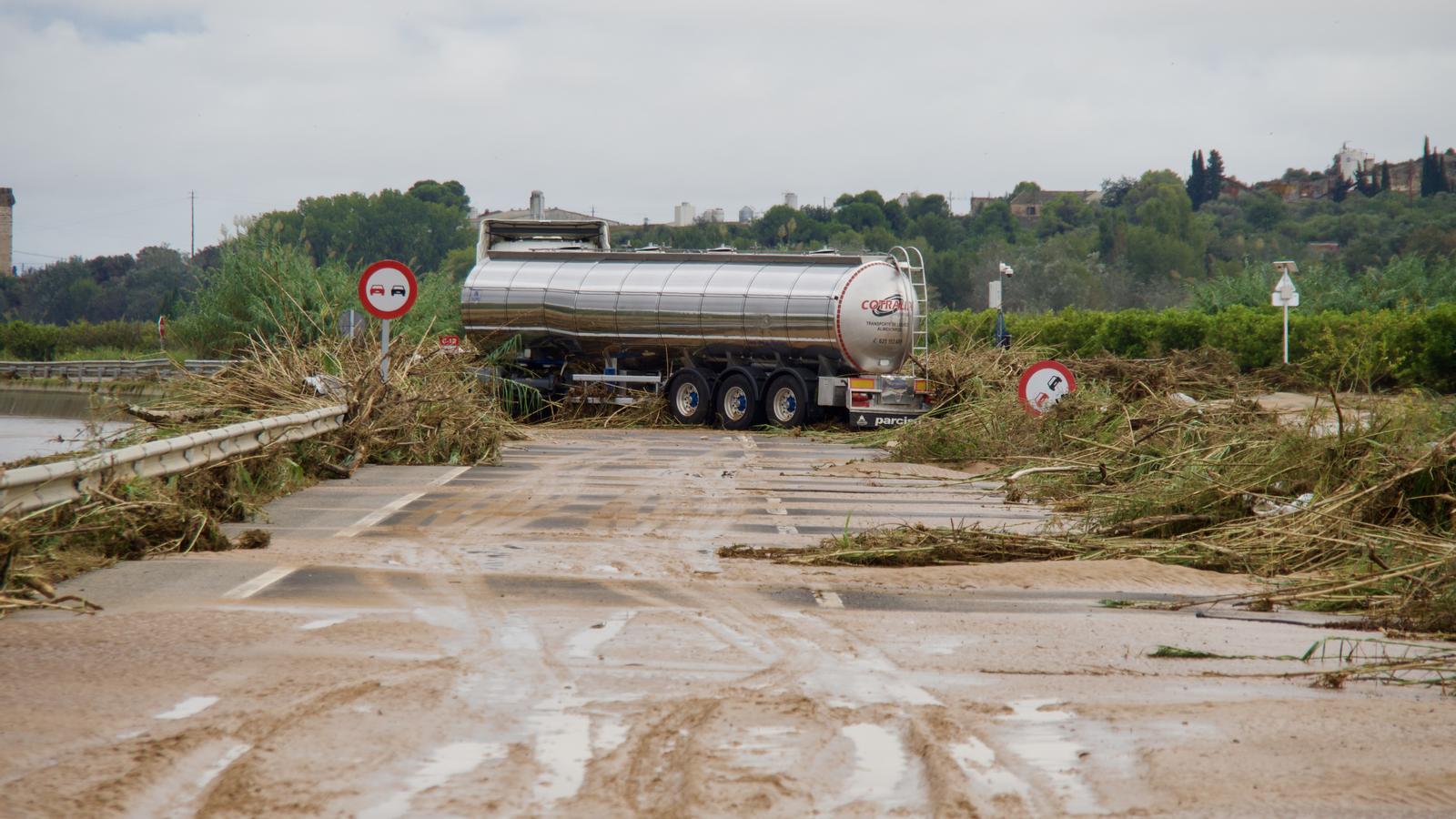
"We always try to warn beforehand. If you warn when it has already started, you are already late," explains Solé, and admits: "Sometimes they will tell us that we warned so that people wouldn't go out into the street and it has been sunny all morning. Well yes, in this area it could have rained or not, but it could have happened that it rained." In the Ebro, however, this Friday morning it was raining and a lot. And it had already been raining all night: "After the whole night, there have been quite a few Firefighter operations underway, mobility was not safe, and confinement was opted for," justifies Solé.
Localized or global phenomena
In fact, in this sense, Solé explains that it is even more difficult to predict –and, therefore, to warn– when the downpours are like those of the last few days: localized in a spot where a lot of water falls in a short time, so fast that they can barely send an alert. On the other hand, generalized phenomena, such as when there is an easterly storm, a DANA or a strong windstorm that can affect a large part of the country, are easier to predict. It is also in these contexts that they see it as more feasible to send generalized alerts and order restrictions. To evaluate the evolution of an episode and decide whether to issue new warnings, Civil Protection also monitors in real time the spikes in calls to 112 and the information from the Fire Department, the Mossos, the ACA, and the city councils. This Friday morning, precisely, there was a high simultaneity of incidents.
Solé admits that the alerts are intrusive and that they have been working for some time on a kind of milder pre-alert. In fact, when they send an ES-Alert, the server already offers them this possibility after several conversations with the Ministry of the Interior, which is the body the system depends on. The main problem is that the vast majority of mobile phones have this pre-alert option disabled by default. This summer, iOS and Android have already activated it in an update that has affected all devices. This now gives the green light to Civil Protection to be able to test the new system.

Drill in sight
Now that the phones are ready, Civil Protection will soon organize a drill in a specific part of the territory to test the sound and the form of the alert. In parallel, they also have their sights set on the future, as Solé explains that they already see how the system will evolve towards satellite technology. This will allow for the delimitation of very precise geographic rectangles, avoiding the current limitation of terrestrial telephone antennas, which cover the entire radius of their antenna in a circular way.
Solé states that ES-Alert notifications are one more dissemination tool that has the great advantage of being able to reach almost everyone with certainty: "I believe we are sufficiently protective, I think that sometimes regarding the topic of safety we might go a bit too far," he comments. In parallel, he insists on the need for the population to impose self-protection measures at these times: "If you open your front door and there is a lot of water, do not go out, wait. And if you are driving and you get caught in a heavy downpour, pull over to one side, leave your lights on and stop," he recommends.
