The debate to redefine education begins: now the topics will be chosen and the proposals will arrive in April
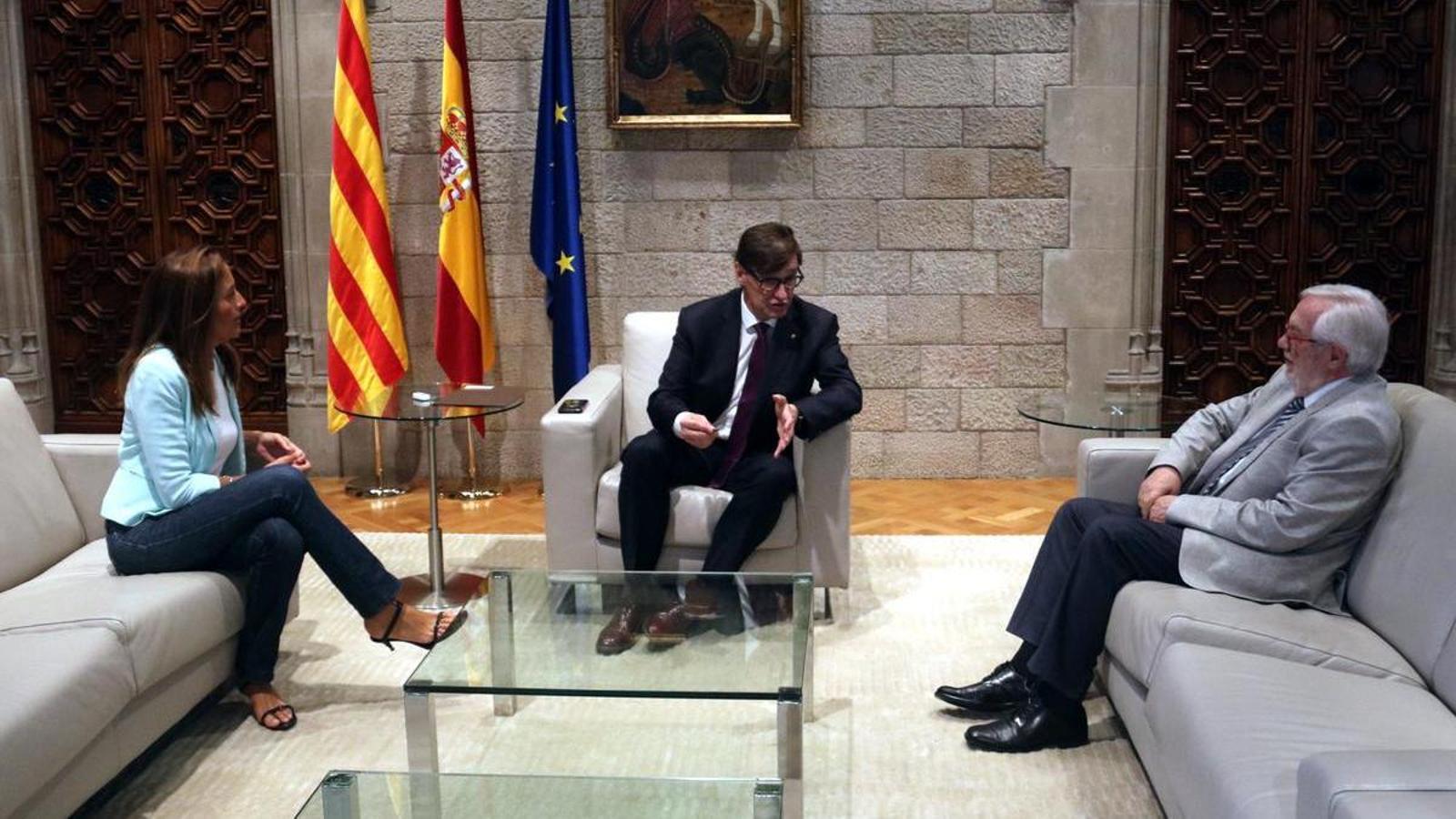
President Illa entrusts the Education Council to lead the transformation with teachers, centers, families and administrations

-
CAT -
CAST
BarcelonaTo lead a "broad" and "calm" debate that allows for overcoming the educational crisis. This is the task that the President of the Generalitat, Salvador Illa, officially entrusted this Monday to the president of the Education Council of Catalonia (CEC), Joan Manuel Del Pozo. Del Pozo will be the one to lead the country-wide debate to redefine the Catalan educational model. A dialogue that aims to "rebuild consensus" and "reconstruct" bridges with the education sector, as explained by the regional minister, Esther Niubó.
The work schedule is set in motion this very month: this Friday the space will be presented to the parliamentary groups, and before the end of September, the CEC will have to choose the topics to be addressed and the working teams. This was detailed by Del Pozo himself during the press conference following the meeting with Illa and the minister. Although the central areas are yet to be officially defined, the minister has already put forward those she considers essential for the agenda. "Inclusive education; reception of newcomers; teacher training and workload; the role of technology in the classroom, and school autonomy," she enumerated. "All of this to reinforce basic concepts and results in mathematics, language, and reading comprehension," affirmed Niubó.
The CEC has set the month of September to make the final selection of priority topics and also of the working teams. During the months of October and November and the working days of December, the process of active listening to the sector will take place: meetings that will be divided by working commissions and will be held throughout the territory, with the participation of teachers, management teams, entities, and also representatives of local authorities. In total, there will be groups of between 50 and 100 people for each issue.
Once this first phase ends, the CEC has set the months of January and February to hold deliberations on each of the key points and on the proposals and concerns conveyed by the sector. Finally, during the months of March and April, a report will be prepared with all the reflections and, if applicable, recommendations to improve the Catalan educational model. The goal is to have closed the debate before the arrival of the municipal elections.
"We have experienced a convulsive academic year"
The president of the CEC –which is made up of 75 members and is the supreme body for consultation and participation of social sectors in educational matters– explained that this dialogue aims to overcome the current moment of "tension" to move towards a "serene and honest" debate that includes not only the unions, but all actors in the sector. "We intend to open a debate of trust to address whatever is necessary. We have experienced a convulsive academic year and, although agreements have been reached, an atmosphere of conflict and mistrust remains. We must return the debate to a space of greater trust," he assessed.
In turn, the minister also defended the need for a new national pact. "The National Pact for Education dates back to 2006. In 20 years, society has changed, education has too, and the context of new technologies, which are advancing at a dizzying pace, has as well," she argued. "A new shared reflection is needed, to take action and overcome the malaise resulting from years of unmet needs and a legitimate demand for recognition," added Niubó.
Regarding whether the Educational Assembly (AEC) would have a role within the debate as its own entity, Del Pozo was clear and explained that the teachers whom the assembly represents will be able to participate in the debate on an individual basis, but the assembly itself has "a difficult fit in the debate due to the very nature of the assembly movement." "They are not prohibited from participating, but being realistic, it is difficult to do so as a group," said the president of the CEC. The Educational Assembly is a new entity, outside of the unions, which was created from each of the school and institute assemblies in Catalonia and which has already become a powerful actor representing teachers, with great strength during the mobilizations of the last academic year.
