The connection between the crime on Balmes street and the port with the most cocaine in Europe
The victim is of Serbian origin and Belgium was looking for him to introduce drugs on the coast of Antwerp

-
CAT -
CAST
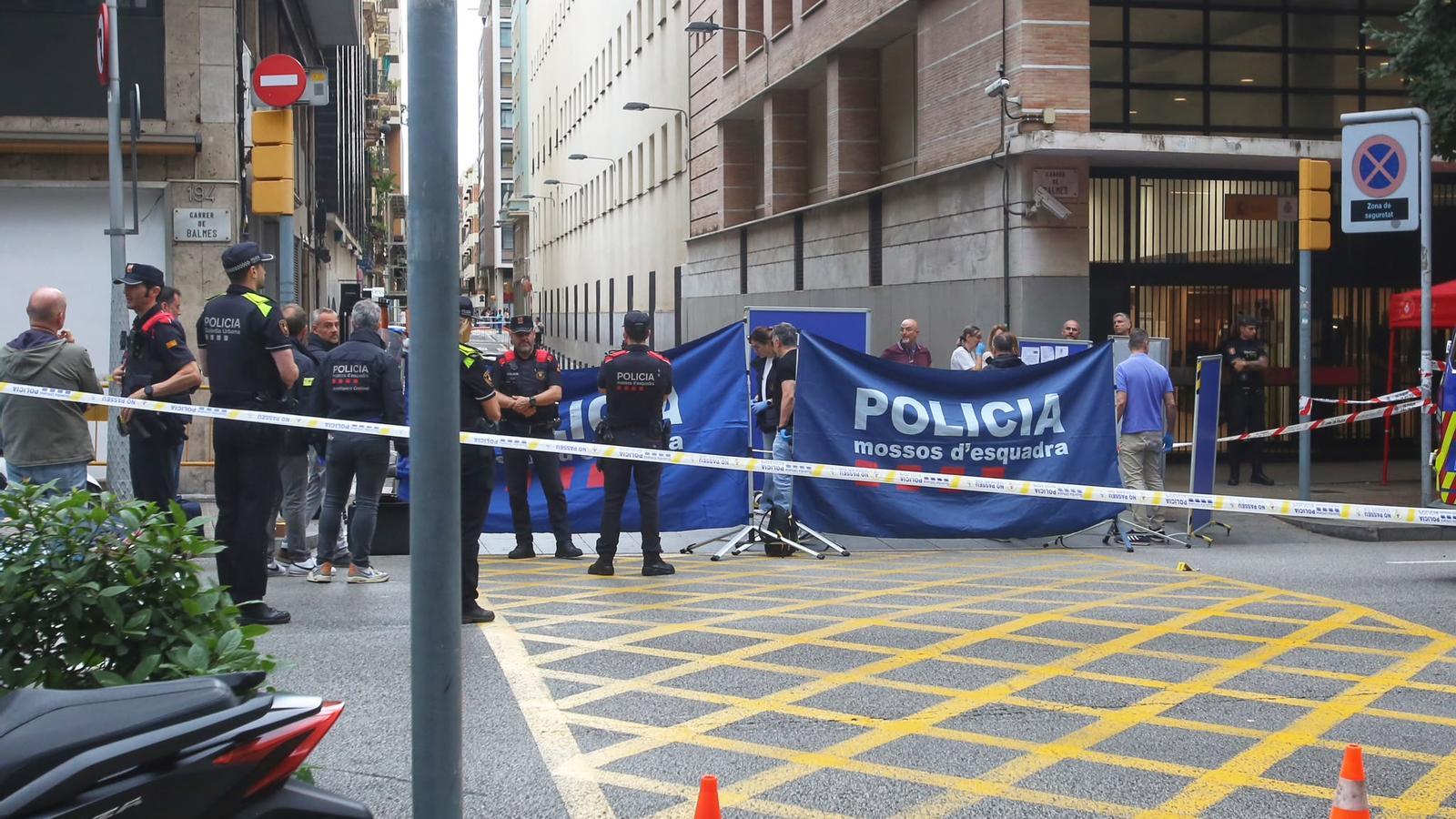
BarcelonaHe was a white-skinned man, bald, with several tattoos all over his body and dressed in sportswear, with a Barça jersey and bermuda shorts. He was dead, lying on the ground on Balmes street, in front of a police station. He had been shot in the head. The police station cameras showed the whole scene: another white-skinned man, dressed in a beige t-shirt and bermuda shorts, with a helmet in one hand and a pistol in the other, had approached him and shot him in the back. Who was the victim? This is one of the first questions the investigators from the Mossos d'Esquadra asked themselves as they searched for the perpetrator, who left the weapon, the helmet, and a mobile phone at a bus stop in Gal·la Placídia and fled.
Finally, the police have managed to identify the victim. It has been difficult. His fingerprints did not yield results. Furthermore, he had several identities in different countries, all false. The fingerprints, however, eventually corresponded to Belgium: the police of that country were looking for him as one of the leaders of a mafia that was introducing cocaine from South America into Europe through the port of Antwerp. This did not surprise the investigators either: Antwerp, located in the north of the country, in the Flanders region, is the second largest port in Europe and where the most cocaine on the continent is seized, according to the ranking of the European Union Agency for Drugs. This report places the port of Barcelona in sixth position.
In Antwerp, 442 tons of cocaine were found in 2024, triple that of the port of Rotterdam (Netherlands), in second place in the ranking. The two port infrastructures, in fact, are separated by just over a hundred kilometers. European reports also indicate that Antwerp is particularly vulnerable because it is a port with a lot of cargo traffic and, in addition, it is highly automated and there are many logistics intermediaries, which facilitates infiltration into management companies.
Origins and clans
The victim on Balmes street, despite being sought by Belgium, was a man of Serbian origin. This led the Mossos to initially link it to the war between two Montenegrin clans that has already left three confirmed victims in Catalonia in one year. Now, however, the port of Antwerp has opened a new scenario: it is clear that it is a revenge between drug clans and that someone hired that hitman to shoot him in the head, but it is not yet known which criminal groups are behind this execution. Nor has it been ruled out that the shooting incident that occurred two days earlier in the Zona Franca – where a man of Serbian origin also died – is linked to the one in Zona Franca. Police sources speak of increasingly fluidclans, which blur into each other, making it difficult – especially if they are from abroad – to know who is who.
Another question investigators asked themselves was what this man was doing in Barcelona. And the answer is that he lived there. In fact, the Mossos are looking to see if the man was leaving – he was wearing sportswear – a gym located a few meters away. The police are already talking to this gym, according to sources from the center. Within the discretion of being wanted by justice, everything indicates that the man was settling in Barcelona.
Barcelona as a hiding place
The main hypothesis is that he was hiding in the Catalan capital, a fact that fits with other crimes of the same type that the police are investigating. These are people on the run from justice who hide in Barcelona and try to maintain a low profile, until a rival clan finds them. In fact, they point out that their presence does not imply that the criminal structures behind them have also been implemented following in their footsteps. Rather, according to sources consulted by ARA, Barcelona is more of a hiding place than an operations center, a fact that greatly worries the police. Nevertheless, police sources admit that the assassin's actions – in broad daylight, in front of a police station, leaving the weapon and a mobile phone in plain sight – were very strange. A national police officer even pursued him, but lost him.
After the six shooting deaths in three months that have occurred in Catalonia, the Minister of the Interior, Núria Parlon, has reproached Junts and the PP for creating "unnecessary alarmism" about security. "We continue to have the lowest rate per 1,000 inhabitants for homicides in European countries," Parlon stated this Wednesday during the control session in Parliament. The socialist assured that Catalonia "does not have a serious security problem," but rather that these are crimes with low but "highly sensitive" rates. She also pointed out that crime in general is "systematically decreasing" below the average for the whole of Spain.
The spokesperson for Junts in Parliament, Salvador Vergés, has denounced that the country is experiencing a situation of "insecurity" and has urged the Government to reverse the situation. For her part, Lorena Roldán (PP) has said that Catalonia is becoming the "Wild West" and has pointed out that minor crimes are decreasing, but serious ones are increasing. "We are working responsibly and we have alerts in place regarding the homicides that have occurred," Minister Parlon limited herself to stating.
