The incredible Pogacar generates opposite feelings: "I have a love-hate relationship with him"
The Catalan cyclist Marcel Camprubí reflects on the Vuelta, which begins this weekend with the Slovenian as the main attraction
-
CAT -
CAST
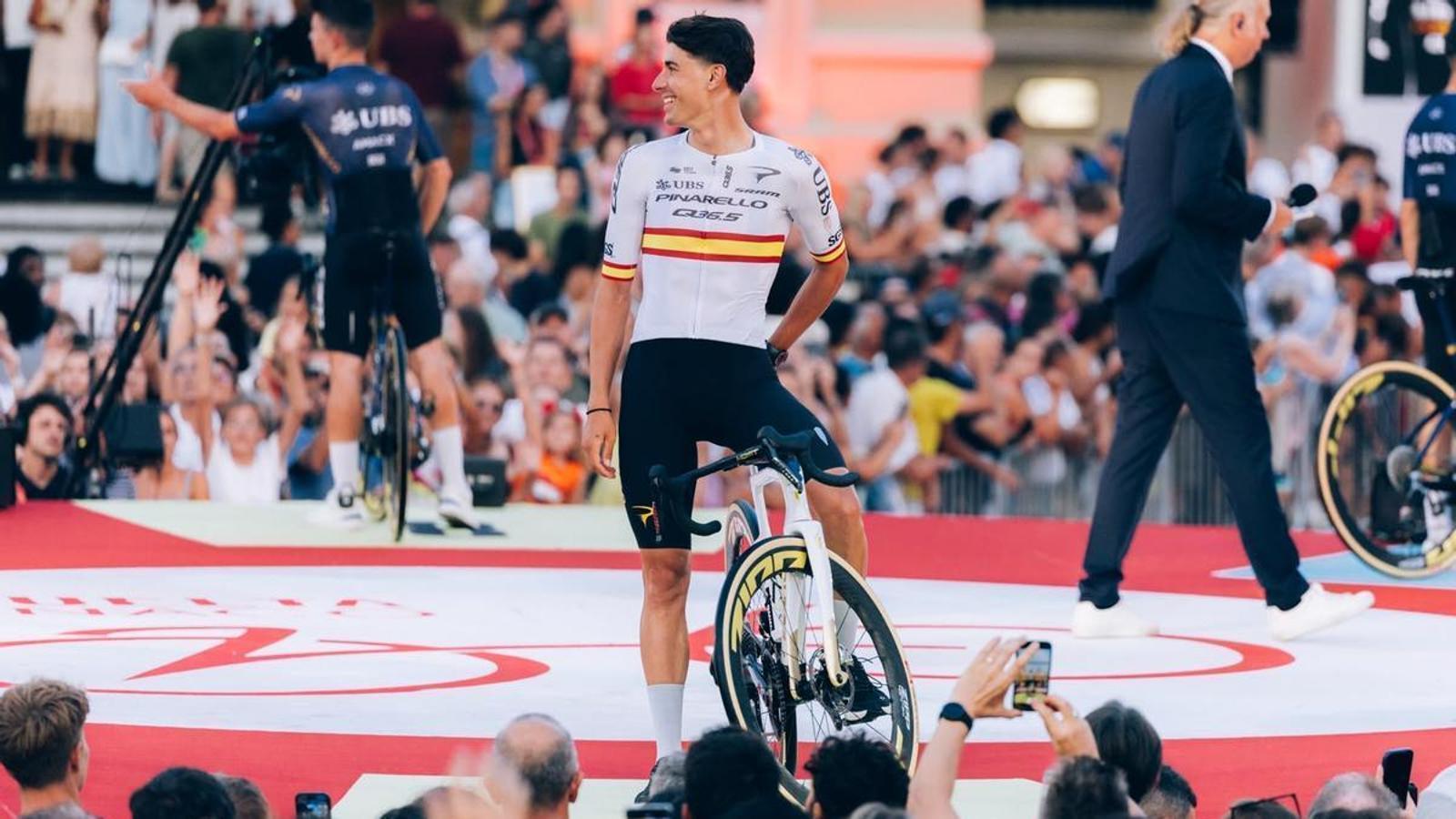
BarcelonaAfter winning the Spanish road championship last June, everything has gone quite smoothly for Marcel Camprubí (Barcelona, 2001). The triumph was a final duel with fellow Catalan cyclist Joel Nicolau on the tough Sabiñánigo climb. “Joel is a rival and a friend,” Camprubí explains to ARA. “He rushed a bit at the final sprint and I was able to finish him off and win. I also have the sadness of seeing him cry as he crossed the finish line. It was a bit bittersweet,” Camprubí concludes. His sports director at the Pinarello Q36.5 team is also Catalan, Àlex Sans, who he highlights was key to his victory and how he helped him through the earpiece with key phrases he received at the right moment: “He told me to come in third in the sprint.” And Marcel did. Also that “it would be a long sprint,” and so it was. And at certain moments Àlex made Camprubí understand that he was the strongest cyclist in the group and to trust himself. “It was brutal,” Àlex Sans recalls via message to ARA. Ambition shines in Marcel with his broad smile as he waits to see how his body will react when the action kicks off at La Vuelta on Saturday when the cat is let out of the bag.
Marcel arrives at La Vuelta with confidence
Before leaving for Monaco, where La Vuelta begins on Saturday, he trained for two weeks in Andorra with a very tough preparation and eager to compete, because like cotton, competition "doesn't lie". He was able to do his last quality training session 5 days before starting the first effort of the race, which will be Saturday's time trial that will kick off the season's third grand tour after the Giro and the Tour. "The individual time trial of 9.4 km will be to activate, I'm not coming to look for the stage or the general classification". The race will be very tough with the bulk of the route through southern Spain with a lot of heat. The first strong dish will arrive on the fourth stage at a restaurant in the Andorran mountains. Sportingly, Marcel has taken a step forward regarding his participation in La Vuelta compared to his performance last year. "I arrive in better shape than in 2025 and with more confidence. I think I can be a protagonist in some stages". The type of days that best suit his profile as a cyclist are tough stages, without ruling out the possibility of entering a breakaway on a day that ends on a tough and explosive climb. One of his teammates in the team for this Vuelta is David de la Cruz. The cyclist from Sabadell, stage winner in the Spanish tour and who wore the leader's jersey in 2016, is in his final stretch as a professional at 37 years old. "For me, he is a benchmark. Very intelligent, very ambitious and detail-oriented. He is a book, you can learn from him constantly," adds Camprubí. He also highlights his sense of humor and his ability to generate a good atmosphere within the team.
The injury that changes everything
Marcel, before becoming a professional cyclist, was a high-level triathlete and achieved a podium finish in the Spanish junior championships. Later, he suffered a foot injury (necrosis of the scaphoid bone). He fought it for a year but couldn't overcome it. Afterwards, the pandemic arrived and he couldn't run due to the necrosis, nor could he go swimming in the pool; he could only cycle on the trainer. After the lockdown we all endured, he had only been able to train one of the 3 triathlon sports and decided to try bicycle competitions, which he loved. Quickly, he saw that he was good at it, facing the adrenaline and nerves of being in the peloton and the descents without added difficulties, and he achieved second place in the U23 Spanish Championship. That was the turning point to fight for the possibility of becoming a professional cyclist, a feeling he had never had before, and therefore, "it was worth trying." After 6 years in the world of cycling, he would hardly have thought that he would achieve the title of Spanish champion and that he would be a few hours away from returning to the Vuelta, where the Slovenian cannibal Tadej Pogacar is also participating this year after winning his fifth Tour. “It’s a love-hate relationship with him. We all admire him, we all envy him, but when he is in a competition he is so good and his team is so strong that you can't have independent ideas and you have to adapt to him and his team. We competitive athletes don't like it, but we have to keep trusting in our personal chances of success because at the Tour we saw that it was possible, as very large breakaways with stage wins occurred.” And Camprubí adds: “Always pure admiration because he is the best cyclist in history” and his sporting achievements “inspire everyone. Furthermore, he has no weaknesses.”

