Beyond unions: rise of teacher assemblies in the face of educational crisis
In Catalonia there are 500 registered center assemblies and they claim to be a player in the negotiations with Education

-
CAT -
CAST
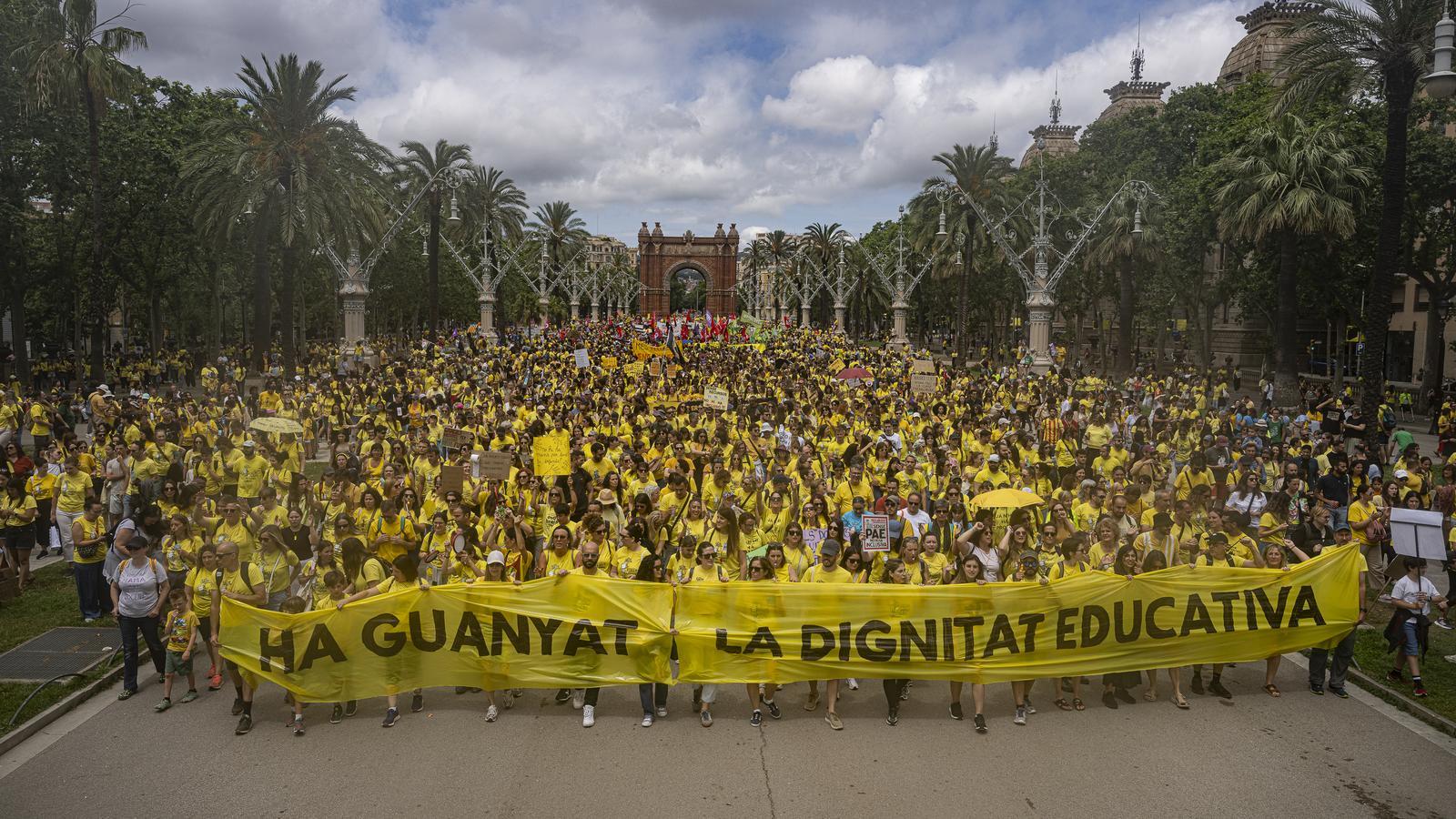
BarcelonaAt the demonstration of the last school year strike and after the nowon the vote on the agreement with the Department of Education, one of the most repeated comments among teachers was that school assemblies should have a decisive role in negotiations with the Government. In fact, in the speeches at the end of the protest, the first to speak were the representatives of the educational assemblies and not the union spokespersons, as usual. Neither the comments nor the protagonists on stage are a coincidence: more than 500 school assemblies have been registered since the website of the Educational Assembly of Catalonia (AEC) opened in February. Furthermore, more than a hundred teachers attended the sixth assembly of the AEC held last weekend.the sixth assembly of the AEC held last weekend more than a hundred teachers attended.
"We are not saying that the unions should be on the sidelines, because they are invited to the assembly, but to listen," explains Mònica Rodrigo, spokesperson for the AEC, the umbrella that encompasses the half-thousand school assemblies. "We are very much on top of it to remind them that this is from the bottom up, and that they have to listen to what the schools want," she adds. Rodrigo believes that "unions are important and, obviously, they have to be there," but explains that they have started to ask for representatives from the assembly to be on the strike committee. However, this is not a direct move against the unions, as, in principle, it will be the same union forces that will ask for AEC members to be able to attend meetings as guests. "We must be the ones who are in the classroom every day who validate the agreements," insists Rodrigo.
But what is behind these new ways of organizing? Teachers from various assemblies point to dissatisfaction with the agreement between the Government and UGT and CCOO in March, as well as the pre-agreement with the executive reached by USTEC and Professors de Secundària, which the majority union then put to a vote. Nevertheless, Jordi Mir, a doctor in humanities and professor at the Pompeu Fabra University (UPF), points out that the rise of this type of organization is not new.
"When we study other cases of mobilization in a context comparable to the current one, what usually happens at the beginning is that unions have an important weight," explains Mir. If the mobilization develops "in a more or less standard labor conflict scenario," normally, the issue "remains within the union sphere." "But when the mobilization has significant growth and those involved in the protest consider that the discontent cannot be solved with only small changes, that's when the movement goes beyond the unions," describes the humanist.
Mir also explains that, in his opinion, the rise of teacher assemblies does not "necessarily have to be read as a delegitimization of unions": "After the vote [on the pre-agreement with Education], the same USTEC spokespersons made a kind of self-criticism and said they understood the result and would make a new proposal," he defends. In fact, just after learning about the no, the USTEC spokesperson, Iolanda Segura, explained that the union would consult its members to find out the teachers' "priorities".
Beyond the synergies (or lack thereof) with unions, the wave of new assemblies began at the start of this academic year. "Assemblies have been founded in each of the centers, which then organized into territorial assemblies, and then we saw the need to find a way to communicate throughout Catalonia to take the demands further," recalls Rodrigo, who insists that the AEC is just a way "to organize and channel" what the center assemblies want.
From not going out to stop evictions
One of these 500 assemblies is the Maresme-La Selva Assembly, the group that extended the initiative not to have camps and outings next year as a form of protest. An action to which 1,300 schools and institutes have already joined. They explain that the initial idea came from centers in Tordera and Lleida, but it coincided with the rise of new assemblies everywhere and that's when the Maresme group began to structure the campaign. A mobilization that, they insist, does not "question the pedagogical value" of these activities, but rather criticizes the fact that they are sustained "largely thanks to the commitment and involvement of the teaching staff, without guaranteeing the necessary resources or legal and criminal coverage".
Beyond protest actions, teacher platforms have also been created to defend other student rights. These are associations such as Docents 080, to protect students against evictions; Sciences in Danger, to demand the non-merger of sciences in baccalaureate; Philosophy Teachers to request an extra hour for the subject, or the Burning Classrooms platform. "It arises from tiredness and exhaustion," explains the creator of the initiative, Pau Sánchez, a teacher at a high school in Baix Llobregat. Together with his friend Octavi, they created an open-source system with which they can measure the temperature in schools and high schools using the plates they have on the kits of robotics that the Department of Education itself distributed to many schools three years ago. "We started with only four or five schools and now we are approaching 300 centers with 623 different devices, which allow us to measure thermal conditions in real-time in different classrooms," explains Sánchez. These measurements have confirmed how almost 200 centers exceeded 30 degrees in the last week of the school year.
The directors, too
Not only teachers have sought new ways to organize themselves. Directors, too, although the trigger was different. "There had always been assemblies of school directors by district, but we decided to join forces when the summer assignments were modified and we saw that we would no longer be able to conduct interviews," explain from the Assembly of Directorates of Barcelona. They also explain that the discomfort, tension, and feeling of not being represented led to increased interest in the assembly from directorates in other parts of Catalonia. "We created a WhatsApp group for everyone, but it overwhelmed us," they recall. In this case, the surge translated into a resurgence of AXIA, the Professional Association of Directors in the Educational Field, which has already had a relevant voice in recent months. Now, from the assembly, they explain that the next step is to decide whether to create a directors' union to "have a direct line" with the Government.
