"It wasn't for the money": thousands of teachers take to the streets again and announce a strike coinciding with the Pope's visit
More than 15,000 people demonstrate in Barcelona in a mobilization that ends with a whistle at USTEC
-
CAT -
CAST
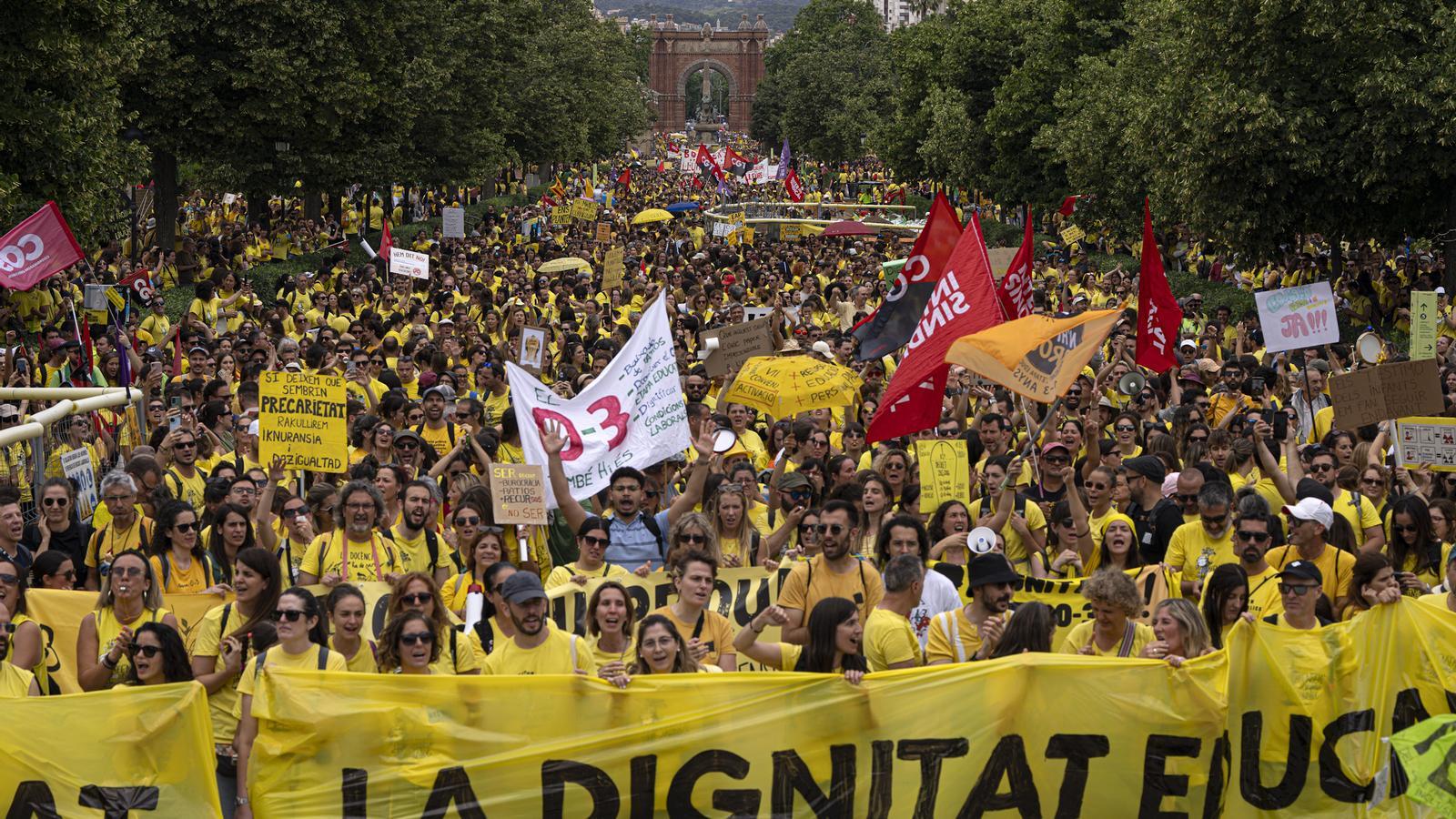
Barcelona"Educational dignity has won" and "It wasn't about money. We are fighting for a new educational model". These have been the messages of the two main banners of this Friday's teacher mobilization. The first was the banner at the head of the demonstration that gathered around 15,200 teachers in Barcelona's Lluís Companys promenade, according to the Guàrdia Urbana, and up to 90,000 according to the unions. A banner that, unlike those of recent demonstrations, was entirely yellow – the color in defense of public schools – and without the name of any union. The second banner is that of the stage in Parc de la Ciutadella, where the demonstration ended with speeches and a booing of teachers at the spokesperson for the USTEC union, Iolanda Segura, after the organization campaigned for a yes vote on the agreement with Education and in its own consultation, 65% of teachers voted against it.
The rejection of the pact with the Government was transferred to the streets this Friday from the early hours with bike rides and mobilizations that cut off the AP-7, the C-33, and the ronda Litoral, among others. The protests were followed by the message from the Minister of Education, Esther Niubó, who warned that "the time for negotiation [with the unions] is over", defended the advantages of the agreement, and insisted that it is necessary to "guarantee an orderly end to the school year and a start to the school year with the maximum guarantees".
Shortly after, USTEC, CGT, la Intersindical, and COS announced a new teacher strike call for Tuesday, June 9, the day the Pope arrives in Catalonia and also when the university entrance exams begin for more than 45,000 students. All this after this Friday's strike was supported by 30% of teachers, according to the Department of Education, and 80% according to the unions. On this day, hundreds of teachers from subsidized schools also took to the streets, called by the Federation of Education of USOC (FEUSOC), to demand an improvement of the system and an equalization of conditions with the public system.

"We need a change of model, and a salary increase won't fix this," warned Albert, who has been a high school teacher for twelve years, from the column that set off from Plaça Espanya towards Arc de Triomf. He also talks about the lack of clarity in educational laws and curricula. "You go to the reference documents and you don't understand how you should evaluate. You can't have evaluation criteria that are 15 subordinate clauses strung together. It's impossible to evaluate this in a single activity," he assures. Albert explains that we need to add to this a methodological change and a shift in teaching perspective that is not being successfully transmitted to the classrooms and which leaves teachers alone. "We have a big problem: we don't understand exactly what is being asked of us and what we have to do," he insists, and underlines the idea that it wasn't all a matter of salary. In fact, at this Friday's demonstrations – unlike previous ones – references to salary on both banners and slogans are almost non-existent. The tone of the demonstration is also less festive and more indignant, despite being a very family-oriented mobilization.

It is not fixed with "pieces"
Among the teachers who gathered in Parc de la Ciutadella, the idea that the educational emergency situation in Catalonia cannot be fixed with "patches" was constantly repeated. "The agreement was a trap by the Government. This extra money does not solve the day-to-day problems in the classroom. Society cannot think that we only want our salary," complained Blanca, from Manresa. "I am very happy that the no vote won," she celebrated, although she admits that the voting result surprised her. "When we talk among ourselves, after leaving an impossible class, what you think about the least is your salary. Everyone would sacrifice part of their salary to have a little more peace in the classroom," explains Jordi, who has been a teacher in a Barcelona high school for eight years.
Beyond whether it was about salary or not the reason for their protest, Laura, from Vilanova del Camí, explains that the underlying problem is that "the world has changed a lot" and they are asked to face "many more challenges with the same resources". In this regard, she recalls that, in practical terms, the 6,400 provisions included in the rejected agreement would mean "one and a half more people per center". "It's a patch that solves nothing," she assures. Furthermore, she denounces that "everything is asked of the school". "You have much more diverse students, with many more needs, and the Government tells you that you have to pass them, and that if they don't pass, it's your fault," she laments.
Both Blanca, Laura, and Jordi also point to training and guidance problems. "We find ourselves having to go on a school trip with a diabetic teenager and having to monitor them every hour, and the CAP nurse teaching us what to do if they have a crisis. We do it, but I don't know if it's my job and I don't think I have the preparation for it. Besides, I have 20 more students to look after," exemplifies Blanca. In this regard, Laura also explains that she spends "more time acting as a police officer than teaching" and that they lack resources and training to deal with disruptive students and those with special educational needs in the same classroom. In fact, several teachers and professors warn that inclusive education on paper "is very good" and they defend it, but it is not a reality in the classroom.
Beyond these aspects, Jordi and Albert also warn of other problems. "I can tell you, for example, that this week there have been classrooms at 37 degrees, and at my center we have been waiting four months for them to change a broken tap," says Albert. And Jordi adds: "And here I'll add that there are students who take a year to get a diagnosis from the psychopedagogical teams because they can't cope with everything".
Warning to trade unions
Another of the key points of this Friday's protest is the role of the unions. "Perhaps USTEC has distanced itself from the people and hasn't understood us," Laura admitted, given that the majority union opted for a yes in an agreement that 65% of public system teachers have rejected. A situation that the USTEC spokesperson, Iolanda Segura, has not shied away from, as she has taken the mea culpa all day and has been self-critical. "I pick up the gauntlet of the whistling," she assured after being booed by some teachers on stage at the end of the demonstration.
"I want to speak to you with sincerity. I don't have an easy role, but I assure you that USTEC would not have signed without the collective," Segura defended, while admitting that it is necessary to "reweave trust" and that they want to "listen to the centers." "We have to be honest: we defended the yes because we believed, perhaps wrongly, that we had to consolidate the gains," she acknowledged. However, she insisted that "love and care" for teachers are necessary and that Niubó must take responsibility for it.
Segura spoke amidst a whistling that stopped when representatives from the other union forces supported her on stage and when Laura Gené, from the CGT – the only union at the table that was against the agreement and that this Friday experienced a sweet moment –, hugged Segura. "We have to go together," Gené defended.
Beyond the roles of the unions, however, the idea that the teachers' assemblies should be listened to more has also gained strength. "We must be listened to without the filter of the unions," asked Marta, a teacher from Castell d'Aro, at the end of the demonstration. "The unions have failed, while the center assemblies have been together," she recalled, and sent a forceful message: "You cannot decide everything from an office and when you haven't set foot in a classroom for 15 years." In fact, one of the most chanted messages this Friday was "We are the ones who are in the classroom and we are the ones who say what is agreed upon."
