A second chance at life behind the stove
Sergi lived six years on the street, for fourteen he suffered from alcoholism, and now he is a cook at Arrels Foundation
-
CAT -
CAST
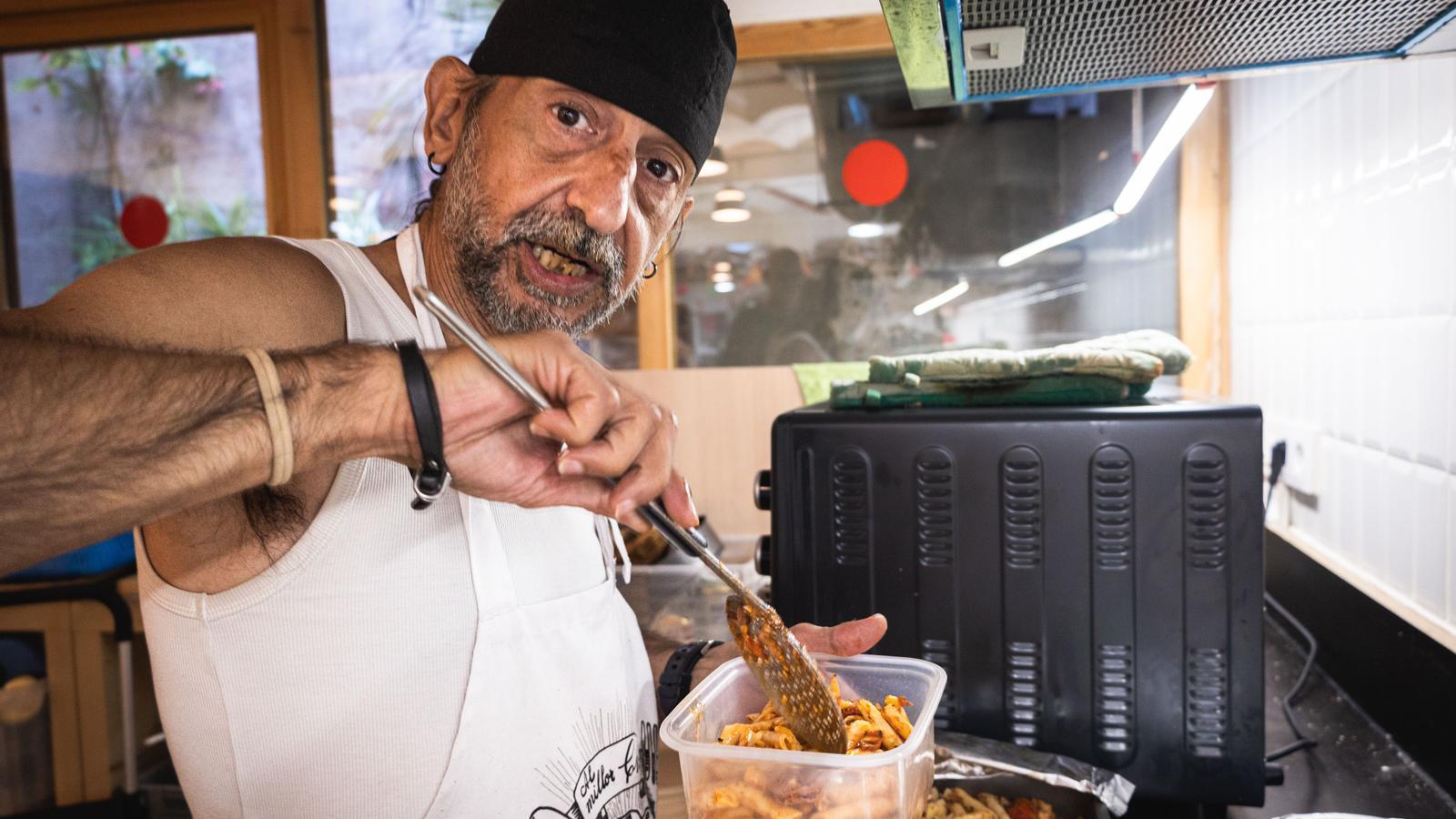
BarcelonaSergi was 36 years old when he lost everything. A bakery on Passeig Maragall, a rotisserie on Ronda del Guinardó, and a Mediterranean cuisine restaurant in Lliçà d'Amunt. But "a bad turn of events" pushed him to live on the street: he lost his businesses and the bank foreclosed on his house. But what cost him the most to recover was his identity. He had gone from having 38 employees and a business under his charge to having nowhere to take shelter. For six years, he lived inside ATMs, under restaurant awnings, looking for shelter inside parking lots in Nou Barris and the Paral·lel. But his worst enemy came inside a glass bottle. "I was drinking about twelve liters of alcohol a day. By the time I realized, it was already too late," he explains. But he did it, and his life has taken a turn. Now he runs the kitchen at the Arrels Foundation workshop, where he prepares breakfast, lunch, and afternoon snacks. "What do I cook? Whatever they give me," he says with a smile.
Sergi tries to put dates to the time he lived on the street, but it is difficult for him. The beginning and end of one day and the next become blurred. "You no longer know if it's Monday, Tuesday, or Wednesday..." he says. He explains that, at first, it is easier to go to restaurant restrooms discreetly. Until, as the months went by, he would go unshaven and unable to shower for weeks. "My physical appearance took a backseat; the only thing that mattered to me was getting alcohol. I was lost," he admits. His life became an attempt at survival. Without thinking. Without looking beyond. He only had to watch out that, when he was drunk, they wouldn't steal the few belongings he had. And he entered a vicious cycle.
He has been working for fourteen years with Arrels Foundation, an organization that helps homeless people in Barcelona. Like many others, he was found on the street during a count and was offered a place to stay in a shelter. At the time, he refused. But he did go there to shower three times a week. "That motivated me a little bit," explains Sergi, who had reached the point of spending eight or nine months without doing so. Little by little, it seemed that things were starting to improve. Through Arrels, he found an apartment to live in and a dining hall to fill his stomach, even though most days he had no appetite. He started working in the showers and changing rooms at the foundation, but he relapsed into addiction. "And you cannot help people living on the street when you yourself are carrying a backpack full of problems," he explains.
"They told me I was dying"
He had to leave everything behind once again. His routine was once again based on sleeping, drinking, and eating. It was a scare at the hospital that changed his life. Two years ago, the doctors who treated him said that his body would not stay alive for more than 48 hours. "They told me I was dying," he explains. That was his signal to put an end to alcohol consumption. It was not an easy fight. But with sobriety, he achieved what he calls "a second life".
In the past, Sergi had a restaurant with a kitchen staff of nineteen people. Now everything is simpler and smaller. He prepares breakfast, lunch, and a snack for 25 people – users of the social housing apartments and the Arrels workshops –, although in winter there are more, as many homeless people go there to look for some of his hot dishes. In addition, he also fills lunchboxes with the leftover food so that those who want to can take it home.

Unlike the "often bland" dishes that most of the city's soup kitchens offer to those most in need, Sergi explains that he prepares a weekly menu that, if not identical, comes very close to that of a restaurant. He plays with the ingredients that arrive as donations to the foundation every Tuesday. And even though the variety is limited, Sergi manages to offer a menu of up to three or four dishes.
Throughout this process, moreover, he fell in love with a worker at the foundation. "Next year I will leave the social housing apartment and we will go live together," he explains happily. Sergi has found himself again. And along the way, he has rediscovered love and recovered his passion: cooking.
