Renfe rejects that Ayuso links public transport pass to the census: "It generates segregation"
The decision of the Madrid government, which opens up to excluding non-registered students, will mainly affect migrant people

-
CAT -
CAST
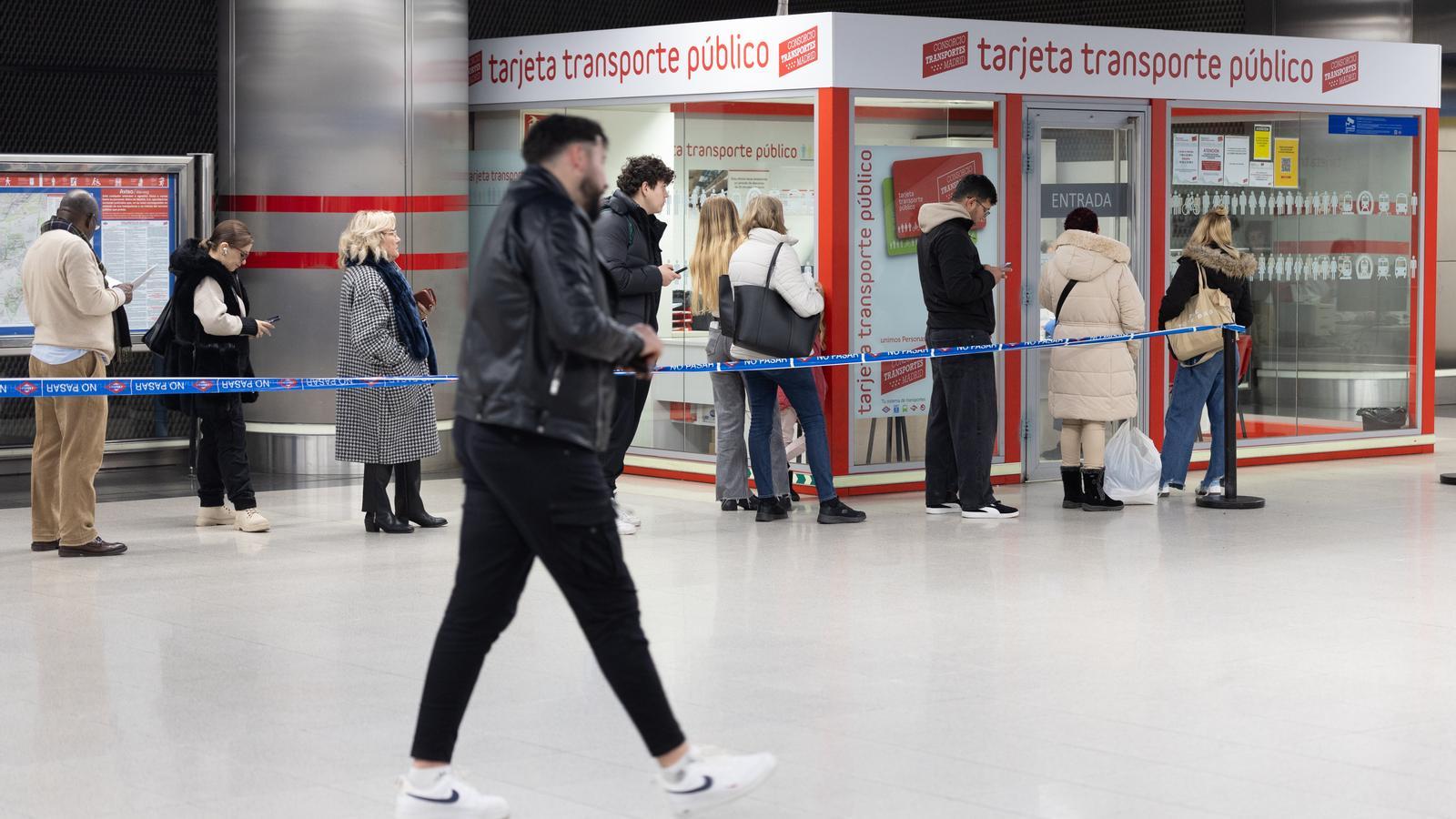
MadridThe latest changes to public transport in the Community of Madrid have sparked a dispute between Renfe and the government of Isabel Díaz Ayuso (PP). Since this Monday, the census registration has become an indispensable requirement to obtain the public transport pass in the community, something Renfe rejects. The Spanish railway operator denounces that the regulatory change encourages "segregation" among users and "differentiation" when accessing a right and a service like public transport. The issue is that the Ayuso government's decision has caused controversy because it targets irregular migrant populations, who often face difficulties when registering in cities, as has been repeatedly denounced by various social entities or the Ombudsman himself. Furthermore, the change also comes at a time when the PP is embracing the "national priority" promoted by Vox, which means sidelining irregular foreign populations.
Until now, to obtain the Personal Public Transport Card (TTP) of the Community of Madrid – a personal pass that allows recharging subsidized fares based, for example, on age – it was not necessary to be registered in a municipality of the autonomous community. From this Monday, however, residency status must be proven. This not only affects access to urban buses or the Madrid metro, but the pass also allows travel by bus throughout the region or by Cercanías. For this reason, Renfe "regrets" the decision, according to sources from the operator.
when registering in cities
, as has been repeatedly denounced by various social entities or the Ombudsman himself. Furthermore, the change also comes at a time when the PP is embracing the "national priority" promoted by Vox, which means sidelining irregular foreign populations.
Renfe explains that the decision was adopted "without prior information or consultation" by the Community of Madrid and "outside the institutional coordination mechanisms," the same sources indicate. In fact, the railway operator will request an "urgent" meeting with the Madrid government to analyze the impact of the measure.

In addition to the foreign population that does not have a register, the decision also affects workers displaced to Madrid from other communities who have not registered, but above all thousands of university students who are temporarily in the Spanish capital and who also do not register. In this regard, the Madrid government has opened up to excluding students from other territories of the State from the decision through agreements with the regional governments. From Ayuso's government they also explain that the change was already "foreseen" by law, but it had not been regulated until now.
A right that is not fulfilled
Only in the city of Madrid, on January 1, 2026, there were about 3.5 million registered residents, according to City Council data. Although Spanish law requires applications to register to be considered (it is a basic and inalienable administrative right), various social organizations have long been documenting administrative practices by city councils, for example, that of Madrid, which make this process difficult and impossible, especially for irregular migrant populations: lack of appointments, denial of these appointments, or the requirement of unnecessary documents. This also happens in Catalonia, and a year ago the Parliament approved guaranteeing universal access to the registry with votes from PSC, Comuns, ERC, and CUP, while Junts, Aliança, Vox, and PP distanced themselves. The federation of Catalan Social Action Entities (ECAS) warned two years ago that at least fifty city councils are failing to comply with the legal obligation to register people who do not have a fixed address, live sublet in rooms, do not have a legal contract, or simply, the property owners do not authorize it.
Coincidence with regularization
The Network of Entities for the Registry, which brings together a hundred entities and will soon be replicated in Madrid, argues that the registry is a responsibility of the administrations to keep an up-to-date record of how many people live in the territory and to have a tool for planning services, such as transport, health or education.However, the controversy also coincides with the Spanish government's extraordinary regularization process, in which, paradoxically, the municipal registry is not a mandatory requirement. Migrant individuals who have initiated the process must prove that they were in Spain before January 1, 2026 and that they have been there permanently for five months before the application.
Among the documents that could be provided to prove this roots there was, precisely, the payment of public transport (either through recharge receipts or a certificate of card issuance). While it is true that the Community of Madrid's decision affects the issuance of season tickets from this Monday and, therefore, these tickets would not serve to prove this permanence, it should be remembered that Isabel Díaz Ayuso has openly opposed this regularization.
Is it requested in Catalonia?
In the case of T-Mobilitat, which would be the equivalent of the Madrid personal card, registration is not a requirement to obtain it. However, there is an exception. The T-16, which is a free pass intended for children between 4 and 16 years old, does require proof of registration in a municipality within the ATM's scope, as it is a pass linked to travel within the area of residence, as recalled by the organization. Additionally, the T-verda also incorporates conditions related to the territorial scope (both regarding residence and the management of scrapped vehicles). In any case, the ATM recalls that registration is not a generalized requirement for the use of public transport passes in Catalonia nor does it condition access to other passes, such as those aimed at young people or other groups. Registration is also required for the AMB's T-Metropolitana.
