Renfe announced this Friday that it has already begun work to upgrade level crossings between platforms at several Rodalies stations. The action begins at the Centelles station and will subsequently continue in Sant Martí de Centelles. The work planned for Sant Sadurní d'Anoia and Sant Vicenç de Castellet will be carried out throughout 2027. Other interventions are also planned at the Mataró and Terrassa Estació del Nord stations. The works include renewing the lighting around the crossings between platforms, improving the pavement, and installing railings on the ramps.
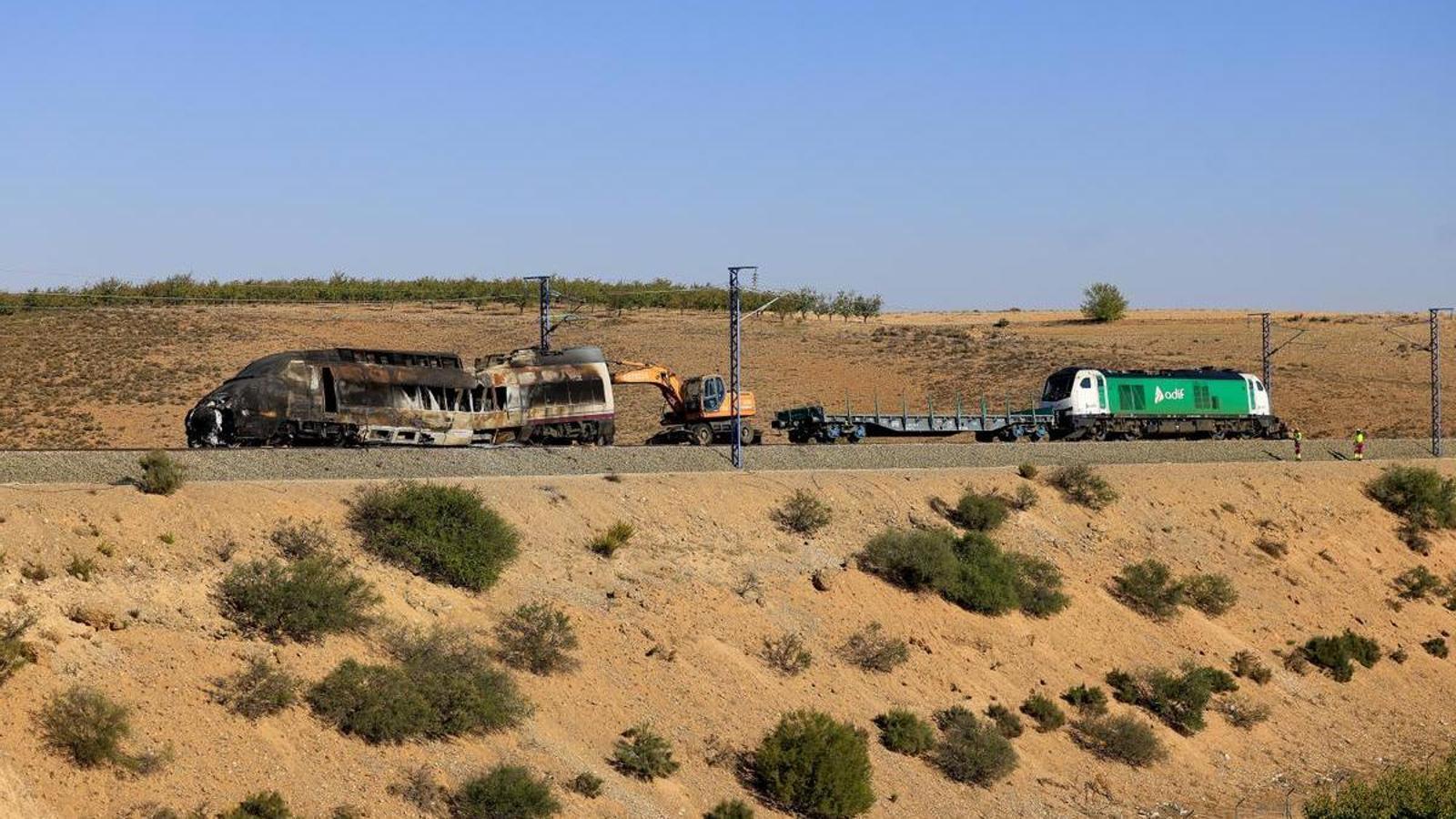
Renfe begins to dismantle the train set on fire on the Barcelona-Madrid line
Adif maintains that the line will recover normality next week but does not set a concrete date for it
16/10/2026 - 17:03 h

-
CAT -
CAST
BarcelonaRenfe has already begun the tasks to dismantle the train that caught fire on Monday on the high-speed line between Barcelona and Madrid and which has kept this corridor running at half capacity since then. The work to remove this part of the train, the most complicated one, began on the night between Thursday and Friday. Once cleared of scrap metal, it will be necessary to check the condition of the track and the catenary and, if necessary, repair it. Nevertheless, the infrastructure manager, Adif, is maintaining the planned schedule and expects that the line will be able to return to normal next week. Even so, at this time neither Renfe nor Adif can specify which exact day it will be possible to return to circulating on both tracks.
The burnt part of the damaged AVE is located in Ricla, in Aragon. At this point, the tasks to clear the track have not stopped since Monday and have progressed in phases. On Wednesday, the part of the train that was not affected by the flames was detached from the locomotive and dragged to the Zaragoza - Las Delicias station. Now the intervention on the material affected by the fire, sector sources explain, is complex and can only be carried out during night shifts, because the work is incompatible with the circulation of trains on the adjacent track.
However, local media claim that during the night between Thursday and Friday Renfe was able to completely dismantle the bodywork, that is to say the exterior scrap of the locomotive, and remove a part of it off the track. This point is also delicate due to the terrain conditions and the need to do it with heavy-duty cranes. The chassis, that is, the internal and resistant part on which the train's mechanical components are mounted, still remains on the rails. These are the tasks that will be addressed in the coming nights, to completely clear the affected track.
Slightly slower journeys
Thus, while affected material remains on the tracks, the high-speed line between Barcelona and Madrid must operate on a single track and at a lower speed in a section that extends for 25 kilometers, between Ricla and Plasencia de Jalón. The spokesperson for Adif in Catalonia, Antonio Carmona, explained on Wednesday that this limitation adds between 10 and 15 more minutes to the duration of the journeys. On Wednesday itself, the permitted speed in this section was already raised from 80 to 160 km/h.
The reasons for the fire on this train, which was covering the journey from Madrid with a destination of Figueres, are still unknown. The 283 passengers who were on board had to be evacuated, without any injuries being recorded. After a total stoppage, in the afternoon, circulation resumed after a few hours, but with restrictions that still affect the operators' services.
The public company Renfe and the private ones Iryo and Ouigo have adapted their schedules and seat offerings to the current possibilities of the line. Renfe has reinforced certain services with more seats and has gradually expanded the number of circulations: on Thursday, it scheduled 65 between Madrid and Barcelona, two more than on Wednesday. These measures allow for maintaining the offering while the restrictions last, but they do not eliminate the disruptions to the journeys.
Renfe begins upgrading several level crossings in Centelles
