No 'hello' nor 'thank you' to ChatGPT? The UN quantifies the risks of massive AI use
A report warns about the unequal distribution of costs and benefits and the conditioning in access to natural resources

-
CAT -
CAST
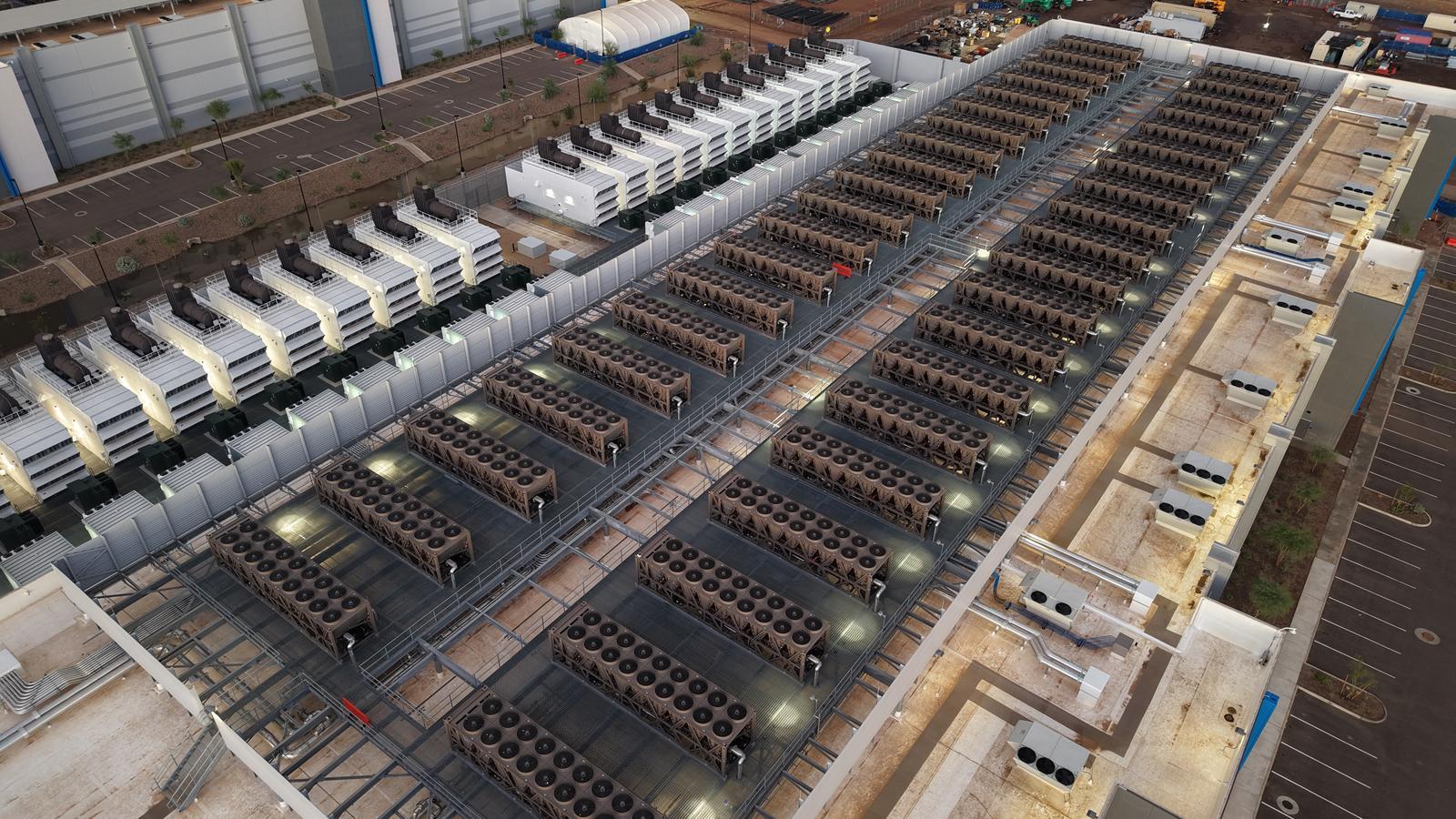
BarcelonaArtificial intelligence (AI) data centers will skyrocket water and electricity consumption and condition the lives of billions of people worldwide. The United Nations (UN) released a report this Wednesday on the environmental cost of this revolution by 2030, and the projections are worrying. Researchers for Water, Environment and Health (UNU-INWEH) anticipate a sharp increase in energy consumption, an intensification of water conflicts, and land overexploitation. At the same time, scientists warn that most consumption occurs when large systems like ChatGPT or Gemini respond to our queries and urge the use of the "concise mode": fewer words, getting straight to the point, to obtain shorter and more direct, energetically more efficient responses.
While it has been warned for years about the serious effects data centers have on greenhouse gas emissions, UN scientists argue that environmental costs cannot be understood without quantifying water and land footprints. Behind AI lies enormous physical infrastructure – data centers, chips, cooling, water consumption, and mineral extraction – and evaluating AI's sustainability through a single metric can "hide commitments" and "shift environmental burdens" to areas already facing water or land stress.
In the report, researchers suggest that by 2030, 945 TWh per year could be consumed, nearly triple the annual consumption of Pakistan, Bangladesh, and Nigeria, or approximately double the consumption of France in 2025. The water footprint associated with AI – from cooling and energy generation – would be identical to the annual water needs of sub-Saharan Africa (9.3 trillion liters), and the land footprint – from energy infrastructure and supply chains – will exceed 14,500 square kilometers, double the extent of the Barcelona demarcation.
The study highlights that the three environmental dimensions – energy, water, and land – do not necessarily evolve in the same direction. For example, switching from coal to bioenergy can reduce the carbon footprint of electricity by an average of 70%, but it increases the water cost more than thirtyfold and the land cost a hundredfold. "This doesn't solve one problem, but creates others, often in places that haven't asked for it," warns the lead researcher of the report, Miriam Aczel.
The cost of talking to AI
The report highlights that between 80% and 90% of energy is not consumed during system training, as previously thought, but when responding to user queries (the so-called inference phase). ChatGPT alone would process approximately 2.5 billion daily requests, amounting to 383 GWh of electricity annually for a single product – which would require the compensation of 2.6 million trees grown for 10 years – and would require an area equivalent to 800 football fields and a domestic water consumption similar to that of 500,000 people.
But why? Every word the user writes and every word the chatbot responds with consumes electricity because the servers have to process tokens (pieces of text). The simplest operations, such as classifying an email as spam or not, require very few resources. But when we ask for text or have a conversation, energy consumption can be up to 200 times higher. If we want to generate an image, the expense increases 1,450 times. Thus, reducing the type of content and the length of interactions could have a significant energy impact. If they are shorter – for example, by eliminating polite phrases like hello or thank you or redundant interactions–, consumption per query could be reduced by approximately 25%.
The study also warns about the unequal distribution of costs and benefits of digital infrastructure. For example, in Uruguay, plans for a data center with intensive water consumption coincided with a drought in 2023 that depleted Montevideo's freshwater reserves. Added to this is the projected increase in e-waste linked to AI, which could reach 2.5 million tons annually by the end of the decade. It would be like taking 250 Eiffel Towers to the landfill each year.
"This report is not against AI," clarifies the director of UNU-INWEH (and Iranian exile), Kaveh Madani, who led the research team. "It is a call to use it responsibly and to proactively address its unintended impacts to make it sustainable and equitable," he states. In fact, UNU-INWEH warns of the geographical concentration of computational capacity: only 32 countries have AI data centers, but more than 90% of the global infrastructure is located in the United States and China.
Madani argues that the revolution must be made "within planetary boundaries" and also benefiting the communities that provide the critical minerals to advance it and those that host its infrastructure and electronic waste. For this reason, the authors call for global governance based on transparency, efficiency from design, equity and environmental justice, life cycle responsibility, global cooperation and sustainable use, with specific responsibilities assigned to the entire AI ecosystem.
