A new disappointment
-
CAT -
CAST
Once again, the PISA test results do not invite optimism across the Spanish state, nor on an international scale. They are falling for the third consecutive time, consolidating a trend that for now seems difficult to reverse.
In the case of Catalonia, despite being above the state's results, the results are not comparable given the interpretive restriction derived from the 23% of students with difficulties who were excluded from the sample; however, if we value the scores obtained and statistically project the results, they would have been similar to those of the rest of the autonomous communities.
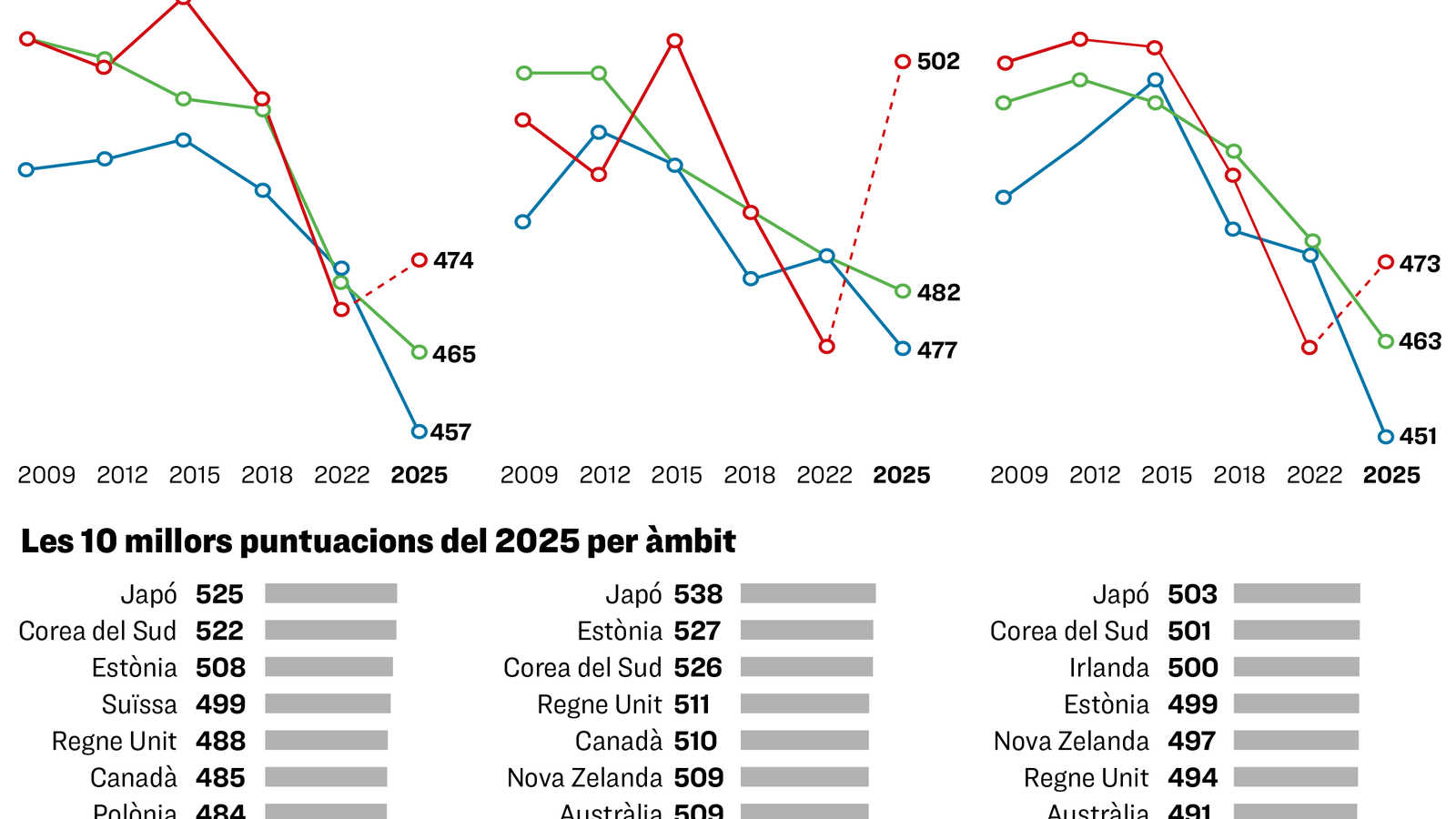
Specifically, the study reveals that in the star competency of this edition, science, the Spanish score was 477 points, 8 points less than in 2022 and 6 less than in 2018, and it is situated below the results of the EU and the OECD. Regarding reading, with 451 points we remain 13 points below 2022 and 23 below 2018. Finally, in mathematics, with 457 points, we drop 16 points compared to 2022 and 24 compared to 2018. In all cases, the score is also below that of the EU and the OECD.
In the rest of the elements assessed, the Spanish school population reacts in a similar way to that of the rest of the countries, and even in some areas notably better, such as the case of resilience capacity, mobile phone usage, the degree of equity, and the sense of belonging.
What do the evaluated competencies mean? The OECD calls them “key competencies,” and with this term, it refers to competencies that are indispensable for developing others that are more complex and of a higher nature, which are the true drivers of a system's quality. Mastering these key competencies does not guarantee that the educational system is of high quality, but without them, it surely will not be. This should help us place the value of the results in their proper perspective.
With all this, the point is to find the formula to get out of the impasse in which we find ourselves and which makes us realize year after year that things are not working and that it is urgent to find solutions.
From our point of view, it must be considered that, in parallel with these effects, there has been an exponential increase in the complexity of society, and that its enormous diversity and the impact of technologies, with AI at the forefront, must be taken into account. This forces education to reinvent itself if it wants to continue fulfilling its central role in personal development. Education has entered a paradigm shift that shakes all the principles on which it was based and is in danger of becoming obsolete.
And conjunctural or cosmetic changes are not enough; we must get to the bottom of the matter; there are symptoms that the situation is worsening day by day. Does anyone think that the dissatisfaction of the teaching staff can be solved simply with a salary increase or an improvement in working conditions?
The system has increased the budget significantly in recent years and schools have better conditions, but teachers are increasingly uncomfortable in their jobs. It is necessary to ask what is actually happening for the teacher to feel unable to manage their environment and enter into personal and professional conflict.
If we do not deeply modify our view of the educational system, we will not fix it; it is necessary to change the architecture of the system, make it more functional and sustainable, incorporate new professionals to support teachers, commit the institutional, social, and productive system to the responsibilities regarding the education of our children and youth, and above all, incorporate teachers and school management in decision-making processes. If we do not implement a new model, we will not succeed. Before, it was society that told the school what it had to do; now, it is the school that questions society and asks it for what it needs and leads the type of response that must be given. All this has nothing to do with the past.
To conclude, a final reflection: this is not the task of a political party, this is a major challenge and requires a great social pact of the country. It is necessary to agree on the foundations of the new system and then demand that they be fulfilled. Not to use education in partisan fighting but to increase the shared sense of responsibility.
